



Technical means for impeding unauthorized the use of the car, still it is necessary. Despite we offer a wide range of branded electronic systems protection, technical literature continues to publish new designs with various security functions. This allows car owners to choose for each practical case anti-theft device with the required set service characteristics and the most appropriate value for the price/quality.
The lock belongs to the group of so-called VRS (Vehicle Recovery System return a stolen vehicle)( Hooks V. electronics against the robber. - Driving, 1996, No. 7, p. 40). They begin to work immediately after theft of the vehicle by an attacker. Although there are many such devices, all of them, as a rule, foreign production, and their price is not available to everyone.
In the embodiment described below lock the components used in the production CIS countries. This leads to low cost of the product as a whole. Besides a set of functions that is as wide as the principle use of digital the formation time intervals, the jamming protection and over-deliver high reliability.
The lock can be installed on any model of car, equipped the engine is a spark ignition system and the nominal vehicle voltage network 12 V. the Principle of the device is that after turning on the ignition and start the engine it gives the driver some time to click on the override button (or close the reed switch), thereby switching system protection to its original state. If this is not done, the device will first served helpful local audible alarm, and then turn off the ignition and turn alarm sound (and light - lamp indicator turns) signaling.
When the attack on the driver when it is forcibly ejected from the car in a transient stop with the engine running and the door open, the device also works. In the case where the driver needs without turning off the engine, open the door, he should then pressing a secret button "reset" blocker, otherwise through 16 will sound a warning signal, and after another 16 - alarm with a simultaneous shutdown of the engine.
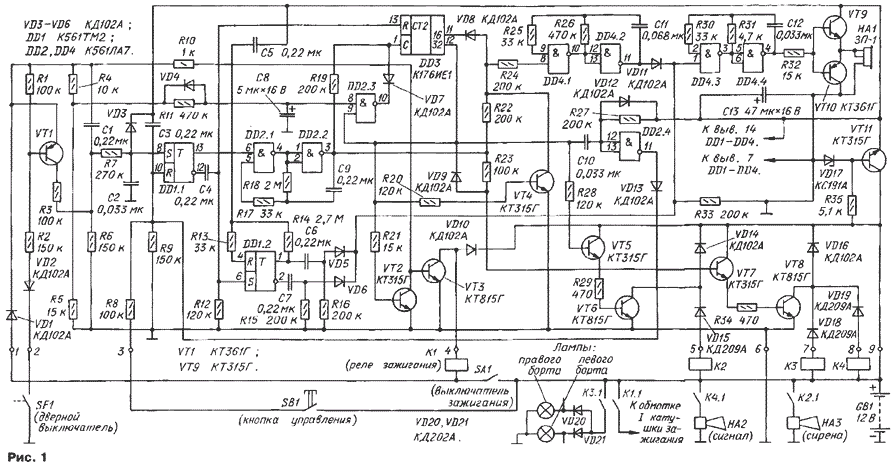
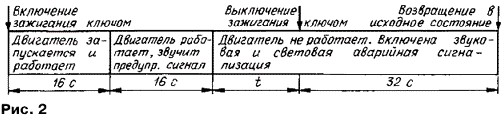
A circuit diagram of a lock connected to the onboard network the car is presented in Fig. 1, a diagrammatic work - in Fig. 2. Device not have a power switch and is constantly in standby mode. Thus triggers DD1.1 and DD1.2 are in the zero state. Lower level with direct the trigger output DD1.1 clock generator on the elements of DD2.1 and DD2.2 inhibited, counter DD3 set to zero. Generators are collected on the elements DD4.1, DD4.2 and DD4.3, DD4.4, is also inhibited. In standby mode, the lock consumes about 0.5 mA.
(click to enlarge)
When you turn the ignition to the lock pin 1 receives a supply voltage, through a resistor R10 is the base current of transistor VT3 and opens it - relay ignition K1. Simultaneously to the input S of the flip-flop DD1.1 through a discharged capacitor C1 and resistor R7 receives a short pulse that sets the trigger in state 1. High level with direct access to the trigger starts the oscillator DD2.1, DD2.2. The values of the circuit are selected in such R18C9 a way that the generator operates at a frequency of about 1 Hz.
The output of the clock generator through resistors R19, R22 and R23 respectively connected with a clock input a five-digit binary counter DD3, with the control input generator DD4.1, DD4.2 (through intermediate resistor R24), with the base of transistor VT7. Counter DD3, who was in the zero state, starts counting pulses the clock generator (timing). For 16 with the outputs 16 and 32 the meter applies a low level voltage, diodes and VD9 VD8 opened and pulses the clock generator does not reach the input of the generator DD4.1, DD4.2 and transistor VT7.
If before the expiration of this time the output device 3 short-submit the on-Board voltage contact closure button SB1 (reed switch or any other way), the trigger DD1.1 will switch to its original state and will not allow the work the clock generator DD2.1, DD2.2. The differentiating circuit will form С4R12 the pulse which will reset the counter DD3 and trigger a single-shot, collected on the trigger DD1.2.
When you start and reverse switch a single vibrator at the point of connection of diodes VD5 and VD6 forms two high level pulse duration of 0.1…0.2 s an interval of 0,5…0,7 S. Enrolling on a starting input of the generator DD4.3, DD4.4 (conclusion 1 item DD4.3), they will cause two packs rectangular pulses with a frequency of about 2500 Hz, which through a resistor R32 will be held at the input of the push-pull power amplifier transistors and VT9 VT10. The load of the amplifier - piezoceramic a sound projector HA1 - two plays short beeps confirming the return of the device to standby mode. In this state, the device can be arbitrarily long, holding relay ignition is turned on.
If at the time of the appearance in the fourth significant digit counter DD3 (output 16) a high level on pin 3 lock has not been reset pulse, the diode VD8 will close and will allow the generator DD4.1, DD4.2, which will begin to generate the pulse sequence frequency of about 10 Hz. Joint the operation of the clock generator and generators DD4.1, DD4.2 and DD4.3, DD4.4 gives a series 16 beeps, reminding the driver to stop the countdown time filing a reset pulse at pin 3 of the device.
In the case where the reset pulse is absent, through 32 in the fifth category counter DD3 (output 32) appears high level, through the resistor R21 begins to flow, the base current of transistor VT2, it opens and closes the transistor VT3, which leads off the ignition relay K1 and stop of the motor. Diode VD8 again opens and stops the generators DD4.1, DD4.2 and DD4.3, DD4.4 is terminated, a warning beep.
Diode VD9 is closed, and through a resistor R23 begin to leak current pulses base transistor VT7. The transistor VT7 and VT8 begin to open and close with the frequency of the clock generator and periodically switch the relays K3 and K4 and sound light-signalling devices of the vehicle.
In addition, through a resistor R28 begins to flow, the base current of transistor VT5. Transistors VT5 and VT6 are opened, and relay K2 siren, which can to be used as an alternative or Supplement the existing sound signal.
The input element DD2.3, there is a high level, and the output is low, therefore, the diode VD7 is open and prevents the flow of clock pulses input of the counter DD3. As long as the ignition is turned off (until will remove the voltage from pin 1 of the device), the counter state DD3 not change the relay coil ignition K1 is de-energized, and sound and light the alarm is enabled. This state corresponds to the time interval t on the sequence diagram (Fig. 2). Its duration depends on how soon the key in the lock ignition is returned to the position "Ignition off".
Immediately after this, the capacitor C8 is quickly discharged through the diode VD4 and resistor R5, at upper circuit on the input of the DD2.3 appears a low level, and the output is high. Diode VD7 is closed, the operation of the counter DD3 will continue for another for 32 until it overflows and zeroing all bits. The transition to the low level at the output 32 will cause a negative voltage drop of the input of the inverter DD2.4. Since its release a short pulse of a high level through the diode VD13 is fed to the input R of the flip-flop DD1.1 and returns the lock in standby mode like a reset pulse at pin 3. When you re-start the engine, the cycle will repeat.
The capacitor C8, resistor R11 and diode VD4 constitute a chain impulse suppression the flickering of ignition. In its absence, if the lock off ignition will coincide in time with a high level at the output of the clock generator, a pack of drobezgevich" pulse of the contact group of the ignition switch through the element DD2.3 will be referred to the input of the counter DD3 and can cause it to overflow and return the device to standby mode. This will make it possible to reboot the engine and thereby reduce the efficiency of the device.
Capacitor C8 prevents the passage to the clock input of the counter DD3 pulses that can be generated periodic on and off the ignition. Thus, a given time interval (32) locking the ignition, and also works with sound and light alarm is the minimum possible.
As already noted, the lock comes into operation, not only at the time of theft car, but when they seize by force. In this case, when the door opening closed contact door switch SF1 and conclusion 2 the device is connected to the vehicle body. Transistor VT1 opens and switches the trigger DD1.1 in one state. The countdown begins the time is the same as when the ignition is on.
The inverter is assembled on the transistor VT4, prohibits the operation of the generators DD4.1, DD4.2 and DD4.3, DD4.4 in the third quarter of the cycle (Fig. 2) when the output 16 counter DD3 high level, but a warning beep in this situation no longer needed. The capacitor C3 allows you to set the trigger DD1.1 in the source (zero) state when you first turn on the device. The capacitor C2 reduces the effect of noise on the input S of the flip-flop DD1.1. Diodes VD3 and VD12 protect the inputs the respective elements and the diodes VD10, VD14 and VD16 transistors VT3, and VT6 VT8 from breakdown of EMF that occurs in the windings of relays with quick closing the transistors. Diodes VD15, VD18 and VD19 and VD20, VD21 serve to decoupling the device from the electrical circuits of the vehicle.
For supply of major components of the lock is provided a voltage regulator the Zener diode VD17 and the transistor VT11. Capacitor C13 suppresses interference, occur during operation of electrical devices of the vehicle.
The lock is mounted on the circuit Board of one-sided glass fiberglass thickness of 1 mm. Drawing card is presented in Fig. 3. In the device used resistors MLT-0.25, or MLT-0,125, capacitors - from the km, oxide - C50-35.
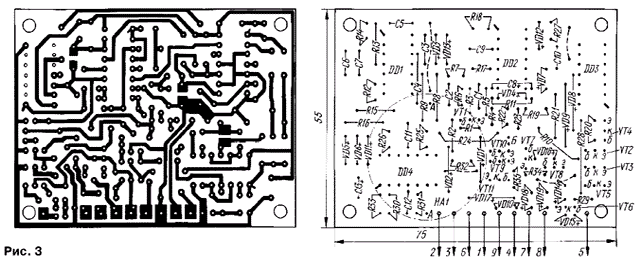
Most of the resistors on the Board set to "upright" (perpendicular to the Board). Oxide capacitors C8 and C13 placed over the chip housings DD2 and DD4 respectively. The Board is provided by a foil pad for mounting capacitors C2, C10 and C11 as usual, and performed for surface way - side printing (C11 consists of the two 0.033 microfarads).
Transistors CTG can be replaced by KT315B, CTE and CTG - CTB, CTE. Instead CTG suitable transistors CTB, KTV or with any CT alphabetic index. Diodes KDA can be replaced by CDA, KDA, or CDA any others with maximum direct current of 100 mA. Zener VD17 - any a low on voltage 9…10 V; Fig. 3 shows its polarity in stabilitron inclusion.
Piezoceramic a sound projector 1 is mounted on the Board on its own wire racks which you first need to unsolder and re-solder perpendicular to the plane of the body of the radiator. Stand soldered to the Board in the holes indicated in Fig. 3 by the letters a, and ensure that not only the mount, but also the electrical contact of the housing with the common wire. Two flexible o soldered into the two holes of the Board, marked by the letter B.
Charge with the details set in plastic box of appropriate size, in the wall which is opposite piezosurgical drill a few small holes. The box is placed in the vehicle in a remote place (for example, the dashboard). The installation location of the override button SB1 should be good to think of. It should be available, but, if possible, is barely visible. Device connect the electrical system of the car flexible wires (for example, PGA) cross section 0.5…1 mm2 .
With proper detail and correctly installing the device starts to work immediately. Sometimes you need to pick up resistors R18, R26 and R31. Selection resistor R18 set the desired time intervals in the sequence diagram. From the resistors R26 and R31 depends on the frequency generators DD4.1, DD4.2 and DD4.3, DD4.4, respectively. If necessary, a selection can be run not by frequency generators, and the volume of the warning signal.
After adjusting and testing the lock in operation cost should be covered a thin layer of epoxy resin - this will increase the rigidity of the Assembly and the moisture resistance of the device as a whole. The "surface" of the capacitors on the Board require mandatory protection compound.
Author: Sergei Ryzhkov, Bishkek, Kyrgyzstan