



In the category of historical relics include numerous items - traces of life our ancestors. It could be jewelry and crosses, and various household items - locks, keys, tools, knives, fishing hooks, lap pads, buttons, weights, etc. To the historical relics include subjects related to ancient wars and battles, arrowheads and spears, sabres, swords, daggers. Physical traces of the wars of the last time, apparently worth to mention a military relics or military Souvenirs. This helmets, firearms and their parts, canteens, military cases, and medals, awards, safes, tanks, planes, etc.
Unlike treasure hunting, pursuing only one goal - to get rich, search historical and war relics associated mainly with the completion of their collections of interesting old finds and war Souvenirs, which are often also have a high material cost and use in the market a large demand.
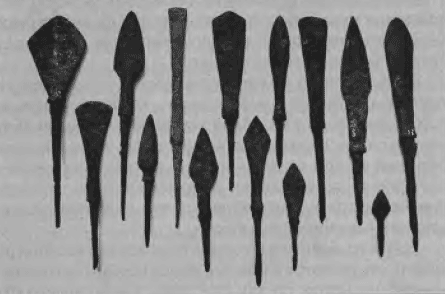
Fig. 39. Arrowheads XII-XIV centuries.
Technique search of historical relics is different from searching for coins only because work, as a rule, in the mode "All metals", because many of the findings from iron is often of great interest.
However, it should be noted one unpleasant feature when searching for historical relics - the land in the search area is rarely smooth and easy to work with device. Have to live with it. In addition, during the search you trapped mosquitoes, horseflies, ticks, snakes, along with the often unfriendly the manifestations of the inhabitants of the surrounding villages. Very important suitable footwear and clothing the ability to establish contacts with the local population.
Another feature to search for historic and military relics is that the search must be conducted in specific locations, or where people lived, or passed battle and battle. For this purpose it is necessary to conduct painstaking historical research in libraries and military archives.
When searching, if conditions allow (no tall grass, for example) recommended coils size (25-30 cm). Such coils catch small objects - buttons, crosses, bullets at a considerable depth. For exploration you can use a special wide-coils, allowing fast scanning of large areas. Finding a suitable plot of land, further work conduct standard coil, providing greater depth and easy the discovery of the exact location of the object in the ground.
It is recommended to use headphones with volume control, adjusting the sound the threshold of the device at the smallest level you can still hear in the headphones. This helps you find small objects buried deep enough.
When you search for historical relics do not rush You need to scan each square meter of the selected area methodically, carefully and completely, moreover, in several directions.
If your unit is rebuilt manually from the pound, you must carefully carry out this operation. This allows you to work with a raised above the ground coil, avoiding interference from the grass and stones. Of course, we must bear in mind that most depth of detection can occur when the coil is as close as possible to earth, and whenever possible, try and do. In the process, stay tuned to handle position "ground balance" has not changed. If this happens, for example, in case of accidental displacement of the handle sleeve or branches when you slogging through the bushes, install it in the original position, otherwise the device will to unsatisfactory work.
After extraction, the findings always recheck the hole device. Often in one place you can find a few items.
Research is also needed to ensure that the desired location is not is a historical monument and is not prohibited to work on it. Unfortunately, many interesting places (settlements, archaeological sites, etc.) not available for fans. However, in the course of your research you will find are places that archaeologists are still unknown.
Promising places to search for historical relics are tracts, often marked on modern maps. The tract is a site that is different from surrounding terrain (forest among fields, meadow woods) and called once former settlements - villages, hamlets, monasteries, etc. and to the present time abandoned. As a rule, small finds there is quite a lot. It crosses, buckles, rings, coins, etc. in addition, where possible and finds treasures.
It is advisable to get maps, both modern and ancient. And try link to a modern map of the now defunct objects - village, Church, Inns, manors, monasteries, chapels, mills, etc.
Determining the coordinates of the tract on the modern map, with GPS Navigator you can then easily find it on the real terrain. Arriving at you are interested in the tract, a beginner can get confused - circle or plowed overgrown with tall grass field, around which a dense forest. How do you know where stood the mansion and other buildings?
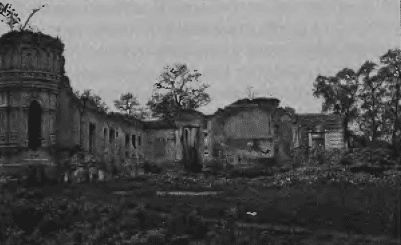
Fig. 40. In such places can be very interesting findings
There are certain signs of finding a place of the former settlement. So, if overgrown field will see a clearing with Ivan-tea or nettle, then maybe this place former buildings or gardens. If the field is plowed, what happens in the spring or in autumn, the place of settlement can be identified by the brick fragments, fragments glass, ceramics and porcelain and darker color of the soil.
In the forest, the settlement place is harder to find, primarily due to the limited visibility. Even in early spring they fall further 100-150 m can't see anything, and in the summer when everything heals, the more. However, thanks to the plants, often able to pinpoint the exact location of the settlement. If in the woods once settled people and freed a space for life, then turned to meadow. After the departure of man and desolation settlement forest is trying to reclaim lost the position of the meadow begins to get covered, first by shrubs, willow, bird cherry, then tree species. First for a seat (in the middle lane Russia) come birch, aspen, Linden, then there's pine, Jay carries seeds of oak acorns.
Already under the canopy of adult deciduous forest grows a tree. So, while the forest on the site of the abandoned settlement will be equal to the untouched surrounding forest to go from 200 to 500 years. Trees and shrubs follow each other not as a hit, and in a certain order. And if you are well distinguished by woody plants, you will not be difficult to learn in the birch grove in the middle of a pine forest place abandoned forest monastery or manor. All the above concerns natural processes occurring in nature. But man has always tried change nature. Therefore, in the woods always need to pay attention to unusual tree and shrub species. For example, in the forests near Moscow such trees as larch, walnut, white poplar, can only be planted artificially. Or, if caught the unusual location of trees, stands carefully check the place out.
Trees growing row is already in the alley, but if it is a century-old Linden trees, it almost certainly the manor house.
In the nineteenth century even the smallest landowner tried to give your garden the similarity with regular Park. Traces of such parks can be found in the most remote areas forests in the Moscow and surrounding areas.
What tool do you need? Well, first of all, increased requirements apply to the shovel. It is understandable - the roots. This is not the meadow sod, then in one by pressing the foot on the shovel will not do. And sharp blade of a shovel already not enough. Abroad for such purposes release a special shovel with sawtooth serrated tempered blade. This shovel may be worth it to 50 dollars, but she deserves it. Will appreciate it when you see digging in the pit pruning the roots of a thickness up to 2 inches. Shovel their cut, and you did not noticed. We have a shovel yet you look for a long time and with no guarantee of success. Maybe I'll find her. Clearly, gardeners without such necessities, for them the upper hand dreams titanium shovel (lightweight and the earth does not stick), and for the seekers artifacts shovels specially import while no one thought. If forest shovels no, it is necessary to take a small sharp hatchet type tourism.
One of the main difficulties of finding a in the forest - extraction findings. The roots, which you met when working in the Bush, nothing in comparison with thick roots trees in the forest. Therefore, we must bear in mind that most of the time when forest looking out for the retrieval of finds.
In the forest not suitable for each detector. Will be practically useless deep device type Pulse Star, SSP-2000ww 104-V. Not to turn among trees with a search frame and a size of 1x1 m. a Little easier with Dogramaci the glubinniki Gemini-3, TM 808. But also not all get through. But with traditional devices is quite normal. Not only need to attach the big coil on the same reasons, prefer regular coil or even less.
Naturally, working with a metal detector in the woods requires a kind of techniques and methods. If in the field or in the meadow, you can widely swing a coil over the principle of "rastogis shoulder, go get the stick hand, in the forest it won't work. It is impossible, as in the open, admire the surroundings, so long, and with all her strength to please the search coil DEREVO, root or stump the Strokes should be more short and strong, permanently you need to look at the coil, but not the sides.
Will have to come to terms with the fact that in the woods you never check the entire surface. Somewhere there's a tree or dense Bush, somewhere is stump. So will accept partial examination. I was a witness, as seekers in the rush passion cut down shrubs and small trees, rake stripped the forest floor, to be in his search closer to the ground, but it is the extremes that may to go only a very experienced and sophisticated in search of nature in anticipation of the big and valuable production.
The tall grass which often grows on the sites of former settlements, you can pritoptal or to mow with a sickle or scythe. If this fails, it is better to leave plot until spring when the new grass has not grown yet.
The forest grows. That is changing with time. It somehow disappears from the calculation seeker. One day, a typical case, we were approached by an elderly man, grandfather which, in the late 20-ies of XX century buried nearly 500 gold ducats in the woods behind her house. The amount is now considerable, and then altogether. Because it was in rush, before the arrest, he was buried all that deep. Woods was small, with all parties limited field, we thought about it and agreed to participate in the search. To why am I writing this? To the fact that, arriving at the place, heirs of the treasures were convinced, what you need to go under all the large pine trees. They don't even occurred to me that for 70 years the forest has changed, then the little trees grew, and large dried up, and fell rotted or were cut down and So it proved.
Or this was a case of… Underground millionaire fearing arrest, in the early 80s he has made pre-packaged noodle "gold stock" in liter jars and buried in the woods. Competently buried, by all the rules, "10 steps to the West from crooked oak" or something . He returned five to seven years. Went to pick up my own, but no such luck was one can can not find. And the signs in place, and everything seems as it was then, and no Zaharenko. Psychic invited - no. When the author came with the device on this place, where everything reminded the battlefield: in the middle of a large trench, even the dugout and the ground around in the craters.
The owner helplessly walked by this place a battle between man and nature and cursing. Helped good knowledge of forest ecology and the very thesis that the forest lives and changing. Curve oak, from which the count was conducted at the burial of the treasure, lay rotten fifty meters away. Half of the oak trees in that forest were curves, with wood rots, so they fell often and look for without the device and ingenuity there could be a very long time.
So, going to look in the woods, remember: the earth is there to protect its treasures more tenacious than in the field or in a meadow, and gives them only a very resistant and persistent, and often just by chance, by luck.
Promising targets in the search for historical relics are the wells, as existing and backfilled. In rough sequence of events wells often proven to be reliable storage of various values, which were quickly to hide from prying eyes. In those places, where during the great Patriotic war battles took place, special teams, collecting military trophies are often used wells as temporary storage facilities, weapons, documents and other things, hoping to go back for them later, which, however, happened always.
Even in normal wells at the bottom may lie ring that fell from hand. So you should check the metal detector of the sludge recovered from the bottom when cleaning the well.
Of particular interest are the monastery's wells. They often contain treasures or just the coins that the pilgrims were thrown into the wells for many centuries.
When you search for war relics and Souvenirs must comply with special measures precautions when working with a metal detector. In some places in the earth there is still a lot of unexploded ammunition - ammunition, detonators, grenades, mines, shells, bombs and other explosive objects.
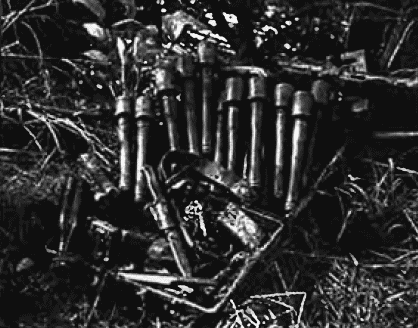
Fig. 41. Dangerous discovery
For long stay in the land of the properties of explosives noticeable change. Military specialists, creating ammunition, do the study of these changes, and their work, as a rule, is a secret the nature and results not available to ordinary people. However, it is known that in corrosion many munitions become unpredictable, dangerous, especially dried in the sun or near a fire.
According to the official rules of the search engines do not lift and neutralize found ammunition, and especially to try to remove the mines and fuzes shells. It is strictly forbidden to throw or hit detected explosive items and put them into the fire.
By the way, the choice of a place for a bonfire should be paid special attention. A fire in the area search military gifts - almost always a source of danger. Known cases when under fire was Mina, who, warmed, and exploded after 2-3 hours, leaving the hapless seekers in the best case without lunch.
Old fireplaces can also be dangerous. Known cases when local hunters for the spoils of war under - clydevale in the fireplace "gifts" - ammunition, detonators, mines to discourage urban competitors. Leaving the fire site, even for a few days, always check it with a feeler or detector.
Talking about collecting the spoils of war, it should be said that this kind search is the most dangerous. However, many young people begin it was with him, hoping to find a serviceable weapon, which under certain conditions stored in the earth. So if you are interested in looking at the battlefields, do it is recommended in the composition of the search teams. Search movement - this is a social movement to preserve and perpetuate the memory of the defenders Of the Fatherland, who died in the Second world war 1939-1945 Prerequisite search movement were detachments of the red Rangers in 50-70-ies, Union the action "the Annals of the great Patriotic war", a joint campaign of war veterans and young people in places of fighting glory First, there were scattered groups enthusiasts, literally understood of the word that the war is not over yet the last soldier is buried. In the 80s the Komsomol tried to combine these natural search group. The official date of occurrence of the search movement should take 1988, when was held the first all-Union rally of search engines in Kaluga. In 1993, Russia adopted the law "On perpetuation of memory of victims at the defense of the Fatherland". According to this law, "conducting a search operation in the field, where hostilities and the opening of military graves in order Amateur initiatives is prohibited".
The collapse of the USSR has an impact on search traffic. The opportunity to enrich themselves attracted on the ground fighting the seekers of weapons, explosives, Nazi "relics and Souvenirs - everything that could be turned into money - the so-called black pathfinders.
Black pathfinders, in its worst incarnation - the looters who are engaged in mainly the excavation of graves. At best it search professionals who well I know that from found good sales.
White Rangers consider themselves professionals, which the earth has something to give to establish the historical truth. They cooperate with similar international organizations, e.g. the International Red Cross or Western museums military equipment
In the history of this division is clear. In real life they are all mixed, but the majority pathfinders become gray. They have their own idea of good and evil and when this is not to trade away your trophies. The division conditionally color: white with time may become black. Too many different ways people get to places fighting. And too often, going to search, Pathfinder can't imagine what he will be crowned, and that will become the prey of a soldier token, buried tea service or bayonet-knife, and in what color - white or black - will color him future trophy.
After going through the search for war relics, many are beginning to understand that in the vast homeland underfoot lay the things to look for are not only less dangerous, but even more interesting and profitable.
Author: L. V. Bulgak