



We offer to your attention a pulse detector is a joint the design of the author and engineer of the city of Donetsk Yury Kolokolov, which managed to translate an idea into a finished product based on the programmable chip microcontroller. They developed software and conducted field tests and extensive debugging.
Currently the Moscow firm "Master kit" is planned to release kits for radio Amateurs self-Assembly of the described detector. The set will contain the printed circuit Board and electronic components, including the already programmed controller. Perhaps for many fans of finding treasure and relics acquisition this dataset and its simple Assembly will be a convenient alternative the purchase of an expensive industrial unit or manufacturing of the metal detector completely on their own.
For those who feel confident in themselves and willing to try to make and to program a microprocessor-based pulse detector, on a personal page Yury Kolokolov placed on the Internet code trial version the controller firmware in Intel HEX format and other useful information. This firmware version differs from the full version, the lack of some modes the metal detector.
The principle of operation of impulse or eddy current detector is based on excitation in metal pulsed eddy currents and measuring the secondary electromagnetic field that induces such currents. In this case the actuating signal is fed into the transmitting coil of the sensor is not constant, but periodically in the form of pulses. In conducting objects induce the decaying eddy currents that excite the decaying electromagnetic field. This field, in turn induces in the receiving coil of the sensor decaying current. According from the conducting properties and size of the object, the signal changes its form and duration. In Fig. 24. schematically shows the signal at the receiving coil pulse metal detector.
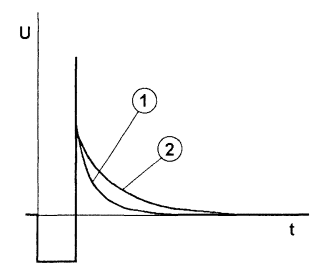
Fig. 24. The signal at the input of the pulse detector. Waveform 1 - signal in the absence of a metal target; waveform 2 is the signal when the sensor is near a metal object
Pulse metal detectors have their advantages and disadvantages. The advantages is its low sensitivity to mineralizovannoi to the ground and salt water, to disadvantages - poor selectivity for the metal type and the relatively large the consumption of energy.
Practical design
Most practical designs of pulse detectors are based on either of two coils to the scheme or scheme with odnokletochnoi additional power source. In the first case, the device has separate foster and radiant coils, which complicates the design of the sensor. In the second if the coil in the one sensor, and to enhance the desired signal is used this amp is powered from an additional power supply. The meaning of such the build is as follows - signal inductance has a higher potential than the potential of the power source used to power into the transmitting coil. Therefore, to enhance the signal amplifier must have own power source, the potential of which must be above the voltage the amplified signal. It also complicates the scheme of the device.
Offer odnotochechnye was built according to the original circuit, which devoid of the above disadvantages.
Main technical characteristics
- The supply voltage 7.5 to 14 In…
- Consumption current: 90 mA
Depth of detection:
- coin diameter 25 mm - 20 cm
- the gun - 40 cm
- helmet - 60
Despite the relative simplicity of the construction of the proposed pulse the metal detector, its manufacturing at home can be difficult because of the need to create special microcontroller programs. This can be done only with appropriate qualifications and software and hardware for working with the microcontroller.
Structural scheme
Structural diagram depicted in Fig. 25 the device is Based on a microcontroller. It is used to form time intervals to manage all nodes in the device as well as display and General management device. With the power switch enables the pulsed energy storage in the coil of the sensor, and then the interruption of the current, after which the impulse arises self-induction, which excites the electromagnetic field in the target.
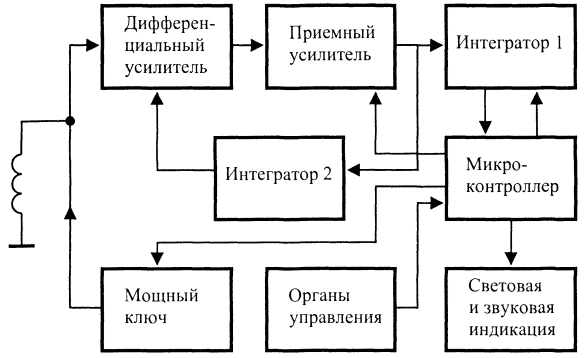
Fig. 25. Structural diagram of the pulse detector
"Highlight" of the proposed scheme is the use of the differential amplifier in the input stage. It serves to amplify the signal with higher voltage supply voltage, and bind it to a specific potential (+5 V). For further amplification is performed by the receiving amplifier with high gain. For measurement of the desired signal is first integrator. During the live the integration is performed the accumulation of the useful signal in the form of voltage, and in the backwards integration converts the result into the duration of the pulse. The second integrator has a high integration time constant (240 MS) and is used for balancing the amplifier channel DC.
Schematic diagram
Schematic diagram of the pulse detector shown in Fig. 26 - differential amplifier receiving amplifier, integrators and powerful key.
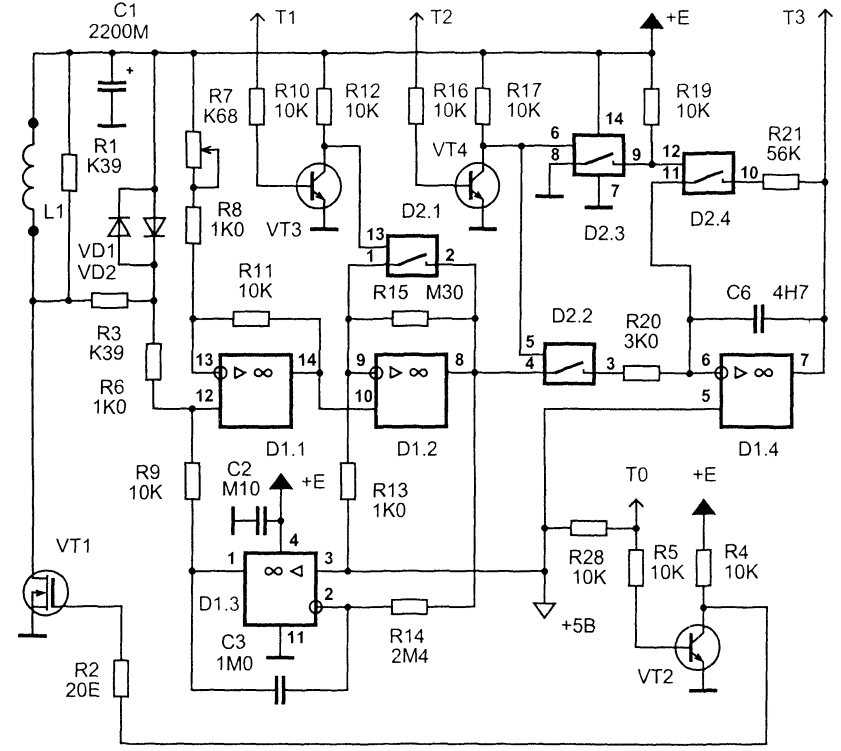
Fig. 26. A circuit diagram of a pulse detector. Amplifying path, a powerful key integrators
In Fig. 27 shows a microcontroller and controls and indication. The proposed design was developed entirely on imported element base. Used the most common components of leading manufacturers. Some the items you can try be replaced by a domestic one, this will be discussed below. Most applied items are not scarce and can be purchased in big cities Russia and the CIS through the firms that sell electronic components.
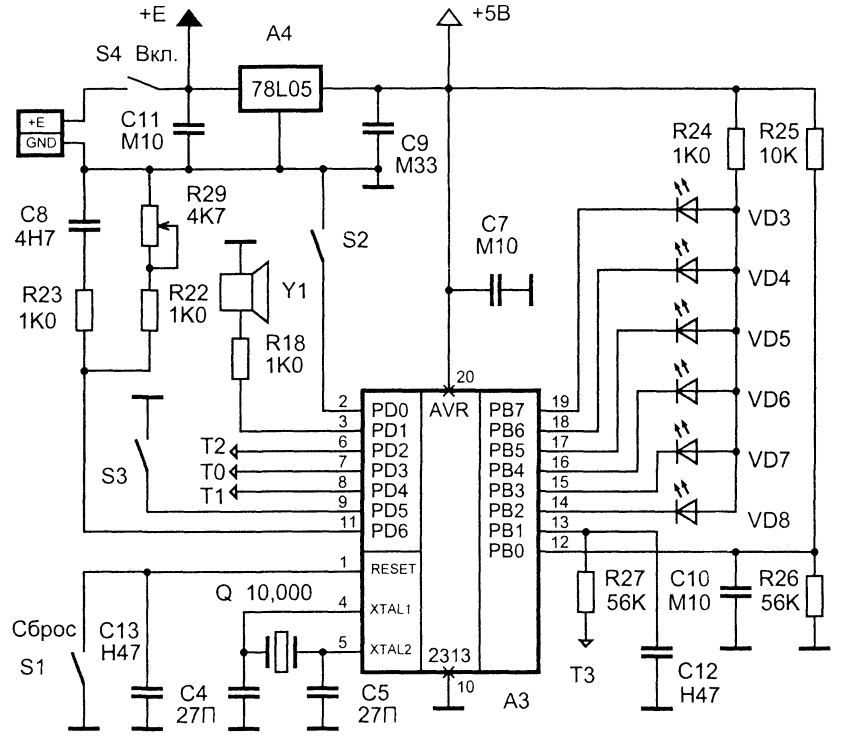
Fig. 27. A circuit diagram of a pulse detector. The microcontroller
Powerful key is assembled on a field-effect transistor VT1. As the applied field transistor type IRF740 has a gate capacitance of more than 1000 pF, for his rapid the closure is used prior cascade transistor VT2. The speed opening with a powerful key is not so critical due to the fact that the current in the inductive the load increases gradually. The resistors R1, R3 are designed to "extinguish" energy of self-induction. Its value is chosen for reasons of safe operation transistor VT1, and also providing the aperiodic nature of the transition process in the circuit composed of the inductance sensor and the parasitic interturn capacitance. Protective diodes VD1, VD2 limit the voltage drops at the input of the differential amplifier.
Differential amplifier assembled on OU D1.1. Chip D1 is a Quad operational amplifier type TL074. Its distinctive properties are high speed, low power consumption, low noise, high input resistance, and the ability to work with voltages on the inputs that are close to the supply voltage. These properties and has led to its use in a differential amplifier, in particular, and in the overall scheme. Gain the differential amplifier is about 7 and is determined by the values of resistors R3, R6-R9, R11.
The receiving amplifier D1.2 is a noninverting amplifier with gain 56. During operation of the high-voltage pulse this self-induction coefficient is reduced to 1 by using the analog key D2.1. This prevents overloading the input of the amplification path and provides quick enter the mode to enhance the weak signal. VT3 transistor, and the transistor VT4, provide for the coordination of levels of control signals, served with the microcontroller, the analog switches.
Using a second integrator D1.3 automatic balancing the input of the amplification path DC. The constant of integration 240 MS is chosen large enough so that this feedback had no effect on the gain rapidly changing signal. Using this integrator output amplifier D1.2 when no signal is maintained a level of +5 V.
Measuring a first integrator performed on D1.4. The integration time the useful signal as a key D2.2 and, accordingly, closes the key D2.4. On the D2 key.3 implement a logical inverter. After integration of key signal D2.2 closes and opens the D2 key.4. The storage capacitor C6 begins to discharge through resistor R21. Time discharge will be proportional to the voltage established on the capacitor C6 by the end of the integration signal.
This time is measured by the microcontroller, which performs analog to digital conversion. To measure the discharge time of the capacitor C6 uses the analog comparator and timers that are built into the microcontroller D3.
By led VD3…VD8 is light indication. Button S1 is responsible for initial reset of the microcontroller. Using switches S2 and S3 are set the operating modes of the device. Using a variable resistor R29 adjustable sensitivity of the detector.
The algorithm of functioning
To explain the principle of operation of the described pulse metal detector in Fig. 28 shows signal waveforms at vital points of the device.
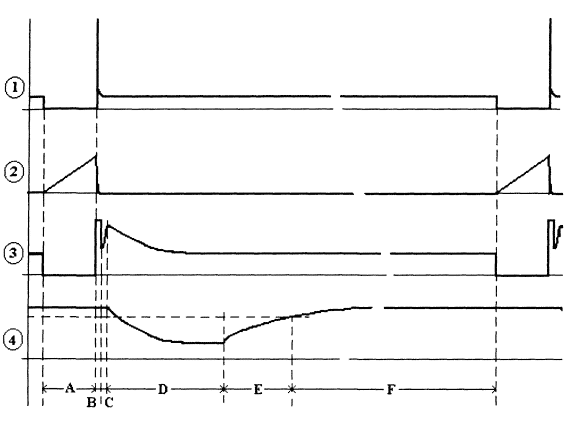
Fig. 28. Waveforms
On the time interval And opens the key VT1. Through the coil of the sensor begins leaking sawtooth current waveform 2. When current of 2 A key closes. At the drain of the transistor VT1 occurs the discharge voltage of self-induction - waveform 1. The magnitude of this release - In more than 300 (!) and limited the resistors R1, R3. To prevent overloading of the amplifier channel are suppressor diodes VD1, VD2. Also For this purpose, the time interval And (energy storage in the coil) and interval (leak inductance) opens the D2 key.1. It reduces end-to-end gain of the tract from 400 to 7. On the waveform 3 shows the signal at the output of the amplification path (pin 8 D1.2). Since interval C, the D2 key.1 is closed and the gain of the tract becomes great. After guard interval, during which the amplifying the tract included in the mode, the D2 key.2 and closes the D2 key.4 - starts the integration of a useful signal interval D. At the expiration of this interval the key D2.2 is closed, and the switch D2.4 open - starts "return" integration. During this time (intervals E and F) the capacitor C6 is fully discharged. Using the built-in analog comparator microcontroller measures the spacing E which is proportional to the level input useful signal. For version 1.0 of the firmware set the following values for the intervals:
- A-60…200 MS, In - 12 ISS
- C - 8 µs, D - 50 MKS,
- A+B+C+D+E+F - 5 MS - repetition period.
The microcontroller processes the received digital data and displays using led VD3 - VD8 and sound emitter Y1 the degree of exposure of the target to the sensor. Led indication is an analog dial gauge - when the target led VD8, then depending on your level of exposure sequentially VD7, VD6, etc.
Types of parts and design
Instead of the operational amplifier D1 TL074N you can try to apply or TL084N two dual opamps types TL072N, TL082N.
Chip D2 is a Quad analog switch type CD4066, which can replace domestic chip CTS.
The D4 microcontroller AT90S2313-10PI has no direct analogues. The scheme is not provided the circuit for in-circuit programming, so the controller it is advisable to set on the socket, so that it can be reprogrammed.
Stabilizer 78L05 can, in extreme cases, replace CREA.
Transistor VT1 type IRF740 you can try to replace the IRF840.
Transistors VT2-VT4 type 2N5551 can be replaced by CT with any letter index. However, you should pay attention to the fact that they have different Pinout.
The LEDs can be of any type, VD8 it is advisable to take a different color glow. Diodes VD1, VD2 type 1N4148.
The resistors may be of any type, R1 and R3 must have a power dissipation of 0.5 W, the rest can be 0.125 or 0.25 watts. R9 and R11 preferably choose to their resistance differed by no more than 5 %.
Adjusted the resistor R7 is desirable to use multi-turn.
The capacitor C1 is electrolytic, 16 V, the remaining capacitors ceramic. The capacitor C6 is desirable to take TKE good.
Button S1, the switches S2-S4, variable resistor R29 may be of any type, suitable dimensions. As a sound source you can use system or headphones to the player.
The design of the enclosure can be arbitrary. Rod near the sensor (up to 1 m) and the sensor itself should not have metal parts and fasteners. In the starting material for the manufacture of the rod is convenient to use plastic telescopic fishing rod.
The sensor contains 27 turns of wire with a diameter of 0.6…0.8 mm, wound on the mandrel 190 mm Sensor has no screen and its attachment to the rod should be without the use of massive wood screws, bolts, etc. (!) The rest of the technology the manufacture may be the same as for induction metal detector. For connection of the sensor and the electronic unit cannot use shielded cable because of its large capacity. For these purposes it is necessary to use two insulated wire, such as type mgshv, twisted together.
The establishment of the device
Attention! The device has a high, potentially life-threatening voltage - at the collector of VT1 and at the sensor. Therefore, when setting up and operation should to comply with electrical safety measures.
The instrument setup is recommended in the following sequence:
- Verify correct installation.
- Apply power and verify that current does not exceed 100 (mA).
- By means of trimmer resistor R7 to achieve such balancing the amplification path so that the waveform at pin 7 of D1.4 match the waveform 4 in Fig. 28. Thus it is necessary to ensure that the signal in the end of the interval D was unchanged, i.e. the waveform in this place must be horizontal.
Further setup correctly assembled the device does not need. Need bring the sensor to a metal object and verify the work of the displays. Description of the work of the governance bodies can be found in the software components.
Software
At the time of writing of this material was developed and tested software software versions 1.0 and 1.1. Code firmware version 1.0 in the Intel HEX format you can find on the Internet on the personal page of Yury Kolokolov, http://home.skif.net/~yukol/index.htm.
The commercial version 1.1 of the software is planned to be delivered in the form of already programmed microcontrollers in structure sets produced by the company "Master Kit". Version 1.0 implements the following functions:
- control of a supply voltage when the supply voltage is less than 7 starts In intermittently illuminating the led VD8;
- a fixed sensitivity level;
- static search mode.
Software version 1.1 differs in that it allows you to adjust the sensitivity of the device using a variable resistor R29.
The work on new versions of the software continues, it is planned the introduction of additional modes. To manage new modes reserved the switches S1, S2. New version, after full testing will be available in sets of "Master kit". Information about new versions will be published on the Internet on the personal page of Yury Kolokolov, http://home.skif.net/~yukol/index.htm.
Author: A. I. Shchedrin