



The author proposes two simple device that automatically neutralizes electric lighting when there is no need, and prevent this unnecessary expense electricity.
Circuit breaker "Day-night" works simply - it reacts to external illumination. If the street is dark, the lighting device includes a lamp, and dawn, when the level of natural illumination grows, turns it off.
The circuit of the machine is shown in Fig. 1.
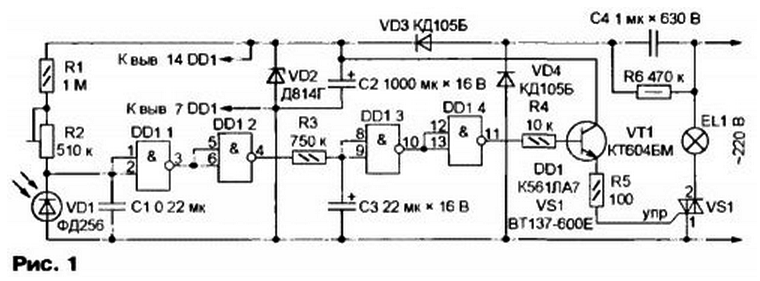
At the entrance he the light sensor is a photodiode VD1, the output - triac VS1. The threshold adjust trimmer R2. The circuit provides R3C3 a delay of response to changes in ambient light sensor, required for prevent the lamp EL1 by brief exposure to the photodiode headlights of passing cars or flashes of lightning. The use of the triac in the switch load (incandescent lamps EL1) allowed to refuse diode bridge, which would be required for the SCR.
When developing this device had to face the problem of selecting sensor light. The fact that there are no photoresistors or photodiodes, designed to operate in the visible spectrum of Light radiation. Homemade sensor from the transistor to open the case very unreliable. It influenced not only the luminance but also the ambient environment, and other factors (e.g., humidity). The best sensors was IR photodiodes PD, FD and FD from systems do old TVs who confidently respond to visible light.
The feeding unit of the machine consists of the quenching capacitor C4, rectifier diode VD3 and VD4 with a smoothing capacitor C2 and Zener diode VD2.
A timer-switch, the circuit of which is shown in Fig. 2, suitable for installation in front door entrances or stairwells of high - rise buildings-everywhere where you manually enabled the lighting device is required after a certain time automatically turn off.
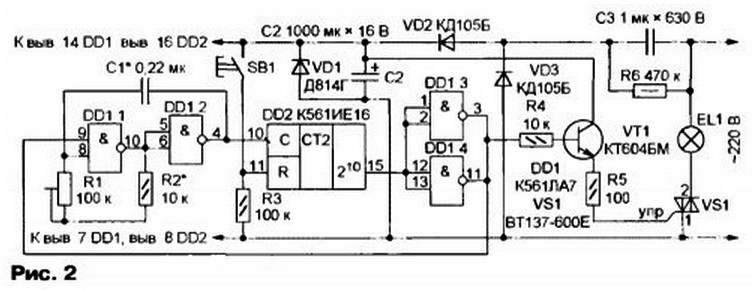
The device is launched by clicking on the button SB1 relay time which automatically turns off the light with a delay of several minutes to hours. The necessary length of the lamp trimmer set R1. If desired, the engine can be provided with a graduated scale. Interval regulation modify the selection of the capacitor C1 and resistor R2. The output circuits and node power timer is not different from the above-described switch "Day-night".
Although the state of the counter DD2 at power-up may be arbitrary, in the account of the pulses generated by the multivibrator on the elements DD1.1 and DD1.2, after a while the pin 15 of the counter will be set high, and the outputs connected in parallel elements DD1.3, DD1.4 low voltage. As a result the triac VS1 is closed, lamp EL1 repaid, and work the multivibrator is stopped. In this state, the device can remain indefinitely - until you press the button SB1. The clicking will put the counter DD2 in the zero state with a low level on all outputs, including the pin 15.
Mounted as a result, the outputs of the elements DD1.3, DD1.4 high the level will open the transistor VT1, and the triac VS1. Lamp EL1 will be included. Earn multivibrator, and after counting 1024 (2 to the tenth power) it pulses at pin 15 of the counter DD2 will again be set to a high level, that will turn off the lighting. The machine will wait for a new pressing button SB1.
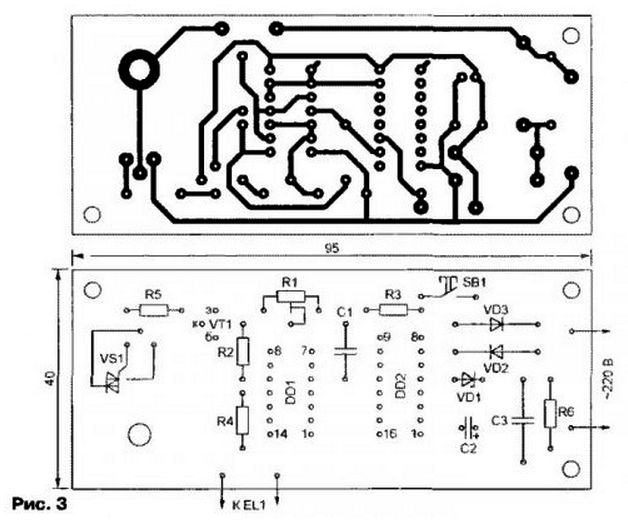
In Fig. 3 shows the printed circuit Board of the timer switch.
Author: V. Bobrovsky, city of Nartkala, Kabardino-Balkaria