



When shooting at close range fotoreproduktsy, exhibits energy industrial "blitzes" is often unnecessarily large and, in addition, the use of troubling others. In such cases it would be useful illumination of the subject by a camera flash filament (Fig. 1), which is difficult without significant cost to make yourself.
Getting to the shooting, the switch SA1 is served on the flash food. The capacitor C1 is charged by a battery GB1 until its voltage. Resistor R1 limits the charging current, which lasts about 12 C. the shutter of the camera sync IC through the capacitor C2 sends a pulse voltage to the control electrode of SCR VS1. SCR instantly closes the circuit of the incandescent lamp EL1, which discharges the capacitor C1. Flash duration is approximately 1/50 with allowing hand-held shooting. To make this possible, the voltage on the charged capacitor has approximately three times the operating voltage of the incandescent lamp. The reason for this are thermal the inertia of the filament lamp and the steep characteristic discharge voltage capacitor. The initial peak of the discharge current is consumed for heating the threads, after which there is a momentary bright glow mode percale. To turn off the SCR after triggering and to give the opportunity the capacitor is again charged to take the next shot, it is enough press and immediately release the button of the switch SB1.
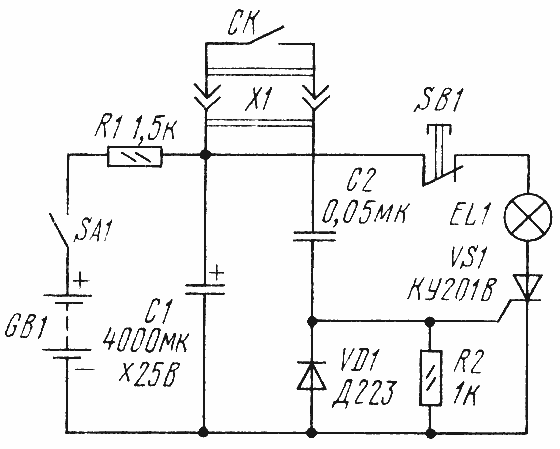
Fig. 1
Relatively long charging capacitor low current allows the use of flash is very small power source GB1. So, with the lamp power of 15 to 20 watts from a film-viewing device, designed for a voltage of 6 V, it can be made up of two or three batteries "Corundum" connected in series.In a self-made flash can be used any SCR series CU, any diode (also indicated on the diagram) series D226. Capacitor C1 - C50-6, C2 - MBM, KLS, km, resistors - MLT or MT with a capacity of not less than 0,125 W. Connector to sync can make yourself isolated from the segment the PVC single core wire of suitable diameter and impaled over insulation thin-walled metal tube.
The entire device is placed in a prepared or homemade housing provided with a clamp for attachment to the holder of the camera. Reflector - a reflector (for example, a large tablespoon) with lamp can be recessed into the body of the outbreak, around them on the Board have the parts and a power source. The relative position of the parts plays no role and is determined only by layout considerations. Lamp can be used from an old lantern-carrying or build it themselves.
Neatly assembled the camera flash does not require networking. Since the work in pulse-percaline mode is able to reduce the life of the lamp, it is desirable to provide for the possibility of a simple her replacement.
While shooting with this illuminator, use a shutter speed of no shorter than 1/30 s and if possible, slow sync F-type. The cameras with rolling shutter with instant sync X-type there may be some uneven illumination of the frame when installed the lamp on the optical axis of the camera. To remedy this effect the flash should be installed on the bracket with the appropriate parties apparatus or shoot with a shutter speed of 1/10 C.
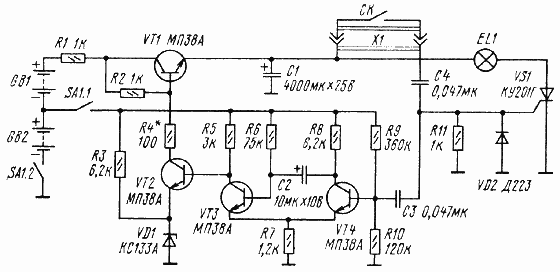
Fig. 2
Described variant of the flash is simple but has disadvantage - after each flash you need to turn off the SCR. This the surgery can instruct automation (Fig. 2). The original version of the augmented electronic key on the VT1 transistor, which is controlled by a single vibrator, made on transistors VT3, VT4, and output stage transistor VT2.Triggered multivibrator team sync IC simultaneously with turning on of SCR VS1 and lamps EL1. Closing in this case, the transistor VT3 opens VT2, which causes the key to VT1 interrupt residual current (holding current) triggered SCR. About after 0.5 s the device returns to its original state and will begin new charging of the capacitor C1.
The sensitivity of single-shot triggering pulses can be adjusted by selection of the resistor R9, the reliability of the closing transistor VT1 is the selection of the resistor R4. As power automation, to avoid overloading of the transistors is conducted from the battery GB2 ("Emery"), should from time to time to change the battery swapped for a more uniform use of their capacity.
Also indicated in the diagram, the automation node can to be used transistors MPB, MP. Capacitors - oxide K50-6 (C1) and KLS (other), resistors - MLT or MT capacity dispersion not less than 0,125 W.
Author: Yu Prokopcov, Moscow; Publication: www.cxem.net