



Service life of lighting incandescent lamps compared to, for example, with fluorescent small. In addition, the lifespan of the lamp often is significantly less than expected due to high voltage in network or result in large inrush current at power on. Offer a simple device eliminates overload, not allowing recording the current through the lamp, exceed the rated value under any circumstances, even during start.
Previously it was proposed many devices for "soft" switching on incandescent bulbs [1-5], mainly on the Datasheet search and triacs. None of them, certainly not in able to prevent the gradual degradation of the tungsten filament, leading to her burn, however, the actual lifetime of the lamps with the "moderators" increases in 1.5. ..3 times.
Offered a similar device at cheap of high voltage transistors, which, although it was originally intended to protect the lamp power 15 W (backlight fridge), it provides a soft turn on any lamps bulb 220V power up to 60 watts. A unique feature of the the device - it will not allow you to turn on the lamp power greater than that to work with which has been configured. For example, if you install in include them in the fridge instead of standard bulbs at 15 watts looks very similar to her power of 25 W and to close the switch does not light up the lamp, and the led "Overload". This the property is very useful when using common lamps today from heterostyly plastic, designed for filament lamps of a power not more than 40…60 watts. The inclusion of such a lamp with a lamp of higher power will inevitably lead to its damage or even fire.
Unlike other "moderators", we offer ready to re-enable immediately after turning off, requiring, for example, waiting a full discharge timing capacitor or cooling to room temperature, heated the thermistor.
The protection device is collected according to the scheme shown in Fig. 1, and include in the gap any one going to the lamp EL1 network wires. After closing the contacts switch SA1 AC mains voltage is supplied to the diode bridge VD1-VD4. In the diagonal of the bridge is a composite key on the transistor VT1-VT3. Thanks the resistor R2 and the large current transfer ratio composite transistor key open circuit lamp EL1 closed.
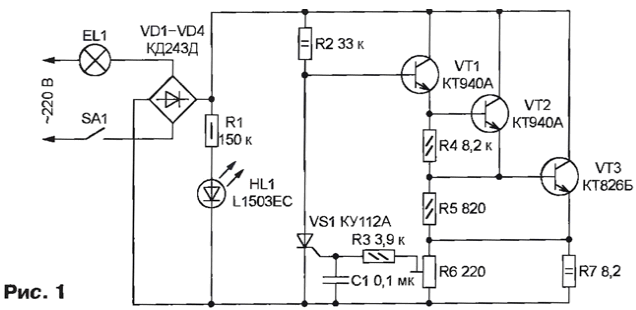
A trimming resistor R6, the device is controlled so that the SCR VS1 open when the voltage drop across the current sensor is a resistor R7, a little more appropriate for nominal lamp EL1 amplitude of the current. Opening the SCR leads to the closing of the cutoff transistors and the current flowing through lamp. A small portion of it continues to flow through the resistor R2 and outdoor SCR, for a noticeable heating of the filament is insufficient. SCR closed when the current is on the border of the two half-cycles is reduced to zero.
The cold resistance of a tungsten filament lamp EL1 many times less than warmed up to operating temperature. As a result, in the first post closing the contacts of switch SA1 halftime cutoff occurs long before it ends, as the current quickly reaches the set trimpot resistor R6 limits. In the next half cycle, the resistance slightly hot threads anymore and clipping occurs a little later. This continues until warm, when the current has not reached a threshold value and the lamp shining in full strength.
Integrated circuit C1R3 slightly delays the opening of SCR VS1. Without her the first circuit after the switch SA1 of the half-cycles of the cut-off occurs so quickly that the filament does not have time to heat up noticeably. As a result, the process ignition of the lamp may be delayed indefinitely. It should be noted that heating is comparatively slow until the lamp brightness reaches approximately half of the nominal, after which it increases abruptly.
The voltage at the output of the diode bridge VD1-VD4 upon reaching the lamp EL1 capacity 60 watts maximum brightness does not exceed 5 V, which corresponds to the total power dissipated by all elements of the protection device, less than 2 watts. A little reduced compared with the voltage supplied to the lamp, a positive affects its service life, with minimal effect on the brightness.
The protection device is mounted on a single-sided PCB size 90x55 mm (Fig. 2) and placed in a plastic protective case. The most crucial element of design - VT3 transistor. It needs to be high voltage, withstand relatively high current and be of adequate current transfer ratio base (not less than 8 at IC=1 A and IKE=12 In). Suitable transistors series CT, CT, CT, CT, CT, CT, CT, CT. Of course, suitable and similar transistors with a prefix of 2 K. instead Of import can be called 2SC2555, 2SC3306, BU526, BU931. The transistors in plastic case will require a heat sink.
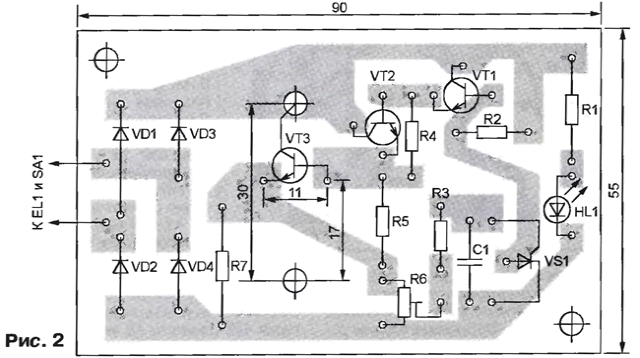
Transistors CTA optionally substituted with CTA, CTA, CTA, 2SC2330, MJE340, BF459 to account for differences in pin assignment. Instead of diodes CDD suitable KDA, CDG, CDB, CDG, 1N4004 and other similar. HL1 led can be any, preferably red glow, because he indicates an emergency situation. Capacitor C1 - K73-17 or K73-9, fixed resistors - S1-4, S2-23 MLT trimpot R6 - SDR-386. The lamp EL1 preferably take a new one, still not working.
Prior to applying the voltage, the engine tuning resistor R6 set in upper circuit position. Close switch SA1 and smoothly dragging the slider of the resistor R6, to get the tanning lamps. It is advisable to light the bulb has reached full brightness for 0.3…0.6 s. you Can achieve much more a long slew of brightness (up to 3…5), but adjusted in such the device will be too sensitive to temperature changes ambient air and of the parameters of the protected lamp as a result of aging.
With correct adjustment of the connection in parallel of the burning 40-watt lamp more one 15-watt should lead to the extinction or drastic reduction in the brightness previously included.
If the device you intend to use to protect lamps of a power not less 40 W, the value of the resistor R7 is permissible to reduce by half. You can do so way: right (under the scheme) the output resistor R3 to connect directly with the emitter of the transistor VT3, excluding the trimmer R6. Permanent the resistor R7 to replace low-impedance trimming wire, for example, PPB, SP5-50M, TDR-12, combining its movable contact with one of the extreme conclusions. It will minimize the voltage drop across the current sensor and the instrument in General.
Circuit elements and devices directly connected to the network 220 In, when working with it is necessary to comply with electrical safety measures.
Literature
Author: A. Butov, S. CORBA Yaroslavl region