



Now a new problem appeared - saving electricity. For solve this problem, an increasing number of firms produces fluorescent energy saving lamp having a base size E27 and E14. Consumption energy these lamps, of course, is much less than standard bulbs filament. Also claimed the life of approximately 4000 hours, i.e. about 4 times the life of ordinary bulbs.
With all these the advantages of this lamp, there is a disadvantage such as high cost. In these the lamps use a special electronic ballast, but usually it comes out failure is extremely rare, but the filaments of the fluorescent lamps burn out quickly enough, often not having worked even guaranteed lifetime, because which they repair almost impossible. Now, however, there were LEDs increased brightness, which can also be used for lighting. Life modern LEDs is around 50,000 hours, that's almost 6 years of continuous operation.
We offer to your attention the led lamp is specially designed for lighting and power from the mains AC voltage of 220 V.
The scheme of this lamp, is presented in Fig. 1, is quite simple, and does not need in adjustment. A distinctive feature of the lamp is the use of wide-angle LEDs, allowing a homogeneous and bright lighting throughout the area. The advantages of this lamp are a very low power (about 2 watts) and high efficiency.
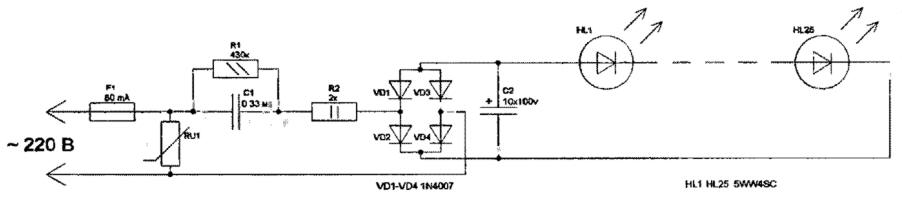
The main elements of the scheme are light emitting diodes (25 pieces) white spectrum radiation, high brightness. As the diodes HL1…HL25 better use a wide angle (160°) led type 5WW4SC. They can be replaced any other wide-angle LEDs with direct voltage 3.2 3.7 V…and a current of 20 mA.
To power the LEDs uses a transformerless power supply, consisting of the quenching capacitor C1, the discharge resistor R1, diode bridge VD4 VD1…, the smoothing capacitor C2 and limiting resistor R2. AC voltage is extinguished by the circuit R1, C1, R2. Capacitor C2 should be designed for a working voltage of at least 250 V. Further low voltage is fed to a rectifying diode bridge, and after capacitive filter (C2) a constant voltage is supplied to the series-connected LEDs HL1…HL25. When using in scheme 37 LEDs you can eliminate the resistor R2.
Was also provided for the scheme for protection of LEDs from high network voltage and on his throws. It is built on the fuse F1 and the varistor RU1. Varistor (semiconductor resistor) has a symmetrical current-voltage the feature, which may be used in AC circuits as the regulating element. With increasing voltage resistance varistor decreases and the current flowing through it increases, due to what fuse F1 blows, and the rest of the scheme remains expensive workable. As varistor RU1 can be used TVR 05 361 or FNR 05 361. Due to the lack of fuse with a lower current burnout had set at 80 mA, although it is advisable to use a fuse at 40 mA.
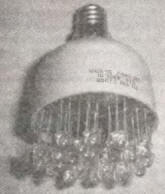
All circuit elements are mounted on the foil fiber-glass plastic. LEDs are arranged in a circle in three rows. As the body best suited bases (E14, E27) energy saving lamps. All parts fit very well inside this enclosure. To fix the Board in the case is best done with a a hot-melt adhesive.
The assembled lamp is presented in Fig. 2.
Attention! When you build this circuit and its testing must be very careful, because the circuit is not galvanically isolated from the network AC!
Author: E. Pereverzev Krasnodar, Kropotkin