



The proposed device responds to light. It is convenient to use as a simple "guard" in the basement with no Windows or somewhere in the utility room (the shed).
If in this room the light comes on, be it a flashlight, candle or even match, the device responds and includes an audio signaling device, which I hope will scare away the intruder. In addition, options for the use of this scheme can be a lot.
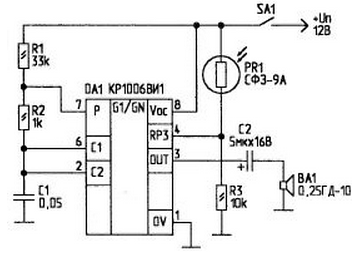
Under the illumination of the working surface of the photoresistor PR1 his resistance reduced to the tens and units of the shortfall (depending on intensity), the current in it the circuit is increasing, and DA1 chip turns into a generator pulses of audio frequency. Rectangular pulses at a frequency of approximately 800 Hz (the sound is sharp and loud) comes through the coupling capacitor C2 on the dynamic head of BA1.
The frequency and duration of pulses are regulated the selection of the values of C1 and R1.
To force shutdown the device (if visit the controlled premises) serves as the switch SA1, which you'll be somewhere discreetly near the door.
Instead of the photoresistor SFZ-9A can be applied with similar devices characteristics, for example, FR-117. FR, FR. PR-PPS-2. PPS-4, CSF-1. To increase the sensitivity of the site I recommend to enable parallel group photoresistors (2-3). The capacitor C2 does not pass a fixed component the voltage on the dynamic head Dynamic head - any, the coil resistance not less than 8 Ohms. Constant resistors - MLT-0,25. the capacitor C1 is KM.
The device works stably in the range of the supply voltage 5…15 V. When the increase in the voltage of the sound volume increases. Power source must be stable.
Current consumption in standby mode (control premises) does not exceed 0.5 mA, which allows to use as the source power even battery or low-power batteries (D0.26-D). In the mode "Alarm" when sound radiation, the current consumption increases to 30 to 40 mA.
Author: A. Kashkarov, G. S. Petersburg