



Psychologists have long established that the well-being of a man, his emotional attitude during labor or active recreation influence the color of the surrounding objects, walls, floors. For example, greenish colors are soothing, and Vice versa red - tone, excite. This means that changing the color of the background environment, interior, can affect the psychological state of man, his health. But the color of the interior items - property is fairly constant, static; to change the color scheme of the room, will have to stick Wallpaper repaint the furniture, change the upholstery…
However, there is a way to reconcile the desired effect, it is necessary only to refer to help… light. I want to offer a description of a simple device that allows to receive the beam of any color and saturation and thus to change colors premises at any time in accordance with the task or mood. The proposed scheme is quite versatile and allows you to use it as in ceiling lamp and table lamp, floor lamp, special source light.
The principle of operation is based on partial overlapping of the luminous flux of conventional white, miss th via linear raster, one or more light filters. Method seemingly quite well-known, widely used, for example, for theatrical effects. Actually there are significant differences: the use of the raster and the possibility of incomplete or mixed beam overlap.
The construction itself is, of course, may vary according to the performance of the device corps, auxiliary elements and methods of connecting and fixing. So stay on the main: the production of raster and filters.
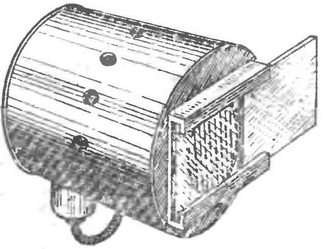
Fig. 1. Homemade lamp bitmap
Linear raster must have even expressed grooves of the protrusions and depressions, forming in orthogonal cross-section a wavy line. If you set it to the convergent pencil of rays, each protrusion and the depression would be to form miniature cylindrical lens, dispersing the light passing through it evenly over the entire surface. If overlap same raster plate or film optical filter, the light output will be uniformly colored, and saturation is proportional to the area of overlap. This should be observed one mandatory condition: the boundary of the slab parallel to the raster lines.
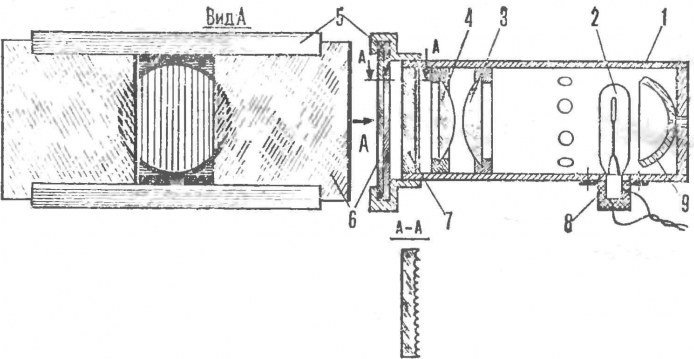
Fig. 2. A schematic diagram of a raster lamp: 1 - housing 2 - lamp. 3, 4 - lens, 3 - skid holder filters. 6 - filters, 7 - raster, 8 - lamp holder 9 - spherical reflector
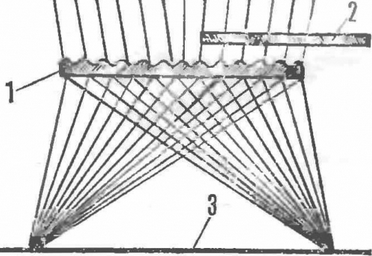
Fig. 3. Pattern of dispersion and dyeing luminous flux: 1 - raster plate, 2 - plate filter, 3 - covered surface.
If you move from opposite sides of the color filters, the resulting beam will get color depending on the color of each filter and the ratio of the areas raster plots, they overlap. For example, when the same simultaneous introduction of the red and green filters get the corresponding saturation blue. Using plates of the primary colors of the spectrum (red, blue and yellow) or the so-called additive mixing which gives any of the others, and ndwiga their Laramie, might give ray all the colors of the rainbow.
Now about how to make this "palette" for the light. Let's start with the raster. For it obtaining it is necessary to make the matrix. Take any suitable rigid plate dimensions and wind it wire diameter from 0.5 to 1.5 mm - tightly, turn to turn. This will be the matrix. The very same raster is applied to the sheet colorless plexiglass, which is pre-softened over electric or gas stove (burners do not forget to cover with a sheet of tin). As soon as it becomes plastic, lay it on the matrix, and covering the plexiglass flat rigid plate (for example, DSP), squeeze the "sandwich" with a force of 70 - 8O kg. will Receive a uniform wavy surface.
Such a plate can be used as a bitmap in any lamp. Driven schematic diagram of it, which will allow you to collect the necessary option or upgrade existing projector, illuminator, making him relevant the nozzle-tube.
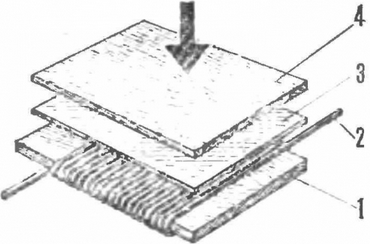
Fig. 4. Receiving raster: 1 - rigid plate, 2 - wire. 3 - heated Plexiglas, 4 - plate, 5 - cargo.
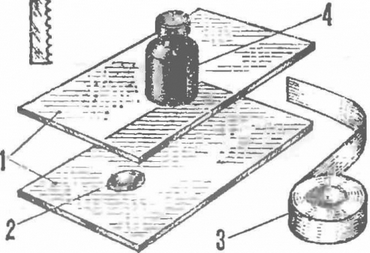
Fig. 5. The fabrication of the filter: 1 - glass plate. 2 - drop paste, 3 - sticky tape. 4 - the cargo.
In the housing (see figure) is installed: a spherical reflector (can be applied household foil), lamp and cartridge (regular lighting, Mignon, film), two PLANO-convex lenses (say, condensor magnifier), raster plate; outside at the exit light flux tin fasten the rails - holder for filters. Poloski can wdigets and before raster: the effect of dyeing and the color distribution is retained.
On its option to check the serviceability of the Circuit I have used ready the lens unit from the projector "Etude". This required only to separate it from corps. The unit is convenient because no need to split hairs with holders for filters - you can insert them in a frame feed transparencies. Tilting petal-ogrenciler on the guide, we take out human frame and (as an option) instead DIGEM from the raster package and filters. As a housing for the power unit the collection I used a large tin can (from under the green pea company "Globe"), taking care of ventilation.
For filters you can use any colored glass plate painted plexiglass, which, by the way, well painted with diluted paste from the ball studs handles. The same paste will help to get the filter and glass plates (e.g., the washed photographic plates). It should only drop one of them to cover the second plate and leave them under load for a few hours, the paste will spread a thin film, like a colored strip. Will only turn over obtained a filter strip of sticky tape.
Author: V. Gavrilov