



The device provides protection lighting lamp from the inrush current at power on and smooth heating its filament, and the adjustment of the maximum load power. The advantage of him in front of some kind, for example, published in [1, 2] - simplicity, combined with a sufficiently high reliability.
As a basis (see diagram) taken method of pulse-phase control SCR, described in [3]. The principle of operation of such a device is well known to readers of "Radio", and therefore we will consider in detail only the work of the newly introduced circuit automatic power control of the load consisting of a diode VD4, capacitor C1 and resistors R2, R3.
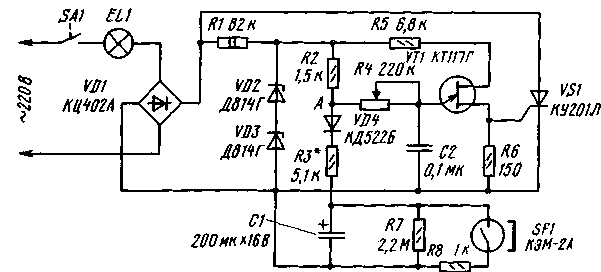
Immediately after plugging in the capacitor C1 begins to charge pulses of current flowing through the resistor R2, diode VD4 and the resistor R3. The peak value of the voltage at point a is not yet sufficient for opening unijunction transistor VT1, so it is closed, closed, course, and SCR VS1. At this time the current through the load EL1 does not leak. As the charging of the capacitor C1, the value of the pulse voltage at point a increases. When she reaches the threshold of opening of the transistor, the capacitor C1 begins to discharge through the emitter-base, bringing to the control electrode of SCR act opens his short pulses.
The power dissipated in the load is determined by the phase shift between the control pulse and the beginning of a period of the anode voltage of the SCR, and the repetition frequency of the control pulses, as at the beginning of one pulse is generated for multiple periods of the mains voltage. These two parameters define the operation of the SCR depend on the charging rate of capacitor C2, i.e., from the peak voltage at point a and the resistance of the entered part of the variable resistor R4. As the charging of the capacitor C1 (1…2) the average current flowing through the diode VD4, decreases so that in the future, this chain has no significant impact on the operation of the device. The maximum power supplied to a load is determined by the total resistance of the resistors R2 and R4 and may be approximately 5…90 % of the nominal power of the load. In practice, this range of adjustment capacity for incandescent bulbs is enough.
The resistor R7 is designed to discharge the capacitor C1 after disconnecting the load from the network. The device should be supplemented with a reed switch SF1, accelerating the discharge of the capacitor, and the Manager contacts the magnet mechanically linked with the switch SA1. Resistor R8 limits the current through the reed switch.
The device of an arbitrary structure can be assembled in the housing of relatively small dimensions. When load power 100 W SCR should be installed on a heat sink and rectifier bridge VD1 to replace more powerful, for example, focused on the four diodes D.
SCR KUL to replace COOK, M, COL-N. Diode VD4 - any of the series KD522, KD521, CD. All fixed resistors - MLT, variable resistor R4-SDR-4A. Capacitor C1 - oxide K50-6, C2 - any compact.
Due to the fact that the device has direct contact with the network, the shaft of the variable resistor R4 topgen to be equipped with a handle made of insulating material.
Accurately assembled device does not require establishing.
Literature
Author: D. Pankratiev, Tashkent, Radio 9-97; Publication: N. Bolshakov, rf.atnn.ru