



In Amateur practice sometimes there is a need to make a simple "flashing lights." The easiest thing to do, using as a light emitter pulse the LEDs. But they are for normal illumination require not stress below 2, i.e., to power such a device is required, at least two galvanic cell or battery. The figure shows an embodiment of a "flashers" with led for power which is used only one galvanic element.
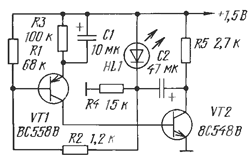
It works so. When turned on, the capacitor C2 is charged through the resistors R4 and R5 to the supply voltage. When this process ends, the base of the transistor VT1 is connected to GND through resistors R2 and R4. The charge current capacitor C1 opens the transistors VT1 and VT2, and the latter connects the charged capacitor C2 in series with the electrochemical cell. During discharge of the capacitor led HL1 some time glows, because to him the applied voltage is above the threshold. When the capacitor C2 discharged completely, the transistors are closed and the process repeats.
When specified on the circuit component values, the device provides 15 flashes per 10 s. It remains operable during the discharge of a galvanic cell to 1… 1.2 V. the current consumed by the device is small, so one element R20 ensures operation of "emergency lights" in a year and a half.
Transistor VSV can be replaced by transistors of the series CT, VSV - KT3102 (or other appropriate structure and static the current transfer ratio of not less than 200). HL1 led should be working a voltage of about 2 V. this will suit ALL, ALA, AL, AS with any letter index (red glow) and AL (green glow).
Author: Zdenek Hajek