



Lighting lamps can burn out is know all. The reasons why this happen is known. Also known how can I extend the "life" lamps. However, most of these solutions quite complex in their practical implementation: requires a large the number of elements, which reduces the reliability of the device and complicates its mounting in the box of standard switch network; the necessary adjustment device.
To achieve the desired easy - only need bipolar (series) switch and silicon diode.
In Fig. 1 shows a schematic diagram of a lamp all details of which (except the lights EL1) mounted in a box standard network switch or in the stand table lamps. Attached the details of the mounted Assembly and the whole structure compact.
Feature of the switch is the presence of two keys - SA1, SA2. Therefore, if you have one-button switch, it must be replaced by two keys.
The device operates as follows. In the original the state of the contacts of the switches SA1, SA2 are open. When you turn lamp EL1 first press of the switch SA1. Current network passes through the circuit: diode VD1, the closed contacts SA1, lamp EL1. Diode VD1 necessary as the half-wave rectifier. Therefore, the lamp arrives half-wave rectified voltage, which reduces the value dissipated by the lamp power twice - the lamp is burning dimly. This prevents cold filament from possible burnout, since the value of the resistance at this point may be insufficient in order to withstand the rated power.
After that close the contacts of the switch SA2 and the lamp comes all the voltage. Now the lamp will burn in full capacity.
In other words, through the diode VD1 and switches SА1, SA2, you can avoid overload for the filament EL1 at the moment turn on the lamp, which greatly prolongs its life.
So in the dark it was easy to find key switch SA1, its illuminated neon lamp HL1. When this night is often not required complete coverage is quite a duty, when the lamp EL1 dimly lit. Then use switch SA1, which is visible in the dark.
The VD1 diode series DB used in power lamps bulbs up to 100 watts. If used for lighting lamps designed the power greater than 100 W, it is necessary to put a diode series KDM. Neon lamp may be of the type TN-0.2 or MN-6. In the switch it should to have so that she was covered only press SA1.
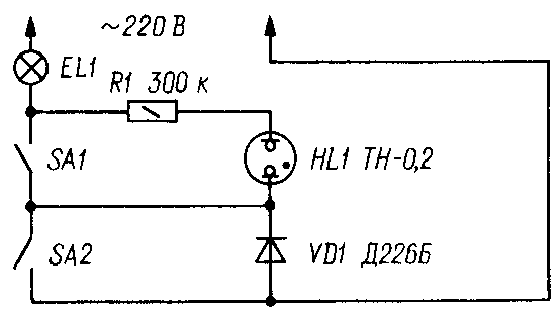
Fig. 1
The disadvantage of this device is the need complying with the order of keystrokes, switches SA1, SA2. To resolve it, you will also need one diode, which is mounted instead of a neon lamp (Fig. 2 - VD1).
Include diodes VD1, VD2 meet or connect with each other their cathodes or anodes. Now a pressing priority the keys does not affect the operation of the lamp. Anyway - pressed if the SA1 or key SA2 - lamp EL1 dimly lit. And only when both keys are pressed, the light is at full capacity.
Off fixt to (and in the first and second variants), simultaneously opening the contacts of the switches SA1, SA2.
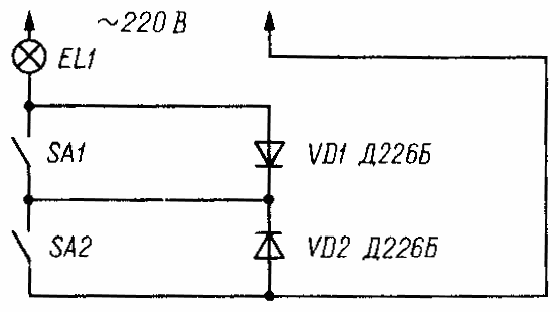
Fig. 2
If the lamp (chandelier) has multiple lamps and they are included separately, you must apply a three-pole (three buttons) switch. In Fig. 3 and 4 shows the schematic of such lamps. The principle of operation is similar to the above devices. First (depending on what kind of lamp - EL1 or EL2 or both at the same time - you need to include pic. 3) close the switch contacts SA1 or SA2, or both simultaneously. The bulb will light dimly. Then close the switch SA3 lamp lights up in full power.
For the device, schematic diagram of which is it is shown in Fig. 4, the order of switching does not affect the operation of the lamps. And when closed the switch SA3 is possible by combining the provisions of the switches SA1, SA2, to obtain additional modes of operation of the lamp. For example, if you close SA1 and SA2 will remain de-energised, the lamp EL1 will be burning at full capacity, and EL2 - dimly. Conversely, if to close SA2 and SA1 unlock, EL1 will burn dimly, and EL2 - in full power.
To turn off the lamp, open the contacts switches SA1 - SA3 at the same time.
Mounted diodes VD1-VD3 directly in the box three buttons switch. And with wattage 100 watts diodes VD1, VD2 should be series KDM or similar, designed on consumption of the lamp current.
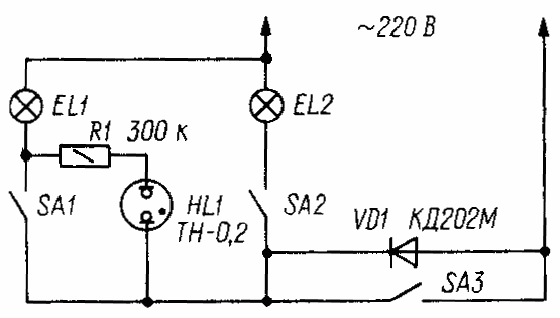
Fig. 3
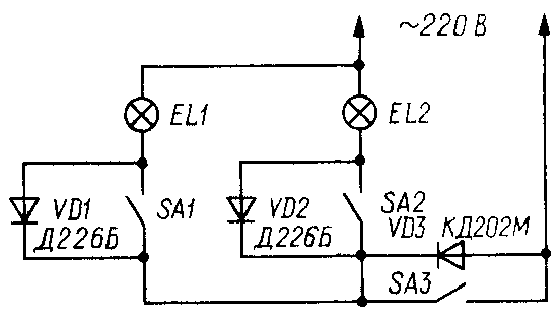
Fig. 4
Despite the simplicity of the schematics, the device have the a disadvantage that does not protect the filament of the lamp from destructive action short "throw" of the current network at the time the lamp is turned on since the I-V characteristics of the diode are not similar to the characteristic of beretter. The "life" of the lamp will depend on the power values of the current pulse. the state of the filament. Therefore, at the confluence of adverse factors - high voltage, strong erosion of the filament,- the probability if the lamp is not less than without this device. However, this solution can be successfully used when there is the need to translate, for example, table lamp standby (night) mode. It should be said that the industry produces for such purposes special switches, in particular DMS-100, the basis of which is half-wave diode rectifier.
Author: K. Kolomeitsev, Ivano-Frankivsk; Publication: www.cxem.net