



Dignity remote control infrared rays (hereinafter simply do) you all have experienced on my own experience. DU has invaded our daily lives and sufficiently saves us time. But at the moment, unfortunately, not on all the electrical appliances install do. This is true for the light switches. Our industry, however, at present produces a switch, but it costs little money, and find it very, very difficult.
In this paper we propose a rather simple diagram of the switch. Unlike industrial, which includes one Bisco, she mostly collected on discrete elements, which, of course, increases the size, but if necessary can easily be repaired. But if you chase the dimensions, then in this case you can use planar parts. This scheme also has a built-in transmitter (industrial), eliminating the need to carry the remote or to search him. Enough to bring to the switch arm at a distance of ten inches how it works. Another advantage is that to do any remotes from any import or domestic radio.
Transmitter
In Fig.1 shows a diagram of the emitter short pulses [1]. To reduce consumption of the transmitter current from the power source, and thus extend the life of one battery. On the elements DD1.1, DD1.2 assembled generator pulses, following with a frequency of 30…35 Hz. Short duration of 13…15 μs, the pulses forms a differentiating circuit C2R3. The elements DD1.4-DD1.6 and normally closed transistor VT1 form a pulse amplifier with IR diode VD1 at the load.
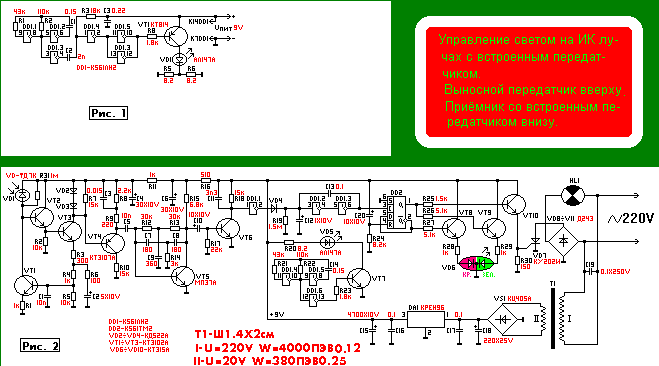
The dependence of the main parameters of the generator of the supply voltage u n and m shown in the table.
Table 1 U Pit,
ISPI, And
Pot, mA 4.5
0.24
0.4 5
0.43
0.57 6
0.56
0.96 7
0.73
1.5 8
0.88
2.1 9
1.00
2.8
Here: ISPI - the amplitude of the current in the IR diode, Pat - the current consumption of the oscillator from the power source (if specified in the scheme face value of the resistors R5 and R6).
The transmitter can also serve any remote control from domestic or imported equipment (TV, VCR, music center).
The printed circuit Board shown in Fig.3. It is proposed to make of double sided foil fiberglass with a thickness of 1.5 mm. Foil with side parts (not shown) are the total (negative) wire of the power source. Around the holes to feed the findings of the details in the etched foil parcels with a diameter of 1.5…2 mm. the Findings of the details connected with the common wire, soldered directly to the foil this side of the card. Transistor VT1 is attached to the circuit Board screw M3, without any heat sink. The optical axis of the IR diode VD1 should be parallel to the Board, and extend it by 5 mm.
Receiver (with built-in transmitter)
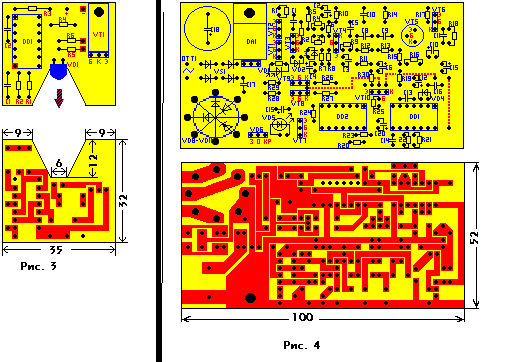
The receiver is built on the classical scheme adopted in the Russian industry (particularly in TVs Rubin, Tempo, etc.) [1]. Its scheme is shown in figure 2. The pulses of infrared radiation appear on an infrared photodiode VD1 , is converted into electrical signals and amplified by transistors VT3, VT4 , servitude connected in the circuit with common emitter. On the VT2 transistor is assembled emitter follower, matching the dynamic load resistance of photodiode VD1 and the VT1 transistor with an input impedance of the amplification stage transistor VT3. Diodes VD2,VD3 protect pulse amplifier transistor VT4 overload. All of the input amplifier stages of the receiver covered by a deep feedback current. This ensures a constant working point of the transistors regardless of ambient level of illumination is a kind of automatic gain control, especially important when operating the receiver in areas with artificial lighting or outside in bright daylight, when the level of extraneous infrared radiation is very high.
Next, the signal passes through an active filter with a double T-shaped bridge, assembled transistor VT5, resistors R12-R14, and capacitors C7-C9. The transistor VT5 must have a current transfer ratio Na=30, otherwise the filter may start to get excited. The filter cleans the signal transmitter interference from AC power that radiated electric lamps. The lights provide a modulated radiation flux with a frequency of 100 Hz and not only the visible spectrum but also in the infrared region. The filtered signal code of the parcel is formed on the transistor VT6. As a result, the collector gets the short pulses (if received from the external transmitter) or is proportional to a frequency of 30…35 Hz (if received from the internal transmitter).
The pulses coming from the receiver arrive at the buffer element DD1.1, and with him on the rectifier chain. Rectifier chain VD4, R19, C12 works as follows: When the output of the logical element 0, the diode VD4 is closed and the capacitor C12 is discharged. As soon as the output element pulses occur, the capacitor begins to charge, but slowly (not with the first pulse), and the diode prevents the discharge. Resistor R19 is selected so that the capacitor has time to charge to a voltage equal to a logical 1 only 3…6 pulse coming from the receiver. This is another interference protection, short IR flares (e.g., from the flash of the camera, lightning strikes, etc.). The discharge of the capacitor takes place through the resistor R19 and takes 1…2 S. This prevents fragmentation and arbitrary inclusion and exclusion of light. Next, set the amplifier DD1.2, DD1.3 with capacitive feedback (C3) to obtain at its output a sharp rectangular perepadov (when turning on and off). These changes are sent to the input of the flip-flop divide-by-2 assembled on the chip DD2. Do not invert its output connected to the amplifier transistor VT10, which controls the thyristor VD11, and the transistor VT9. Invert supplied to the transistor VT8. Both of these transistor (VT8, Vt9) are used for the ignition of the corresponding color on the led VD6 when turning on and off lights. He also performs the function of "lighthouse" with the lights out. Input R of the flip-flop divider connected RC circuit, which carries out the reset. He needed to if disabled voltage in the apartment after switching on the light from accidentally turning on.
Built-in transmitter is used to turn on lights without remote controller (when you touch your palm to the switch). It is assembled on the elements DD1.4-DD1.6, R20-R23, C14, VT7, VD5. Built-in transmitter is a pulse generator with a repetition rate of 30…35 Hz and the amplifier into a load of hard labor included IR led. IR led mounted next to the IR photodiode and should be sent to him in one way, and they must be separated by an opaque partition. Resistor R20 is selected in such a way that the triggering distance, when the tray palm, was equal to 50…200 mm in the built-In transmitter can use a IR diode type ALA or any other. (I, for example, used the IR diode from the old drive, but the resistor R20=68 Ohms).
The power supply is built on the classical scheme on CREB and the output voltage equal to 9V. It includes DA1, C15-C18, VS1, T1. Capacitor C19 is used to protect devices from power surges in the mains.Load the diagram shows a lamp.
The printed circuit Board of the receiver (Fig.4) is made of one-sided foil fiberglass size H mm and thickness of 1.5 mm. All parts, except the VD1 diode VD5, VD8, install as usual, these same diodes are installed from the installation. Diode bridge VS1 assembled Yes discrete rectifier diodes commonly used in the imported machinery. Diode bridge (VD8-VD11) is installed in series diodes CD (in the schema specified otherwise), the diodes when soldering are arranged one above the other (column), this method is applied in order to save space.
Literature:
1. Radio No. 7, 1996, pp. 42-44. "IR sensor in alarm".
Author: Rusin Alexander, Moscow; Publication: N. Bolshakov, rf.atnn.ru