



The generator provides stability (with frequency up to 30 MHz) sufficient to Amateur SSB transceiver. The oscillator circuit shown in the figure.
Transistors V1 and V2 connected in the circuit with a common base. The gain of the cascade transistor V2 is close to unity, because its load is low resistance emitter junction of the transistor VI. A large resistance of the collector junction of the transistor V2 is included in the emitter circuit of the transistor V1. creates a deep negative feedback current. Due to this, the output resistance of the cascade transistor V2 is increased many times and is the unit of mega ohms.
Such a high output impedance allows to include in the collector circuit LC circuit completely. A large load resistance allows to obtain a high overall gain of the cascades (up to 1000) and set a weak feedback (via the divider SS), whereby the attenuated impact on the loop emitter circuit of transistor V2.
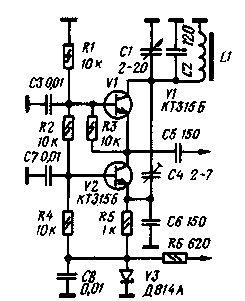
The output voltage is removed from the junction point of transistors, low impedance and well decoupled from the circuit. So the load has little effect on the oscillation frequency.
The generator used resistors MLT-0,125, capacitors NW, C7, C8 - K10-7, S1 - KVM-1, C2 - XAT-1, C4 - PDA-MP. C6 - CD-2. C5 - CD-1.
For the frequency range 28…29.7 MHz was applied to the coil on the ring core size CHH ferrite WC. containing 9 turns of wire PELSHO 0.47.
Effective RF output voltage was 0.2 V. This voltage is sufficient for operation of the mixer with germanium diodes. If the voltage has to be increased, should be replaced with a Zener diode DA on having a higher voltage stabilization. The increase of the output voltage can be obtained with a reduction the resistance of the resistor R5.
After a ten-minute warm-up frequency drift of the oscillator (28 MHz) amounted to 800 Hz for five minutes, and for the next orientation meeting is less than 100 Hz. After a half-hour warm-up oscillator frequency was in the range of inaudible beat for 10 min. In the absence of external electric and magnetic fields, the signal was almost sinusoidal.
Author: Yu Medinet (UB5UG), Kyiv; Publication: N. Bolshakov, rf.atnn.ru