



So the first step is to establish which pins correspond to the heater, cathode, grids, deflection plates, and anode. With this done we can make our simple oscilloscope as follows: connect the Y input via a suitable capacitor to one of the Y deflection plates; for X deflection we use a neon lamp oscillator to generate a timebase; and with a focus regulator circuit we have a complete oscilloscope.
Circuit diagram:
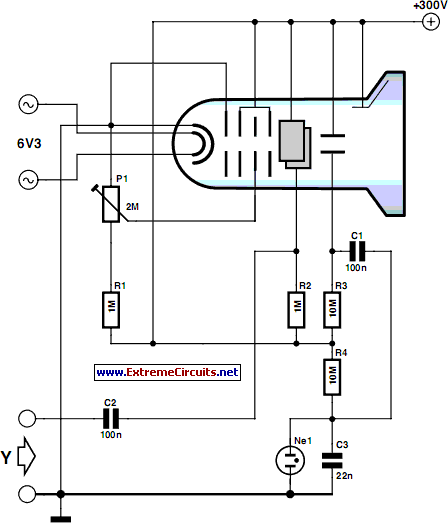
Minimalist Oscilloscope Circuit Diagram
Operation of the horizontal deflection oscillator is visible as the gentle flickering of the neon lamp. Whenever the voltage across the parallel-connected capacitor reaches the strike voltage of the lamp, it is discharged with a brief pulse of current. It is hard to imagine a simpler way to generate a sawtooth waveform. The supply voltage of 300 V is adequate for simple experiments, even if the tube is rated for operation at 1000 V or even more.
Now, if a signal is applied to the Y input, we should be able to see the waveform on the screen. It must be admitted that the design’s sensitivity, linearity, trace size, bandwidth and triggering facilities leave a little to be desired. Nevertheless we have shown how little circuitry is required to make a real working oscilloscope.