



Connected to personal computer equipment can consume from the AC idle dozens or even hundreds of watts of power. In addition, if electrical equipment for a long period of time without the need, for example, being in standby mode, is connected to AC power, it is more likely its damage.
To automatically turn off the power connected to the computer devices can be assembled in a simple design, a schematic diagram of which represented in Fig. 1. The device is designed for the connection of loads total the power output of 1200 watts.
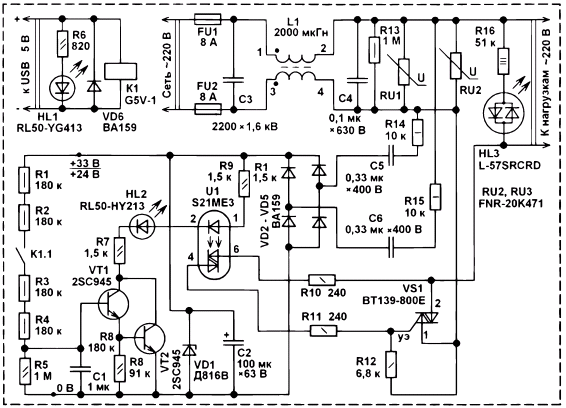
Depending on how you connect the device can operate in two modes:
1
- power to the load is energized at all times when on the computer itself energized
network;
2 - power to the load is supplied only if the computer is in
working condition.
The first mode of operation is ensured by the fact that if the computer is in standby, sleep or hibernation mode, USB ports usually there is a supply voltage of +5 V, which can be disabled in the BIOS settings some computer motherboards.
In the second mode, the input management must be connected to the power line +5 In the computer, the voltage at which is usually absent, if the computer does not work. Voltage power +5 V served on all of the red wire coming from the power supply Board computer.
The second mode is difficult to implement for laptops and netbooks. The first mode most appropriate if this device will control the power various disk drives, the voltage which is undesirable to disable when the computer enters standby mode. Upon receipt of the input control 5 V DC, led should be illuminated HL1 and closed contacts K1.1 electromagnetic relay. This relay provides the necessary electrical isolation between the computer and the mains voltage of 220 V. For the same purpose and improve the reliability of the device taken and other additional methods the junction node of the computer from 220 V To this end, the contacts relay enabled via the series resistors R1 - R4. These resistors significantly reduce the leakage current network - computer-human grounding in the case insulation breakdown electromagnetic relay. In addition, significantly reduced the likelihood of damage to the computer in the event of a nearby lightning strike during a thunderstorm. Also increase the level of protection from adverse collisions in the network power the following elements: U1, R7, R9, R10, R11, R14, R15, C5, C6.
In addition to the protective functions of these radioelements and perform other functions necessary for the corresponding nodes. When the closed contacts K1.1 open transistors VT1, VT2 included as a composite transistor in the Darlington circuit. The use of composite transistor allows to increase the resistance of the resistors R1 - R4. Capacitor C1 eliminates the sensitivity of this node to interference. When the transistors are open, the led is lit HL2. and also the led triac optocoupler U1. Triac OPTRON offers on each half-wave of the mains voltage, with him offers powerful triac VS1. The load receives a supply voltage, what signals brightly glowing double-crystal led HL3. Resistors R10, R11уменьшают DC and pulse current through photoemitter, as well as protect it in case damage or open circuit of the triac and VS1
Node transistors and the optocoupler U1 is powered voltage +33 from capacitor DC source, implemented on quenching the excess capacity of the capacitors C5, C6. Bridge rectifier AC is implemented on the diodes VD2…VD5. Resistors R14, R15 reduce the pulse current source capacitor power. Pulsation of the rectified voltage smoothing the oxide capacitor C2. The Zener diode VD1 limits the rectified voltage is at around 33 Q. When I open the transistors VT1, VT2 voltage on the plates of the capacitor C2 is reduced to 24 V.
Voltage 220 V AC power to this unit and the connected load is supplied through the fuses FU1, FU2 and LC noise the filter C3L1C4. In parallel included varistors RU1, RU2 eliminate high voltage transients and protects connected loads from overvoltage.
The device can be mounted on the PCB size 155x70 mm, sketch which is shown in Fig. 2. It has all the elements, except for the inductor L1 In the left part of the Board in the place of installation of the electromagnetic relay to reduce the probability of breakdowns made two air slots, you can apply your design resistors types CM, S2-23 C2-33, MLT, RPM power, as indicated on the diagram. Varistors FNR-can 20K471 replace FNR-20K431, MYG20-471, MYG20-431. When the varistors should provide for the protection of structures against fire them housing, for example, asbestos paper or fiberglass.
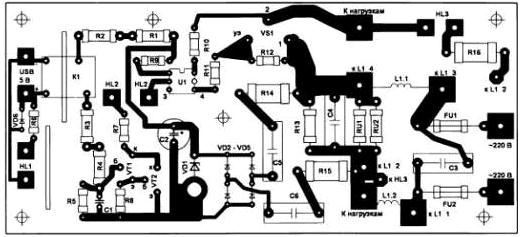
The number of parallel connected varistors can be increased. Capacitor C3 high voltage ceramic K15-15 capacity 2200…10000 pF. Capacitors C4…C6 as film. K73-17, K73-24 or similar imported on the operating voltage of not lower than 250 VAC current. The capacitor C1 of any type small, the oxide capacitor C2 C50-35, K50-68 or equivalent.
The diodes. WE you can substitute any of the series part no 1n4001 1N4007…, UF4001… UF4007, CD, CD, CD, CD. Instead of the Zener diode DW in this design can use DB, 1N5362, 1N5363, or 1N5364 two series-connected Zener XA, XA, SA. LEDs RL50-YG413 and RL50-HY213 can be replaced by any General application continuous illumination without built-in resistors. Led L-57SRCRD can to replace any of the series L-57, L-937. In the absence of double-crystal LEDs counter-parallel crystals can be set to standard led, turning it on in thin diagonal of the diode bridge rectifier.
2SC945 transistors can to replace any of it. US, SS9011, SS9014, 2SC1815, or 2SC1845 domestic series CT, CT, CT. Instead of a triac optocoupler can S21ME3 apply S21ME4 that contains a built-in detector zero".
, Another suitable low-power triac optocouplers, Optimiser which is designed for a working voltage not lower than 400 V. Powerful triac. VT-E designed for a working voltage up to 800 DC 16 And, pulse 140 A. Can be replaced by any similar series. VT-600, WT-800, VT-600, WT-800, VT-600, VT-800, or MAS-A8. Triac mounted on the heat sink, the cooling surface area of which is to be enough for prolonged use under high current loads the case temperature of the triac does not exceed 60°C.
Excess capacity triac necessary to ensure that the triac could sustain pulse current charging capacitor filter mains voltage connected load. The inductor L1 any two-winding with an inductance Polubotok from 100 µh windings which designed for maximum current load.
You can use ready-made two-winding inductor, for example, from large-format copy machine, a powerful computer power supply or manufacture independently on the basis of the ferrite core from the output line transformer CRT TV or monitor. The core must be assembled with non-magnetic gap of about 0.5 mm. In this case, for example, 15 of turns of magnet wire on the core of the transformer. TVs-will give LC an inductance of about 100 µh. The diameter of the copper wires is not less than 1.2 mm fuses FU1, FU2 installed the current 8 A based on the capabilities of the device with the laser a printer.
If you do not intend to connect to this device high current consumers electricity, then you can install the fuses at a lower current. Relay 65V-1 has the winding resistance of about 160 Ohms, designed for a working voltage of 5 V. It can be replaced by GJ-SH-105LM, coil which is also designed for a working voltage of 5 V. In the absence of such the relays can be used common electromagnetic relay with a coil 12 In, for example, RAS1215, SDT-SS-112DM, G2R-14 IN this case, a control input connected to the source voltage +12 V computer for example, using a standard four-pin plugs "Molex".
Relay is not soldered to the the holes of the circuit Board, and glued to her body polymeric glue, the connections are short-circuit wires.
This is necessary to enhance the safety of operation of the device. Unmistakably collected from healthy components of the device begins to work immediately and not require networking. To check health source the control voltage, it is advisable not to use the computer, and laboratory the PSU. In the operation of the design should take into account that most of its elements (except R6, VD6 and HL1) are under voltage AC.
Author: A. L. Butov