



Now USB is a universal port of the computer to which connect a multitude of devices. On USB withdrawn sufficiently powerful source of 5 V, therefore, many devices are not only communicating through him, but are powered from the USB port. This is different scanners, web cameras, external CD / DVD drives, modems, etc., In the Internet you can find the descriptions very silly trinkets, powered by USB - micro cleaners, heaters, tea and even microsoftware.
In principle, from USB, you can power many other peripherals, not even designed for this, but there are some limitations. In particular, the voltage power, which is 5 V. Despite the fact that the periphery is supplied from a private network adapters usually requires a higher voltage.
The figure shows a diagram of a simple adapter that allows you to raise the voltage, taken from the USB port, 6…15 V (depending on the resistances of the resistors R5 and R6), provided that the load current will not exceed 150 mA.
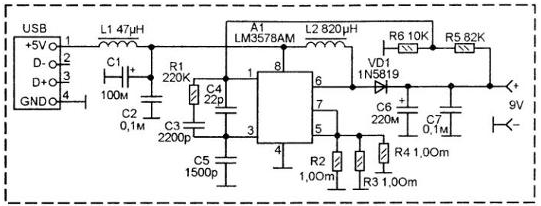
The circuit is based on boosting DC-DC Converter on the chip LM3578AM. As the transmitter pulse, at the entrance set the inductance L1, preventing the penetration of impulse noise as in the circuit of computer and the computer in the chain feeding device consisting of a chip A1 a pulse generator with PWM and the output key. The key goes to pin 6 and 5. Conclusion 7 - input control the protection circuit, which voltage drop on the resistance of the resistor R2-R4 determines the current through the switch. And when exceeding the permissible values triggered protection.
Pumping voltage occurs across the inductor L2. Then this AC voltage is rectified by the Schottky diode VD1 and smoothed capacitors C6 and C7. Stabilization of the output voltage occurs comparison of the voltage taken from the divider R5-R6 with a reference voltage, produced by the stabilizer, which is part of the chip.
Control input / output 1. The values of resistors R5 and R6 shown in the diagram for obtain the nominal output voltage 9 V:
- for voltages of 6 V - R5=47K, R6=9,1 kW;
- for voltages of 12 V - R5=110K, R6=10 kω;
- for voltages of 15 V - R5=130K, R6=9,1 Ohm.
In principle, it is possible to obtain different voltage, selecting the appropriate the resistors R5 and R6. The ratio of their resistances must be such that when the required output voltage at pin 1 A1 was voltage of 1 V.
Mounting the inverter can be most conveniently done on a small printed circuit layout Board.
Choke L1 and L2 - ready, industrial manufacturing.
Author: A. Zhurbin