



The use of capacitors to reduce the voltage supplied to the load from the lighting network, has a long history. 50 years of ham radio operators is widely used in transformerless power supplies radios capacitors, which are included in series with the filaments of tubes. This allowed us to eliminate the quenching resistor, which is the source of heating of the entire structure. In recent times we see the return of interest to the power source capacitor with damping; in recent publications [1, 2] discussed in detail the options of such structures and their calculation. Inherent to all without exception, such devices lack - increased risk due to output galvanic connection to the electrical network is clearly understood, but is allowed in the calculation of the literacy and accuracy of the user. However, these constraints are insufficient to keep out of trouble, why transformerless devices may have only a very limited application.
The author tried to approach the issue from a slightly different perspective. The question is: will the radio Amateur to risk, building the source for any one of the schemes, if there is a possibility to use the more compact transformer? It is unlikely. In this decision he will, most likely, not having such a product and bow to an independent manufacturer. To understand it easily because for winding 5…6 thousand turns of ultra-thin (0.05 mm) wire can not do without the winding machine with the meter and associated skills.
Here may be of interest compromise version of the source that provides electrical safety, with damping capacitor and a simple, accessible novice radio Amateur transformer. This transformer will work, if the voltage on the primary winding to limit the value of about 30 V. this is enough For 600…650 turns of relatively thick, comfortable when winding wire; for the sake of simplification, it is possible for both windings to use the same wire. The over voltage here will assume the capacitor is connected in series with the primary winding (the capacitor must be designed for a rated voltage of At least 400). On this principle it is advisable to arrange the low voltage loads with a current in the primary circuit (including a small transformation ratio) up to 0.5 A.
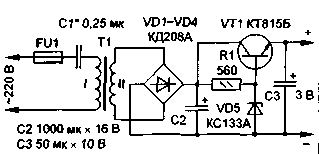
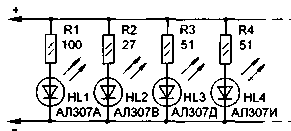
In Fig. 1 is a diagram of such a device, suitable for operation with a garland of LEDs desktop mini Christmas trees or audio player. The inclusion of LEDs (8-10 pieces) is performed in parallel (Fig. 2); this eliminates the usual mess of wires, they are easier to make invisible in "needles" of the trunk and branches. The transformer can be assembled on the yoke W h. For winding suitable wire sew-1 with a diameter of 0.16 mm; number of turns of the primary and secondary windings - 600 and 120…140 respectively. To make such a transformer will be able, as they say, "on the knee". Electric strength not less than 2 kV will provide an insulating spacer between the windings of the Mylar film having a thickness of 0.1 mm or condenser paper.
In order for the device is not out of order if the load [1], to the output of the bridge VD1-VD4, you should connect the Zener DG. In normal mode it does not work because it has a minimum voltage stabilization above the operating output of the bridge. Fuse FU1 protects the transformer and stabilizer in the breakdown of the capacitor C1.
From the editors. To limit the current when the power supply is connected to the network in series with the capacitor C1 must include a resistor of a few hundred Ohms, and the capacitor is discharged after off - parallel to a resistor of a few hundred ohms. In the chain of serially connected capacitance (condenser 1) and inductive (transformer T1) may be resonance voltage. Keep this in mind when designing and building such power sources.
Literature:
1. Biryukov, S. calculation of the utility power source capacitor with damping. - Radio. 1997, vol. 5, pp. 48-50.
2. Haviko O. the power supply with a capacitor voltage divider. Radio,1997, No. 11,pp. 56,57.
Author: Yu Prokopcov, Moscow; Publication: N. Bolshakov, rf.atnn.ru