



The voltage of the onboard network of the car is 12 V. If you ask the acoustic impedance of the system is 4 Ohms, then the maximum the power that can be obtained with the high voltage supply will be 36 watts. It the theoretical maximum assuming bridging the inclusion of the amplifier and the zero impedance of the output stage transistor in an open state, there are, almost to a digital pulse amplifier.
For the analog amplifier maximum power will be no more than 20 watts per channel at bridge connection.
For more power you must either use the pulse output cascade that generates the audio signal by the method of pulse width modulation, or you need to lower the impedance of the speaker system. In the first case, the sound will to attend the ultrasonic component from the PWM, as well as. will need more complex responses to the distortion of the signal.
In the second case, the resistance of the voice coil is already comparable with resistance wires coming toward her that, in General, such measures could offset no. There is another way - the organization of the current-feed additives in the output of the cascade for by rectification of the output signal and large storage capacity. But it is also not very well, because it is difficult to obtain a sufficiently linear, frequency response, and can be uneven dependence of gain in power from input of the signal.
Of course, all of the above measures increasing the power output of the amplifier, powered by a low voltage source, have a right to exist, and when neat and proper performance of give good results. But, there are more the traditional method of increasing the capacity ULF simply increasing the voltage power using the voltage Converter, and even arranging with his by using a bipolar power supply.
This method pesopay to use in car not compromise road option ULF, and almost any scheme unch used in stationary the instrument is capable of providing significantly better sound quality than a clever scheme a powerful auto-ULF, volitionally on the capacitors and low-impedance speakers, because as you say, anyone Amateur Hl-end - the best sounding and gives a simple single-tube without cascade feedback circuit with high impedance output. But this is of course another an extreme example.
Whatever scheme "normal" unch that you plan to use in the car, it will need a voltage Converter power. This Preobrazovatel should give increased bipolar voltage, in this case ±20 V at an output current of up to 4 A. This power supply can feed with ULF output of up to 60-70 watts, made by the traditional scheme.
Schematic diagram of the inverter shown in the figure. The scheme is largely model. The master oscillator with PWM scheme for stabilizing the output voltage made on the chip A1. The nominal oscillation frequency is about 50 kHz (adjustable resistor R3). Exemplary output voltage is input to comparator (pin 1) and depending on the voltage at pin 1 of the comparator changes the width of pulses generated by the chip so as to maintain the output voltage stable. The magnitude of the output voltage accurately set a trimming resistor R8, which will shape this measurement the tension.
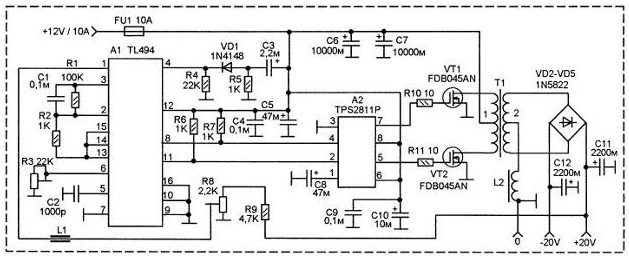
The circuit VD1-C3-R4-R5 forms a soft start circuit.
Weekend-of-phase pulses are removed from the terminals 8 and 11 A1 for submission to output stages, but here they first arrive at the driver output transistors on the chip A2. The task of this chip in strengthening the capacity of these pulses, as there are powerful field-effect transistors with low the resistance of the open channel. Such transistors have a significant capacity closures. To ensure sufficient quickness of opening transistors need to provide more rapid charging and discharging of capacitances them gates, for this is the driver for A2.
On the food chain have large capacitors C6 and C7, they should be unsoldered thick cable directly to the point of diversion of the primary winding of the transformer.
For option, giving a bipolar power supply (as in the diagram) secondary the winding has a tap from the middle. This venting through the inductance L2 is connected to common wire. Diodes VD2-VD5 (diodes-Schottky) made rectifier, giving positive and negative voltages. In the scheme of single-supply the secondary winding has no outlet, and the negative terminal of the rectifier bridge need to connect with a common disadvantage. In this case, if the required voltage 40V the resistance of the resistor R9 should be doubled compared to marked on the diagram.
As the basis for transformer used carefully dismantled and unwound transformer from the power source of the old color TV models 3-USCT. It should be noted that the transformer core is there glued very well and not every attempt to divide it half ends success. In this sense, in my opinion, it is better to have two such transformer (fortunately, unnecessary power supplies MP-1, MP-3, and others now abound). One the transformer is cut frame together with a coil and remove it. Remains the core, which is already without the frame and the winding is much easier to divide and productively. The second transformer gently break up and break the core, so as not to damage the frame. As a result of this "barbarism" get a good one core and one good frame.
Now about the winding. The winding should keep a lot of current, so it is necessary a thick wire. For winding the primary winding is used three times folded the wire sew 0,61. For the same secondary wire, but folded in half. Primary winding - 5+5 turns, the secondary winding -10+10 turns.
Coil L1 is not a coil and a ferrite tube, put on the wire. L2 - 5 turns folded into three sections sew 0,61 on a ferrite ring with a diameter of 28 mm.
Rare transistors FDB045AN can be replaced by others, and the choice is quite high as the maximum voltage of the source-drain not less than 50, current drain 70 and the resistance of the channel 8 open not more than 0.01 Ohm. On such parameters can pick up quite a few candidates for replacement, there is, almost any FET transistor for automotive ignition switches and other things.
Capacitors C11 and C12 for a voltage not lower than 25, the remaining capacitors on the voltage is not below 16 V.
Author: Gorchuk N. In.