The article describes typical fault chargers mobile phones. A diagram of one of these blocks, composed by "live" the model provides recommendations for modifying the output parameters and application renovated unit in Amateur practice.
Currently chargers of mobile phones more common than the phones themselves. On the radio there are a large number used devices (power supplies) at low prices. Among them a lot nonconforming. They are for Amateurs special interest because of its symbolic value. The output voltage unit, as a rule, is significantly different from that specified on the nameplate, and almost completely missing its stabilization.
Analysis of several blocks of different manufacturers showed that they are similar, like twins, not only structurally, but as for the circuit. Similar was the problem.
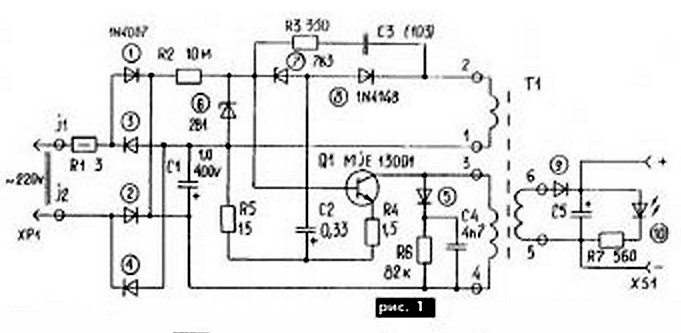
The scheme of one of the variants of the charger of the mobile phone shown in Fig.1. It is composed of "live" sample, so the designation of the positions of the elements conditionally.
When you switch the unit to the network, the led light means the power supply and run in principle worked. Output voltage without load was 5.5 In, and load (incandescent bulb 13.5) fell to 3.5 V. heard weak “crackle" of the transformer in both cases.
The assumption that observed in the transformer breakdowns or a short closure of turns in the coil, was not confirmed. No loss of capacity electrolytic capacitors.
The culprit was a Zener diode, conventionally indicated on the diagram of Fig.1 figure 7. He had a leak and floating options.
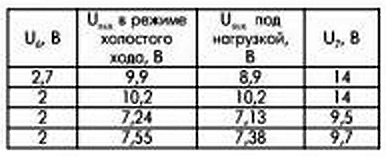
Free space in the housing of the power unit is allowed to be used instead a chain of several series-connected domestic Zener. When this was easily able to obtain other, except for the passport, the values of the output voltage (see table).
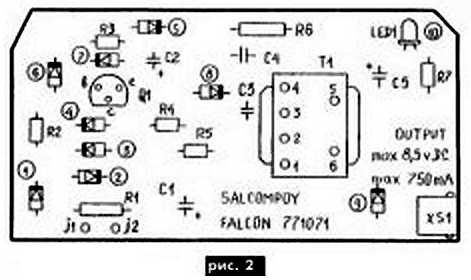
This is probably of interest to radio Amateurs, as so powerful and small-sized power supply, they will always find a use for it. Location items on the Board shown in Fig.2.