



Automotive ignition system is now largely built on the thyristors [1], however, the transistor of the system has not lost its relevance [2, 3]. Recently produced many powerful, including composite, transistors with characteristics that can be used for automotive ignition systems.
The proposed scheme of automotive electronic ignition module was developed and tested by the author in the car "Lada 2108", etc., which use transistor switches (3620-3734) with a non-contact Hall sensor (53.013706).
The difference of this design from standard [2] is that for forming pulses interrupt is used chip CLA connected in the circuit of the Schmitt trigger.
Technical characteristics do not differ from the regular ignition module, but with the use of a Schmitt trigger interrupt pulses are generated with a steeper trailing edge, which allows almost instantly to disconnect the current source from the ignition coil, thereby increasing the high voltage on its secondary winding.
The use of the capacitor C2 provides disconnect the ignition coil from the power source when stopping the vehicle engine, thereby preventing useless heating of the coil.
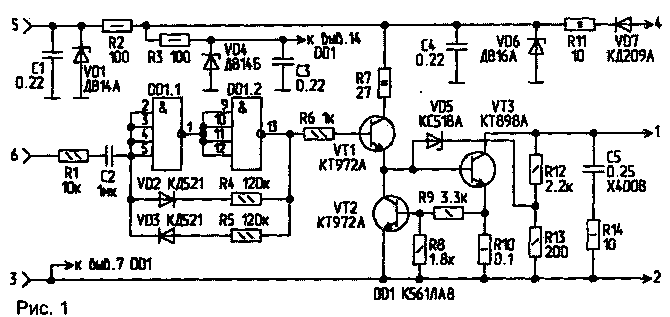
The block diagram of the electronic ignition shown in Fig.1, contains:
diagram of the pulse-forming with adjustable duty cycle on the chip DD1. collected on a Schmitt trigger;
- powerful key on the transistors VT1 and VT3 with active current limiter transistor VT2,the voltage divider resistors R8, R9 and current sense resistor R10;
- a voltage regulator to power the chip DD1 on the Zener diode VD4, condenser NW and resistor R3;
- protection circuit against excess impulse voltage on-Board network on the Zener diode VD6, the capacitor C4 and the resistor R11;
- protection scheme block from wrong attach the battery to the diode VD7;
- protection circuit of the transistor VT3 from pulse overload when working ignition coil diode VD5. the resistors R12, R13.
The circuit operates as follows. When the ignition voltage from the battery is supplied to the circuit via a diode VD7 and resistor R 11. Ignition coil voltage at the initial time is not received, because the starter does not rotate the motor shaft and the input circuit DD1.2 missing pulses. The output DD1 there is a low voltage, which keeps the transistor VT1 in the closed state, therefore, is closed and the transistor VT3.
When the starter turns the motor shaft, the sensor output pulses occur flowing through C2 to the input of the element DD1.1. Last switches, and the output DD1.2 pulse appears, which opens the transistors VT1 and VT3. Through the ignition coil current flows, and in the magnetic field of the coil accumulates electrical energy. In the next moment, when the output of the sensor disappears pulse of positive polarity, the Schmitt trigger sharply reverses the condition, the output element DD1.2 appears a low level received at the base of the transistor VT1. Transistors VT1 and VT3 quickly closed and the current flowing through the ignition coil, also disappears quickly. In this case, the primary winding coil is induced EMF of self-induction voltage of 400 V, and the secondary winding of the ignition coil there is a high-voltage impulse - 23000 25000…V.
In a powerful manner to transistors VT1 and VT3 apply the scheme actively limit the current in the ignition coil, which protects the transistor VT3 overload and stabilizes the current magnitude of the"gap"at fluctuations of the supply voltage vehicle electrical system, thereby ensuring the constancy of the output characteristics of the ignition system [S].
Unlocking the transistor VT1 output transistor VT3 is saturated, providing a low residual voltage at the output of the electronic ignition unit. While the current flowing through the output transistor VT3 and talisma measuring resistor R10 included in its emitter circuit, below the acceptable rating level, the transistor VT2 is locked.
Upon reaching the output current limit level,the transistor VT2 starts to open, and the potential at its collector is reduced, which reduces the amount of current management. The transistor VT3 when it comes out of saturation mode in active mode, the output voltage increases to a level that supports the specified voltage limits. In case of exceeding the pulse voltage in the ignition coil, it is through the divider R12-R13 is applied to the Zener diode VD5, which when opened, it locks the transistor VT3. Chain C5-R14 connected in parallel to the output the transistor is an element of the oscillating circuit impact excitation, i.e. determines the magnitude and slew rate of the secondary voltage produced by the ignition system. Resistor R14 limits the capacitive current through the transistor VT3 at the time of unlocking the latter, if the capacitor C5 is discharged. Structurally, the electronic ignition unit is made on a printed circuit Board (Fig.2) from unilateral folgero-finished fiberglass size h mm, on which are mounted the elements of the scheme. Fees are determined in the standard case from the switch 3620-3734.
In electronic ignition module used chip CLA and resistors MLT. Resistor R10 C5-16 capacity of not less than 1 watt. The capacitors K73-11, for a voltage not less than 63 V. the Diodes VD2, VD3 - KDA or any silicon thin. The Zener diode VD1 is the voltage stabilization 8 In, type DA or CCA. The Zener diode VD4 - on voltage stabilization 9 V, type DB or CSA. The Zener diode VD5 - XA or CSG. Diode VD7 - type CDA, you can replace the diode CDG. Transistors VT1, VT2 - CTA; VT3 - CTA or CTA (CTA). VT3 is set on a standard radiator aluminum plate having a thickness of 4 mm, isolated from the body double mica strip with thermoprotei paste.
To establish unit applies a sound generator with a frequency of from 30 to 400 Hz, simulating the operation of the sensor switch. To obtain the output signal voltage 7…9 V, if necessary, it is necessary to make the power amplifier transistor KT815 [4]. To view the pulses do any oscilloscope, better two-beam. In addition, the necessary power supply with adjustable voltage from 8 to 18 V with a current of at least 10 A.
At the time of configuration schemes you can do without the ignition coil, load collector of transistor VT3 on the throttle with the magnetic circuit of the electrical steel plates inductance of 3.8 mH, resistance 0.5 Ohms. You can use unified low frequency inductor type D 179-0,01-6,3. Generator-sensor simulator pulses connected to the input of the circuit and observe on the oscilloscope amplitude and shape of the output pulses.
The change of the resistances in the circuits VD2-R4 and VD3-R5 to adjust the duty cycle so as to regulate the actuation and de-actuation of the ignition coil.
To set the desired current limit of the oscilloscope is connected to the emitter of the transistor VT2. In the emitter circuit of the transistor VT2 is necessary to temporarily connect a resistor 0.1 Ohm. Changing the voltage on the power supply, see the appearance of the signal at the emitter. Adjusts the current limitation is performed by resistors R12 and R13. After presetting circuit installed in the vehicle in accordance with the wiring diagram [2] and produce its final configuration.
Literature:
1. Lomakin L. electronics behind the wheel. Radio, 1996, N8, P. 58,
2. Starks V. Transistorized ignition system - Radio, 1991, N9. P. 26-29.
3. Bela Boone. Electronics on the car. - M.: Transport,1979.
4. Cars "Lada 2108" and their modifications. And repair of the device. - M.: Transport,1987.
5. Utt V. E. electric vehicles: a Textbook. - M.: Transport,1989, s.
6. V. sydorchuk E-octane-corrector. Radio, 1991, N11, P. 26.
Author: G., Skobelev, Kurgan; Publication: N. Bolshakov, rf.atnn.ru