



The lighting desktop many simple approach: that will screw me the bulb is more powerful. The result - "no cause" blurred vision, development visual fatigue, decline in health, the signs of sitophobia (photophobia). And it never occurred to us, malaekahana that to create a proper light comfort long-established mass production of a variety of lamps with variable brightness, among which occupy a worthy place in particular, and sconces floor lamps with built-in dimmer switches.
However, provided by the market light comfort is not cheap. But health each more expensive and this is a first! Secondly, it is not necessary to buy everything ready. Because you can exercise and thrift, providing existing devices lighting improvised electronic regulators collected, for example, by shown in Fig.1 the circuit diagram with a minimum number radio component.
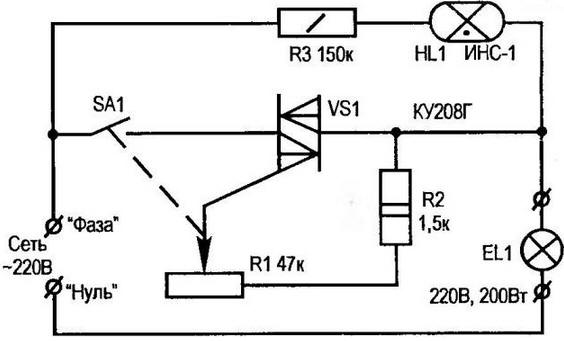
Fig.1. A circuit diagram of a homemade device for adjust the brightness of the lamp
Incandescent ЕL1 is connected here to a household 220-volt network via triac VS1, the mode which is defined in this technical solution value the total electrical resistance of resistors: variable R1 (primary) and constant R2 (backup). Minimum 1.5 kOhm, typical situation, when the "resistor" is brought to zero, create the conditions under which the current through serially connected to the triac and the filament lamp maximum (Fig. 2A). Accordingly, the maximum and the brightness of EL1.
With the rotation of the rotor of the AC (primary) resistor of the above-mentioned General electrical resistance increases, and the mode of operation of the triac is changed so that with increasing numerical values R1 (R2 safety remains unchanged) begins to shorten the time of passing a current through VD1, through the filament ЕL1 (Fig. 2B,2C). This reduces the brightness lamp.
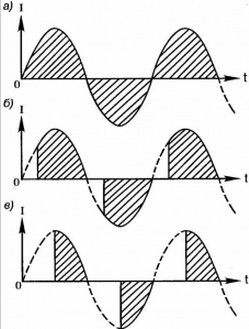
Fig.2.The shape of the current flowing through samestore causing the glow filament lamp filament at "zero" (a) slightly (b) and maximum (in) turn the knob of the dimmer slider of the variable resistor R1
A more detailed account of the operation of the triacs subject of many publications, and linger now this is hardly helpful. And other features of the considered technical solutions it is useful, probably, to note the presence simple, but very useful (from the point of view of the operators) electrical circuit: neon lamp НL1 with an additional 150-kiliany resistor. This is a kind of mini night light that helps when you haven't lit the lamp (be the sconces, floor lamp or even a chandelier with adjustable filament lamps) quickly and accurately find the switch on the wall. And the Wallpapers are invariably clean around keys with "neonai", orange glow in the dark!
As already stressed earlier, details for the proposed IED it takes a bit, they are compact, easily embeddable in any lighting the valve, therefore, no PCB is required. Mounting - hinged, well familiar, perhaps, to everyone from school physics course.
Control the brightness of the lighting is possible without any problems to post in the terminal block of the switch, with on its cover (front) handles variable resistor R1, combined with the switch SA1, and eye "Naoki". No nitroacetophenone operations for correctly assembled device not 'll need.
Literature
Author: K. Vashchenko