



Yellow, almost sunlight pours lying under a table lamp book. To read easy and pleasant; but after an hour and a half, and you notice that this colors start to get bored. To rectify the situation is very simple: you turn the knob-knob color shade gradually changes. From the solar spectrum, you can choose any from red to dark blue, and you can change not only the color itself, but also its richness.
So I developed a filter for the light. The principle of its actions are based on subtraction subtractive colors, but the basic difference from many others in that dyes of three colors - yellow, Magenta, and blue - I applied liquid.
The filter design is shown in figure 1. A cylindrical housing installed four colorless glass, three of which can move along its axis. Move the glasses is Cam rings. Thus, rotating you can change the gap from zero to maximum between any two adjacent Windows.
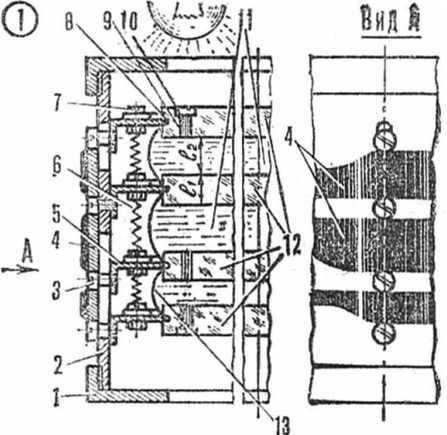
Fig. 1. Device filter: 1 - cover, 2 - body, 3 - correcting screw, 4 - lobe ring, 5 - bracket, 6 - spring, 7 - screw 8 - sealing cord, 9, 10 and casting the hole and the screw-plug, 11 - liquid dyes, 12 - glass, 13 - plastic cavity.
Liquid dyes desired concentration fill the space between the panes. Changing the gap, thereby changing the saturation or, in other words, the density of the corresponding color. Well, as the combination of any two of the three main subtractive colors different densities give all the colors of the spectrum, the total Collier thus determined by the thickness ratio of liquid dye, and saturation - thick layers.
As a dye, I used the solutions of bichromate (Csgo) - (yellow), potassium permanganate Cmpo (Magenta) and blue ink "rainbow" for pens. Their concentrations are chosen at random.
Glass, better organic, have a groove around the circumference, designed for consolidate with it, a plastic bellows, compensating excess volume liquid when approaching the glass. The fur is not hard to make: polyethylene the film is cut the appropriate number of rings, and their edges are welded together heating.
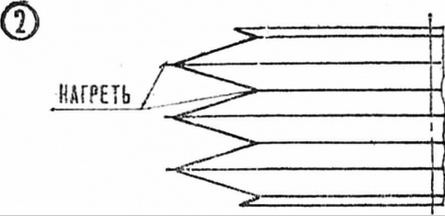
Fig. 2. Device plastic fur
Anyway, that's all. I have deliberately not addressed the issues of installing such the optical filter on the lamp - in each case will be docked be carried out in their own way.
Author: A. Pirogov