



In several publications [1-3] is proposed to use in electrodynamic lanterns ("tracker") instead of incandescent bulbs SuperBright LEDs. For the power of these led "bulbs" recommended vetravati in "bug" rectifier with energy storage (battery or ionstorm) and the node regulating or stabilizing the rectified voltage.
Simple experiments have shown that the inclusion by the circuit of Fig.1,and the led shines without blinking and steadily from one half-wave peremennoy voltage, produced by the generator G1.
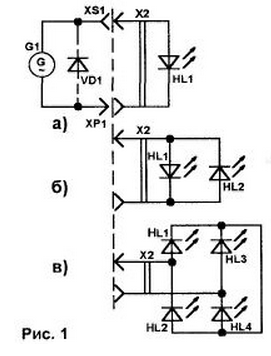
To protect the led from reverse voltage you do not connect the diode VD1, if the amplitude of the AC voltage does not exceed 10, According to [4-6], LEDs can withstand reverse voltage 15.. .20 In and above, and from my "bug" even during intensive operation lever failed the "squeeze" more than 9 V.
Therefore, all alterations are minimized. We only need to make a led "bulb", having built super-bright led in a standard cap from the bulb filament. The required steps are described in detail in [3]. Recommend conclusion the led is soldered to the threaded portion of the cap is not from within but from outside, near a shallow cut made by the needle file in the flange of the cap. Flux at service is half (so comfortable) aspirin. Tin cap is washed with water, wiped and dried. After that, the conclusions of the led molded and soldered to threaded and Central parts of the cap. Preferably to fill the internal cavity of the cap insulator. I used a drop of mounting foam. After polymerization in a day, you can use a "bulb" in the cartridge flashlight and use it as usual.
Not "disappeared", and the second half wave voltage is to include one led, solder it anti-parallel to the first (Fig.1,b). Place in the basement enough. This other option is preferable due to its high light output and uniform loading of the generator. The diagram in Fig.1,also loads evenly generator, but since the LEDs are enabled in pairs in series, at low the speed of the generator (during acceleration) the light illuminates when a higher voltage. This scheme is more suitable for mains operation.
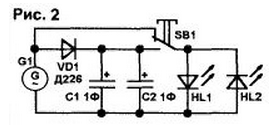
If you use a supercapacitor as the energy storage, it is activated by the circuit of Fig.2.
About the work of supercaps in the "bugs" should say a few words. When charging was discovered that you cannot raise the voltage to the desired instore the level that is called "head". After ultracapacitor "uploaded" charge certain value, the voltage does not rise above, no matter how you try. But worth it only to stop pumping and to take a break of no more than 10…15 C (at this the voltage at instore falls to a few tens of millivolts), as the following the pump is easy to another"obstacle" to overcome which it is again necessary momentary pause, etc. until you reach the desired level voltage instore. Particularly noticeable is the phenomenon when two supercaps. To to raise the voltage up to 4.41 In, it took about twenty such "steps*.
Do you need to raise the voltage on instore to a nominal 5.5 V? I guess not, because it is harmful to inistra. In [7] gives the following figures: at a temperature of from -25°C to +75°C and an operating voltage of 0.6 Unom ultracapacitor is capable of 40000 hours (about 5 years). The conclusion is that at Unom=5.5 V electric double-layer capacitor cannot be charged to a voltage above 3.3 V in addition, the average value of the direct voltage drop on the led is 3.6 V. This is higher than "gentle" 3.3 V to inistra.
On simple expertise it is established that the discharge ioniser on one led (reduction voltage of up to 4.41 In up to 3.33 In) occurs for 1 min, and increased brightness observed the first 10…20 s. After that ultracapacitor is discharged with reasonable light output another 20 minutes. Thus, meaning to raise the voltage on instore above the 3.4…3.5 In there. The table shows the time of discharge from inistra 3,52 In the brightness of led. The criterion of selection was the intelligibility of the newspaper text when illuminated by the flashlight. These figures correspond well with the bit voltages in a battery (two cells of size AA) flashlight electrician in which instead of incandescent bulbs installed one led.

To be mounted in the lamp housing scheme, shown in Fig.2, it will be easier if remove the yoke with the socket of the lamp base. In the rst volume easily are electric double layer capacitors C1, C2 (diameter 18.5 mm, thickness - 5.5 mm), diode VD1 and LEDs HL1, HL2.
Button SB1 (microswitch MP) is placed over the leash, be moved the yoke relative to the focus of the headlights. As a General wire used plate foil stimulated fiberglass. To her right the places are attached by soldering the findings of all components, except the VD1 and SB1.Diode VD1 connects the + terminal of an electric double layer capacitor with a button. The rest of the installation is flexible insulated wire. Board mounted with two screws with countersunk heads to plasticboy the cheek of the generator that protects the rotor with magnets.
Literature
Author: V. Miroshnichenko, Krasnodar