



Network flash lamp for photography are of two types - with a storage capacitor without it. The most widely pulsed light sources with a storage capacitor, as they provide reliability of operation and the constancy of the energy of the flash. However, the light sources without the storage capacitor is much smaller than the interval of time between outbreaks (generally determined by the power dissipation pulsed light), dimensions and weight, and often the cost. Therefore, the flash, without the storage capacitor cause permanent interest of photographers.
Several variants of the network without flash storage capacitor have been described in the magazine "Radio" [1]. The camera flash thyristor, V. Quadrangle can not provide constant power the flash and the reliability of its operation for the reason that the flash point does not always coincide with the maximum voltage of the positive half cycle of the network outputs the flash lamp. Ignition pulse lamp will not happen if the sync of the camera is closed at the moment of transition of the mains voltage through zero, or during the negative half-cycle of the mains voltage on the findings of the flash lamp. 't flash and in the case where the voltage has not reached the threshold of ignition of the flash lamp to the moment of closing the sync of the camera.
In the light source on the thyratrons Winking B. no noted flaws, but it is built on old components - the thyratrons, a neon tube and has a fairly large footprint.
A clear activation of the pulsed light source without the storage capacitor and the constant energy flash easy to secure the introduction into it of the node that synchronizes the timing of the flash lamp with a maximum value of the positive half of the mains voltage on its conclusions, even under arbitrary circuit of sync. Such a node can be a single-shot, consisting of a differentiating circuit and a D-flip-flop [2].
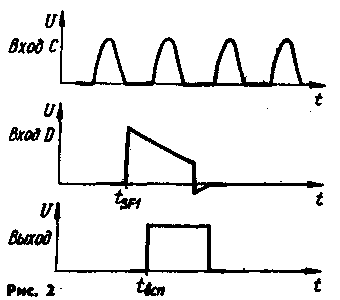
In Fig. 1 shows a circuit diagram of a network without flash storage capacitor constructed on the basis of synchronized single vibrator. With the closure of the synchro terminals SF1 (they are inside the camera, but to review the operation of the device shown here) is charging the capacitor C2. After disconnection of synchro terminals of the capacitor C2 discharges through resistors R5 and R6 and at the information input of D-flip-flop is formed starting impetus. The voltage divider R2R3 to the input of the flip-flop receives the clock pulses representing the positive half of the sinusoidal mains voltage with an amplitude of about 9 V and a frequency of 50 Hz (Fig. 2). As a result, the trigger is switched either immediately, if the starting pulse coincides with a clock or with a delay of a period of clock pulses.
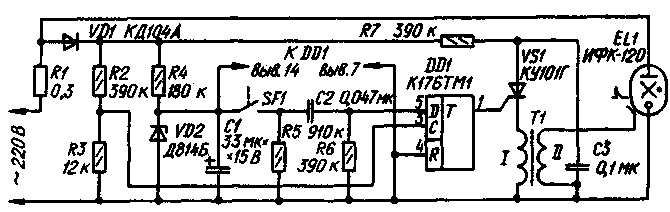
Fig. 1
The output pulse from the flip-flop is supplied to the control electrode of SCR VS1. Through the open SCR and the primary winding of pulse transformer T1 is discharged capacitor C3. The secondary winding of the boosting transformer high voltage occurs, the voltage pulse resulting in ionization of the gas inside the cylinder of the flash lamp EL1, causing it to flash. Resistor R1 limits the current through the flash lamp EL1.
For the manufacture of flashlight is convenient to use the # 1 spare parts for the camera, "Beam-70" factory-built (from use case, a pulsed lamp with reflector and cord to connect to the sync of the camera). All parts of the device, including pulsed lamp with reflector, mounted on the circuit Board. The fee attached to the rear reflector. All items are placed on the edges of the Board.
The resistor R1 is made of nichrome wire of diameter 0,5 mm, wound on a resistor FR-0,5 any resistance, number of turns - 15-20. Pulse transformer T1 is wound on an annular magnetic core TO HH ferrite NM. The winding of I contains 3 coils of wire sew-2 0,31 and winding II - 600 turns of wire PELSHO of 0.1. Must ensure reliable insulation between the windings.
When you solder the cable connecting the flash bulb of the camera, it is necessary that the external output connector sync was connected with the right scheme contact pair SF1.
Properly collected flash build is not required.
In the lamp-flash, which tells article V. Kalashnik, sync SF1 are under voltage. Especially dangerous left circuit output pairs of sync, because striking the current from him almost unrestricted (current from the right of withdrawal is limited by the large resistance of the resistor R5). That's why this flash can only be used in cameras that have synchro terminals are not electrically connected to the housing.
The editorial Board recommends, for the purpose of improving electrical safety, add a flash device to enable the plug into the outlet so that the lower scheme network cable is kept at zero voltage relative to the ground.
This device - a pointer to the phase conductor of the network - consisting of series connected resistor and a neon lamp, it is necessary to mount plug in lamp. The plug may serve plastic Cup with lid from under the cream. It is mounted on the bottom pins, and a neon lamp set from the side of the cover. Free output resistor (MLT-0,125-300 ohms) soldered to the top but the network diagram the output of the flash lamp, and the free output of the lamp (TH-0,2) - to the ring of copper or brass foil, glued to the outer surface of the plug housing.
When you turn on the lamp to take the plug in your hand so that your fingers touch the ring, and is inserted into the socket. If the neon lamp is lit, the inclusion is considered correct, if not, the plug should be removed, rotated 180° and re-inserted into the socket - lamp is lit. In this position the fork work with a flash unit is the most secure. Only now you can insert the plug of the connecting cable into the sync socket of the camera.
In conclusion, we note that the above measures are in any case are not exempt from fulfilling all the rules precautions when handling electrical installations.
At the same time we offer our readers to think and to offer for publication in the journal options network flash, possessing all the useful qualities described here, but with the full "decoupling" from the network both pins of sync.
Literature
Author: V. Kalashnik, G. Gheorghiu-Dej, Voronezh region; Publication: N. Bolshakov, rf.atnn.ru