



The device proposed by the author, is a night light with independent power and led as light source to turn on and off which can acoustic signal, for example, cotton in the palm. To place it easy in any convenient place, so it will be useful for tourist trips, a hike and other cases, since it can perform the functions of the lamp, and also will find used in various games and competitions "clap louder", etc.
Diagram of the device shown in Fig. 1. It consists of a microphone WM, pulse shaper transistor VT1, single vibrator on the trigger DD1.2, countable trigger DD1.1 and switch on the transistor VT2. Source light used led EL1 increased the brightness.
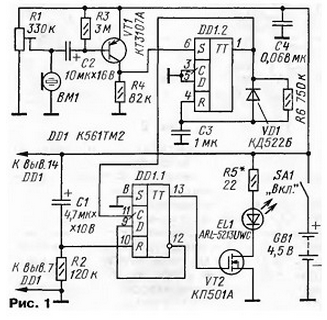
The device operates as follows. After power up, the capacitor C1 is charged via the resistor R2. At this point on the resistor - high level, which is fed to the input R (pin 10) D-flip-flop DD1.1 and sets the low level on its direct output (pin 13). Transistor VT2 is closed and the led EL1 de-energized. Transistor VT1 is also closed and its collector low.
Now if clap hands, then at the output of the microphone WM bursts appear voltage across the capacitor C2 arrive at the base of the transistor VT1 and open it. Collector current increases, and the load - resistor R4 - is formed one or more (depending on the duration and nature of cotton) pulse amplitude close to the supply voltage. The intensity claps in the palm is not always constant, so the resistor R4 and one cotton you receive a different number of pulses. To counting trigger DD1.1 switch once each time the cotton, in the device, enter the single vibrator.
The pulses arrive at the input S (pin 6) trigger DD1.2 and mounted on his the direct output (pin 1) high level, thereby triggering a single-shot. Through resistor R6 starts charging the capacitor C3, and as soon as the voltage across it exceeds approximately half of the supply voltage that will be interpreted by the entrance R trigger DD1.2 as a high level, the trigger will be returned in the condition with low the level of the direct output, and the capacitor C3 is rapidly discharged through the diode VD1. On the output of the single vibrator is formed by a voltage pulse with duration T, determined by the resistance of the resistor R6 and the capacitance of the capacitor C3:
T = 0.7*R6*C3, where the capacitance of the capacitor C3 is in microfarad and the resistance resistor R6 is in megohms. For these in the scheme of the values of the elements - about 0.5 s.
The momentum of a single vibrator will arrive at the input of D-flip-flop DD1.1. Since the inverting output (pin 12) DD1.1 is connected with the information input D is turns it into a counting trigger. Therefore, the pulse front of the single vibrator he switches to a state with a high level of the direct output and to the gate of the transistor VT2 will do the opening voltage, the resistance of its channel sharply will decrease and the led EL1 begins to Shine. The duration of formed the single-shot pulse is several times the length of the cotton, so a shift will occur once one cotton. If now again clap the palm, then a single-shot again generates a pulse and counting trigger switches, but this time in a low state, the direct output, the channel resistance of the transistor VT2 will increase and the led EL1 goes off.
All parts of the device except the battery and the switch, are mounted on the circuit Board of one-sided foil fiberglass with a thickness of 1…1.5 mm, depicted in Fig. 2. Board is placed in the housing of suitable size for where you set the switch. In the housing opposite the led and microphone make holes.
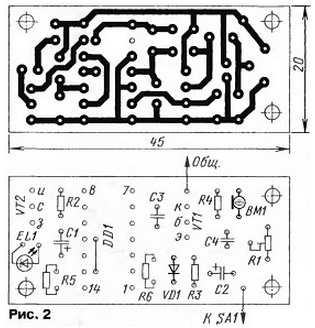
In the device used resistors R1 - SDR-38A, and the rest of the IFL; capacitors C1, C2 - oxide K50-35 or similar imported; C2, C3 ceramic K10-17, km-6. The diode can be applied to any silicon series CD, KDUS, CD, CD, KD521, KD522; bipolar transistor - CT with any letter index. Instead of a field-effect transistor KPA suitable CPB or its functional analogue - chip CKT. The microphone WM - electret, for example XF-18D. Switch SA1 - small-MTB-102, SMTS-102 or similar. Except as provided in the scheme, you can apply ultra-bright white light emitting diodes ARL-5013UWC, ARL-5613UWW, green - ARL-5213PGC, red - ARL-5613URW or similar.
To power you can use a galvanic battery 3R12G or battery of three series-connected electrochemical cells or batteries sizes AA or AAA. In the stationary embodiment, the suitable AC adaptor, preferably stabilized with an output voltage of 5 V. In this case the device you need to install a Jack for external power source. The current consumed by the device in standby mode (when the led shines), does not exceed 0.25 mA. It keeps working when reducing the supply voltage to 3 V, but depending on the type of led brightness may significantly decrease.
The establishment of a nightlight is to install trimmer R1 the voltage at the microphone within 0,7…1,3 V. because the microphone has VM built-in amplifier, by changing its mode DC, you can modify sensitivity. The desired value of the current through the led, and hence the brightness its glow will be set by selection of resistor R5.
Since the device responds to acoustic signals, when loud music the led will periodically blink with a frequency of about 2 Hz. Therefore nightlight can serve as an indicator of exceeding the permissible noise level. In this case led EL1 should use a red glow. Interesting the use of the device can be found in various competitions, contests where the parties shall alternately with two or three attempts to light (and pay off) the led clapping in the palm. The winner is the one who will manage to do it with the greatest distance. From the editor. It should be noted that in the extreme positions (see Fig. 1) engine resistor R1 microphone sensitivity drops sharply. To when adjusting this, between the engine and the microphone must to install a resistor of 5.1…10 kOhm.
Author: A. Oznobishin, Irkutsk