



Usually to improve the efficiency of flash bulbs used breakdown of generation Converter voltage of the power source at the moment of reaching an output voltage of a predetermined value. The main disadvantage of this method is that the transistors of the inverter after the collapse of the generated oscillations remain connected to a power source. The transistors at this time closed, but the presence of the initial collector current, high-power transistors used in the inverter reaches several tens of milliamps, leads to unnecessary consumption of the power source. For example, the initial collector current of transistors PB may be equal to 20-40 mA. In the push-pull Converter total current will be 40-80 mA, i.e. during the interval between the flashes is spanned 30 min 0,02-0,04 A-h, i.e. almost 10% of the capacity of one battery 3336L.
This drawback can be eliminated by collecting the Converter in the circuit shown in Fig. 1. The peculiarity of it is that for a given level of output voltage through the relay R1 is disconnecting the inverter from the power source.
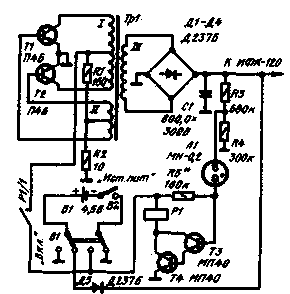
Fig.1
When installing the V1 switch in the "On" position at cascade, assembled on a composite transistor T3, and T4, the supply voltage is connected and both transistors are opened. Through the relay coil R1 current to flow, and it works through the contacts R1/1 will give a voltage on the transmitter is assembled on the transistors T1 and T2. The storage capacitor C1 begins to charge. When the voltage across it will increase to about 300 V, lit neon lamp L1 and the divider R3R4 positive voltage through the lamp will go to the base of transistor T3. The transistors T3 and T4 is closed. The relay coil abastecida and contacts R disconnects the inverter from the power source. As the voltage on the capacitor C1 due to the self-discharge will fall to such a level that the lamp L1 is off, the transistors TK-T4 will open again and come back Converter. The same thing will happen if the discharge of the capacitor C1 during the outbreak. Thus, in the absence of generation in the described embodiment, the Converter current consumption from the power source is still almost only the collector current of the transistor T4, amounting to fractions of a milliampere.
The transistors TK and T4 in the device may be any low frequency. Relays R1-RES-10 (RS4.524.304) or PCM-2 (10.171.81.58). Transformer TR1 is not different from that used in converters for flash bulbs.
Lamps-flashes the Converter operates at a very large capacitive load, resulting in a mode at power on is very busy, delayed the process of charging a storage capacitor, which leads to additional energy loss of the power source. You can significantly alleviate the mode of operation of the Converter at the initial time and at the same time to speed up the process of charging the capacitor. if you reduce his rastormojka charging before switching Converter to a voltage, for example, before the voltage of the power supply.
To ensure that such a regime switch Q1 (see Fig. 1) mounted in the position indicated on the diagram. The power source V1 through the diode D5 is connected to the storage capacitor C1. Diode D5 is intended For protection of power source voltage from a partially discharged storage capacitor during shutdown of the Converter.
Significantly more cost-effective flash lamp powered by AC power. However, they have the disadvantage of the presence of voltage on the camera body, and an associated risk of electric shock.
It could be fixed insulating body of the camera from the mains separator transformer. In this case, the voltage for charging a storage capacitor is removed from the secondary winding of the transformer. The disadvantage of this method is that the transformer must have a large size due to the high isolation requirements and are designed for relatively high power, so that the charge storage capacitor is small, and the charge has been made fairly high current. This drawback can be avoided if the charge on the capacitor to produce directly from the mains, through a transformer to charge the capacitor of the ignition, thus dividing the body of the camera and the network. The layout of such a flash lamp is depicted in Fig. 2. Transformer TR1 in this case may be significantly smaller dimensions (any low step-down ratio of turns of the primary winding to the secondary 10:1). The other parts and transformer TP2 is common, used in lamps-flashes.
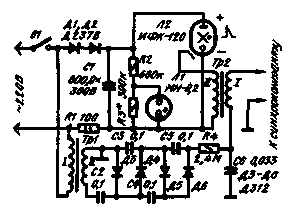
Fig.2
Author: Kovalev, Klimovsk, Moscow region; Publication: N. Bolshakov, rf.atnn.ru