



It's no secret that the halogen lamps used in cars, often overlook down. This occurs as a result of inrush current, inevitably arisen once turned on, when the spiral filament is still cold (cold) state.
For example, "halogen" fog lights are designed to work in normal mode with a consumption of 55 W of power (at 12V supply). In according to known to every schoolboy-law for high school student an electrical circuit, the resistance of the filament should be about 2.6 Ohms. And in fact this is true, but only when heated filament. The cold lamp the resistance measured with an ohmmeter, a little more than 0.2 Ohms. This means that in the moment you turn this "Halogens" it will inevitably take place 60 amp inrush current!
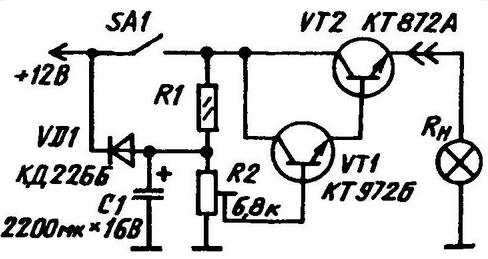
To extend the life of incandescent bulbs in the low voltage network and 's meant my proposed device. Time modulating heating output lamp working temperature - dependent resistance of the resistor R1 and the capacitance capacitor C1. Under these scheme, the value does not exceed 2.5 s.
The saturation voltage of the composite transistor VT1 - VТ2 you can install regulation of the rotor resistor R2. This allows you to pick the correct time release mode (depending on power load) in the range from zero to the maximum delay.
The choice CTA as power semiconductor triode is not accidental. This the transistor is produced by NPO "Transistor" (Minsk) able to withstand for a long period of time, a large inrush current during 1 to 10 A. For optimal performance in our scheme, it needs to be installed along with CTB on a common heat sink area of about 100 cm2, while the current consumed by the lamp, to 6 A.
If the switch SА1 replace bridge and in series with the resistor R1 enable microtuber or microcopy, then there is the added convenience - the lack of a power switch. His role now will be to perform the power transistor.
Due to the small size of the parts used in this device, printed the fee is missing. The entire Assembly is hinged manner (safe and well familiar with each school's laboratory works on physics).
Author: A. Filipovic