



Night duty or (with reduced brightness) illumination, allowing at the same time significantly increase the service life of the lamps, can be implemented in different ways. Among a simple and reliable method using a quenching capacitor in the circuit power supply (Fig. 1). In this case, the capacitance C1 is calculated as reactive resistance to obtain the desired voltage across the lamp ЕL1. The Resistor R1 required for capacitor discharge after disconnecting the circuit from the network. Its denomination is taken in the range of 100-500 ohms.
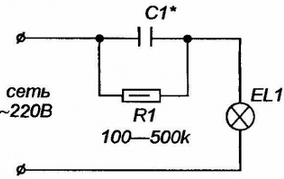
Fig. 1. A circuit diagram of night nln duty (reduced brightness of illumination, allowing at the same time significantly increase the lifetime lamps with the introduction of additional capacitive resistance
Due to the nonlinearity of the active resistance of the filaments and real the scatter of the static parameters of the lamps, the exact computation of capacity capacitor C1 is quite difficult even for experienced specialists. However, the calculations can be significantly simplified if we use approximate formulas. In particular, for an electrical circuit with low voltage and low-power incandescent lamps (switch, light, flat and other voltage 10-42 V and current up to 0.5 A) calibrated perfectly acceptable practice, the ratio of:
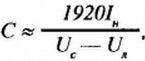
where: With - incremental capacity (quenching) of the capacitor, UF; IR is the rated current lamp, A; Il - the voltage that I want to get to the lamp, In; IC - voltage mains AC V.
When using standard light bulbs on the light socket or the bulb specifying a nominal operating voltage (usually 220-240V) and power consumption (10-200 W), the coefficient in the numerator should be reduced to 1150, and I n be found using known to everyone at school by law Ohm.
As practice shows, the capacity of the quenching capacitor is in any case better count providing to the lamp to half of its nominal voltage. For example, if u n is 24 In, Il, it is recommended to be equal to 12 V. Found approximately the value of C1 is subsequently specified - depending on the desired brightness of the lamp. Not to forget about nonlinearity the resistance of the filament, leading to the fact that a slight increase the extinguishing capacity of the capacitor can sometimes cause a sharp increase in voltage across the lamp, and reduction threatens almost abrupt decrease in the Silt.
In order to further simplify the procedure of calculation and selection extinguishing electricity consumption is recommended to use ready data (table 1), verified in practice for some types of lamps when connected to the home network (220 V, 50 Hz) in accordance with the above scheme.
Table 1. Recommended values of damping (incremental) containers for turning common types of bulbs to ultra-reliable operating in 220 volt outlet when the notoriously low voltage filament
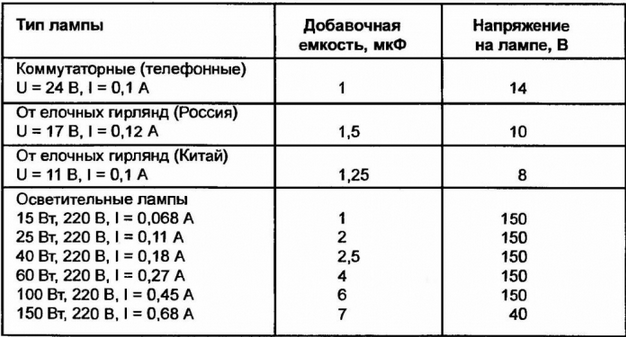
It is useful, I think, to emphasize that the blanking voltage using capacitors really can significantly increase the lifespan of the lamps with a rather a slight decrease in brightness. Besides this technical solution (unlike classical circuits for power semiconductor diodes) does not to irritating 50-or 100-eravamo the flickering of the lighting…
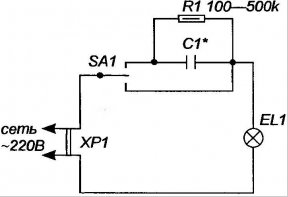
Fig. 2. Ordinary table lamp can serve as a nightlight, thanks a small revision with the use of the quenching capacitor
Additional benefits and services can be obtained if embed extinguishing (extension) the capacitor corresponding to the capacitance in a conventional table lamp, several altered her scheme of inclusion (Fig. 2). However, it will have to replace the regular two-pole toggle switch-button SА1 three fixed positions.
Author: M. Garcev