



In this article we will talk about the lighting and the correct distribution of sources light.
So the apartment was always light, you need to remember a few small rules:
a) if you allow the size of the property, the room walls must be painted in a light tone (this rule should be run, and when pasting Wallpaper);
b) to keep the room more light (especially if you overlook the North side), it is recommended to use lace curtains white or delicate pastel shades (pink, light yellow, light green, etc.) as they very well reflect sunlight;
in order to create a complete artificial lighting conducive psychological comfort, it is necessary to know how to use different sources of artificial lighting: chandeliers, lamps, table lamps, sconces and etc.;
g) that glasses good at reflecting sunlight, they should be kept clean. It should be remembered that through the clean glass into the apartment comes much more light.
But in the early twenty-first century life is impossible without artificial light. But it is unlikely have you ever wondered what great role in life is lighting of the apartment. And meanwhile it is not only common thread between day and night, but one major psychological and hygienic factors of a normal existence. The problem of artificial lighting is very important in the development of the design of the residential of the room. It has not only aesthetic but also psychologically. When the lighting design for each room and the entire apartment as a whole need to remember that each light source creates comfort for the eyes, contributing the most supportive environment for recreation, performing work, etc.
Light and color, able to increase or decrease the size of the room. For example, in order to reduce the size of the room, with the development of light and color decisions need to prefer warm tones. If the room is small, then increasing it is possible to use fluorescent lamps or conventional bulbs bulbs with lampshades (lamp shades) cool shades.
The aesthetic function of lighting is to make the lighting match the furnishing of the room, its color scheme and other design elements. Should know that the lighting design of the dwelling is able to affect the state the human health. The wrong lighting can cause headaches, increase fatigue, increase heart rate, affect the metabolism. Very bright light is harmful for the eyes, as it can cause psychological discomfort. In addition, irrational distributed light sources in some cases are able to trigger some allergic reactions, such as conjunctivitis. So way light can affect not only the sensation of color, but also to promote the creation of a working environment, spirituality, etc.; they may, however, cause painful conditions and psychological dissatisfaction. Light distribution always depends on the purpose of the room. It can be Central (typically, the lamps hanging from the ceiling) and local. Each of these types of lighting has a specific purpose: Central covers all room, local places for work or leisure.
In the previous Chapter it was mentioned that all light sources are divided into the lamp incandescent and fluorescent lamps (CFLs). Incandescent bulbs may vary not only power, but also color emission, shape, etc. In Central (General) or local lighting they can be used in various residential spaces.
Fluorescent lamps have a more limited application than the lamp filament. They vary in shape and defined purpose and often used for local lighting and General lighting in kitchens, utility or industrial premises. Fluorescent lamps consume far less energy than incandescent bulbs, so their use is more economical.
There are details that create preconditions for harmonious lighting residential of the room.
Lighting of premises for the intended purpose is divided into several types:
(a) orienting;
b) working;
b) decorative. Orienting lighting
This view is used to illuminate the entire area of the dwelling. Used incandescent lamps greater or lesser power and fluorescent lamps (lamps daylight).
They can be placed in the hall, living room, bedroom, children's room, kitchen, sanitary node, hallways and other living spaces.
Fluorescent lamps are recommended as orientation light in kitchens, the corridors and adjacent rooms. In some cases, fluorescent lamp used for bedroom lighting. This is because they dissipate soft matte color that calms the nerves and eyes. Working lights
This kind of lighting is designed to perform a particular activity. As a rule, as a working used local lighting. It can be used in the bathroom and the living room, bedroom, children's rooms, kitchens, corridors and hallway. In those places where it is planned to create working light, in depending on the nature of jobs you can apply lamp accent lighting, to stream of light fell only on the workplace. Decorative lighting
This kind of lighting is designed to use lighting and colors lamp to highlight in the room an area in the interior: a corner, a table with beautiful vase, picture, curtains, Drapes, etc. it is Sometimes called exhibition (from lat. expositio - "flaunt it"). For decorative lighting use a variety of table lamps with colorful lampshades, wall sconces and other fixtures. In recent years it has become fashionable so called multicolor rotating lamps that create comfort in the room and intimate atmosphere.
One of the main components of the optimal lighting solution is the correct one the distribution of the bright areas of light in the room, as well as the intensity light selected portions. It lies in the compatibility of luminance and the color of the solution of the object or area of the room. When designing the lighting particular room you should remember that it should go in the direction from the ceiling to the floor, and not Vice versa. This is due to the psychological perception levels light. Otherwise, it will facilitate the emergence of visual discomfort and cause irritation. The brightest area of the room must be a ceiling, which, as noted above, it is necessary to paint, or whitewash to paste materials of light tones. Walls can be darker, in accordance with the dimensions of the room and its interior. The darkest part of the room could be her the floor, painted in dark paint, covered with linoleum or covered with carpet. Thus, a greater or lesser illumination of the room depends not only on the location and the intensity of light and its colors, interior and other design elements. Another important element in the development of lighting solutions living room is the ability of different objects reflect light. The entire luminous flux is divided into direct and reflected lighting.
Direct lighting is to hit the light beam illuminated
surface. Indirect lighting has the ability refractions of light. It main characteristic is the reflection of a light beam from any surface. It must be remembered that less refractions of light have rough, unpolished objects, as well as carpets, rugs, etc. From all interior, perhaps, only the polished products are most clearly able to reflect the light. So they seem lighter than it is fact.
In addition to proper distribution of the bright areas and the ability of light reflection those or other subjects of great importance in light of the decision of the dwelling is the difference between pale and bright patches of light. It is especially important in the rooms designated for mental work. For example, in order to avoid visual and emotional exhaustion, it is necessary that in the room reigned a small Central lighting, and the place of work additionally highlighted Desk lamp, the light which fell directly on the book, manuscript, etc in addition, the lampshade for a table lamp, you should select these colors, are less likely to irritate the eyes. Among them is the most favorable green, because it is useful for the eyes and does not cause fatigue. Need remember that the brightness of the light source may depend not only on its color, but on the level of incandescent lamps. If it has more power, dissipates more bright light than a lamp with low power. This can to use when developing the design of the residential premises. For example, chandeliers and the lamps, distributing yellow color, will highlight the warm colors of the spectrum (red, orange, yellow, brown and shades), and cool-spectrum color (blue, blue, green and shades) will visually fade, to become discolored, that is, change its original color to a more neutral. Therefore, when choosing the color scheme of the apartment it is necessary to think in advance about light sources that all the elements harmonize with each other. Another an important aspect in the design of lighting a living space the ability of objects to cast shadows with directional light. Need note that the lighting is of two types: direct and indirect. Direct lighting with his ability to tenebrioninae reveals a clear boundary surfaces interior.
The main advantage of reflected light is the creation of muted lighting, which, as a rule, not able to tenebrioninae. To the distribution of light and shadow plots was uniform, it is recommended use not more than two light sources. One they must be direct and the other indirect. In addition, it is desirable that when additional lighting (especially when three or more light sources) light rays do not intersect. Otherwise, such coverage will be promote a feeling of discomfort and cause irritation. And now a little about the lamps that have an important place in the interior design and lighting the decision of the dwelling.
You must know that all the lamps are divided into several groups:
a) lamps for General lighting;
b) the local lighting fixtures;
b) combined lighting fixtures.
To lamps for General lighting (Fig. 68) include various mnogolampovoy chandeliers or gas-lamps fitted with one canopy.
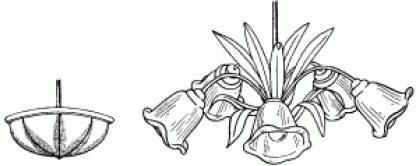
Fig. 68. Lamps for General lighting.
Lampshades for lamps produced from different material: crystal, transparent or frosted glass, heat-resistant plastics, etc. Their goal is uniform dispersion of light over the entire space of the room. The shape of the lamps, as a rule, depends on the nature of light dissipated.
It should be remembered that the nature of the scattered light all lamps for General lighting are divided into 5 categories:
(a) direct lighting fixtures;
b) lamps primarily direct light;
C) the lamps evenly diffused light;
d) lamps primarily reflected illumination;
d) the lights of the reflected light.
Lighting local lighting (Fig. 69) can have very a variety of forms.
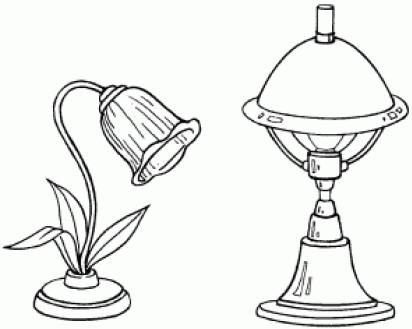
Fig. 69. The local lighting fixtures.
They are issued in the form of table lamps, single lamp or dual lamp wall sconces, floor lamps, etc. Their aim is the diffusion of light in specific functional area: on the desktop, place for reading in the living room or the bedroom, in the kitchen.
Among the local lighting lamps, the great demand for such lamps, parts which can move and change its position, resulting in there is a change in direction of light flow. These lamps are very comfortable, so depending on settings, they can spread to both direct and the reflected light (Fig. 70).
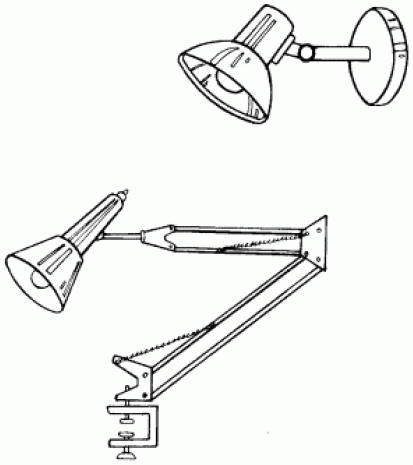
Fig. 70. Lamp.
Lighting combined lighting can simultaneously be used for General and local lighting (Fig. 71).
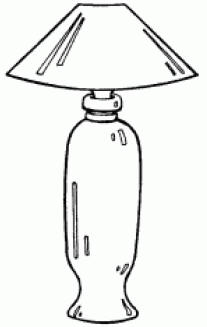
Fig. 71. The combined lighting lamp.
They can be table-top and wall, involve the use of a lamp bulb high power and large scattering matte-white or colour the lampshade. As they are able to perform a decorative function, they often do of various expensive materials.
For example, the industry produces lamps, the base of which is semi-precious stones, organic glass, special alloys, plastics. The shades of these lamps produced from opaque white or colored glass, printed cotton, silk and other fabrics. Typically, these lamps are beautiful, they are often used for decoration of the interior rooms.
As noted above, in some cases, the design and lighting the solution dwelling a large space is devoted to the exposition and mind decorative lighting of the room. To do this, use a different wall or table lamps combined.
In addition, to illuminate separate areas of the room, there are special low floor lamps with mobile or stationary direction the light flux.
Let us consider some examples of lighting solutions separate rooms. In the hall or the living room is quite possible to use a bright light to use mnogolampovoy chandeliers and other light sources. A place for reading and other activities can be decorated decorative table lamp, wall lamp etc In the bedroom light should not to be very bright and annoying. In order to physical and psychological comfort as a local light source above the bed for each family member it is recommended to hang decorative sconces. Same sconces can be used to additional lighting mirrors, trellis, etc. In the office or in a specially equipped part of the bedroom, in addition to the main light source, suspended from the ceiling, it is recommended to equip and also any local lighting (e.g. Desk lamp).
In the kitchen it is recommended to use as a Central lighting (on the ceiling) and local (sconce, table lamp, etc.).
Bathroom and toilet is recommended to cover both Central and local the light sources. In the corridors and hallway recommended sources lights suspended from the ceiling or attached to the wall.
Thus, the right combination of Central and local sources lighting, General, local and decorative lighting can create a cozy, psychological comfort, but also to emphasize the dignity of the interior. Zoning the room with different lighting may depend on the nature refractions of light and the use of multi-colored lamps. By nature refractions of light, the light can be directed right and diagonally. Different the direction of flux creates a sense of the emergence of several the functional areas.
The room can be divided using a variety of fixtures. So, in place for recreational reading, you can set color decorative lamp, and the rest the space of the room lighting by using a common (Central light).
Author: Corser N. G.