



Small rural settlements and gardening Association fed complete transformer substations. The function of automatic lighting control performs them in the photo relay FR-2. This the device is unstable: the time of turning on and off lights depends markedly from the voltage and the ambient temperature. Author of published article has developed its own version of the machine, and offers to meet our readers.
The automatic lighting control (AVO) consists of a photocell (photoresistor), electronic unit and power unit. In the electronic unit (see figure) includes Converter on transistors VT1, VT2, the amplifier transistors VT3, VT4, Executive relay K1 and device lock ("debounce").
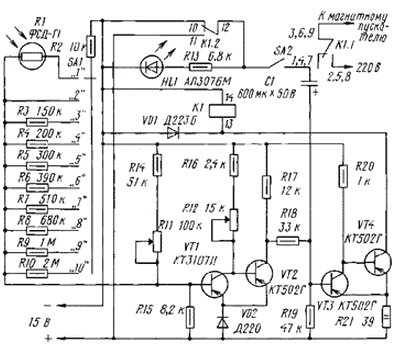
The electronic unit is mounted on two printed circuit boards dimensions h mm, installed one above the other at a distance of 40 mm. mounted On top of the Board the switch SA1 fixed on its conclusions, the resistors R3 - R10, the variable resistors R11, R12, relay K1, capacitor C1 and diode HL1, and lower all other details.
The photoresistor is placed on one of the vertical walls complete transformer substation (KTP). Dusk falls the light flux with sky. Increase the illumination of the photoresistor by installing the reflector from stainless steel or plate glass at an angle of 45° to the vertical wall KTP at this distance from it, so in the winter the snow does not linger and reflector not blocking the access of light to the photoresistor. It will also protect the photoresistor from the direct rays of the Sun that can incapacitate him, as well as from light car headlights or street lights, causing false operation of the machine.
In AVO applied photoresistor FSD-G1, fixed resistors MLT-2 (R21) and MLT-0,5 (the rest of), the variables R11 and R12 - CP3-BM or SP-0,5. Capacitor C1 - C50-7 (option "A") with two parallel sections (300 UF). Switch SA1 - PN, SA2 made in the form of jumpers. The transistor has a coefficient KTI the current gain of about 200, and CTG - 150.
The author used a relay MERA LUMEL (Poland). Will fit on any other voltage of 12 V, the resistance of the winding 100…140 Ohms. Power relay contacts to ensure the inclusion of the starter in KTP and be a current capacity not less than 10 A.
As the PSU is good source with a stabilized voltage the output 14…15 V. the Current consumed AVO when the relay mode ("Dark"), - 100 mA, and when switched to "Light") - 16 mA.
Before establishing AVO to check the voltage on the electrodes of the transistors (see table). They are measured relative to the circuit +15 V voltmeter with a high impedance input. Before the measurements, the engines of the resistors R11, R12 should be set to the position corresponding to the minimum resistance. Then switch SA1 to put in the position "10" and rotate the engine resistor R11 from the position of the minimum resistance to the moment of turning on the relay (ignition LEDs HL1). After that you can measure the voltage on the electrodes of the transistors in the "Dark", and put the switch SA1 to "2", in the "Light".
Table
Mode ABO Voltage on electrodes of the transistors, VT1 VT2 VT3 VT4 B To E B To E B To E B To E "Light" 1,65 0,92 0,90 0,92 11,47 0,90 1,26 0,64 0,59 0,64 15,17 0,59 "Dark" 1,54 1,59 0,89 1,59 0,89 0,89 0,50 4,68 3,90 4,68 3,96 3,90To configure ACD on the place of installation must switch SA2 to disconnect the capacitor C1, set the sliders to the resistors R11 and R12 is in position minimum resistance, to put the switch SA1 in position "1" and all parties to close the photoresistor from the light. Next you need to turn on the power and slowly rotate the engine resistor R11 to the moment of tripping. When the appearance of bounce we must remove him, slightly turning the engine resistor R12. Then turn the engine resistor R11 in the direction of increasing resistance to restore the relay is in the "Dark".
With the switch SA1 is possible to estimate the sensitivity of the instance photoresistors, designed for use in AVO. To do this, by moving the movable the contact of the switch from position "1" in position"2", "3", "4" etc. determine which of them is included AVO. The greater the resistance will be included is R1, the higher the sensitivity of the photoresistor. Over time she falls, if the PSA starts to work in positions "4", "3", the photoresistor should be replaced. To AVO worked in larger light, you should increase the resistance of the resistor R11. This changes and the position of the switch, which turns on AVO.
Then set the switch SA1 in position 2, the switch SA2 to connect capacitor C1 and to check the operation of the lock relay, eliminating the bounce. To do this, by moving the movable switch contact SA1 from position "1" ("Dark") to "2" (Light"), check the delay turn off the relay (20).
From "Light" to "Dark" AVO switches without delay and held in this mode, with about 40, even if the switch to immediately return to the mode The "light".
In conclusion, the switch SA1 is put in position "1" and open access to light the photoresistor.
Author: N. Mikhailyuk, Moscow