



It is known that incandescent bulbs are short-lived. They usually come out of down in the moment of switching on, when through a cold filament lamp large current flows, either with a significant increase in the mains voltage. As practice shows, increase the voltage by 10% reduces the life of the lamp 100 watts is almost 6 times, and reduced by 15% - increases 10 times.
To extend the life of the lamp will allow the machine which is schematically shown in Fig. 1. Just note that in parallel shown in the diagram lamp EL1 in the socket x2 it is permissible to include multiple loads whose power drawn together with EL1 not exceed the triac VS1. The machine can be used for power one or two expensive powerful lamps, say, used in the backlight the objects being photographed. In this embodiment, it will bring great economic benefit than in the protection of conventional incandescent bulbs.
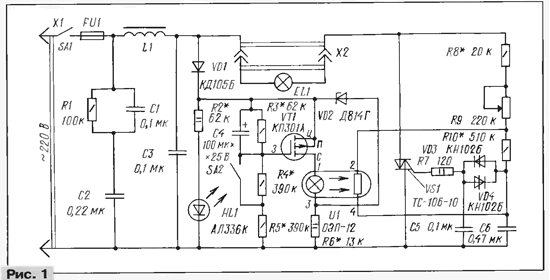
Mains voltage to the device is supplied through the switch SA1 and fusible fuse. A chain of resistor R1, capacitors C1 - C3 and the inductor L1 represents polioptila-schy filter. Power part of the machine consists of triac VS1, diacs VD3, VD4, resistors R7 - R10, capacitors C5 and Sat. In the management node is composed of the VT1 transistor, diode VD1, the Zener diode VD2, the optocoupler U1, the resistors R3 - R6, and capacitor C4. The inclusion of the machine in network signals led HL1.
This device performs three functions. First, it provides a smooth the ignition of the lamp, wherein in the first heating process should be more for a long period. In Fig. 2 shows that in the range from 0 to 90 In when it starts to warm up the thread, this interval is equal to 6, and the rest of the voltage to 220 V rising 3…4 s. may also manually adjust the brightness and smooth extinction of the lamp.
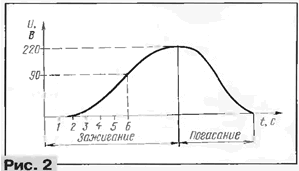
As indicated above, the voltage across the load should be limited to 200, that will greatly increase the life of the lamp. Smooth its extinction occurs when the break contacts of the switch SA2.
The machine works. With the closure of the contacts of the switch SA1 rectified the diode voltage VD1 is supplied to the charging chain consisting of resistors R3, R4, R5 and capacitor C4. The contacts of the switch SA2 must be open. In first field-effect transistor VT1 is closed, lamp EL1 is not lit. To protect transistor from breakdown of Zener diode VD2 is set. The charging capacitor C4 is determined by the resistance of resistors R4 and R5, the resistor R3 limits the voltage drop across the capacitor C4.
After closing the contacts of the switch SA2, the voltage at the capacitor C4 begins to grow, lamp EL1 smoothly ignited as it starts to open the transistor VT1, pins 1 and 3 of the optocoupler U1, the tension increases, and dark the built-in resistance of the photoresistor (pins 2,4) begins to decrease that leads to the opening of the triac VS1. The final voltage EL1 is determined the resistance of the resistor R8: what it is, the less the voltage across the lamp. The brightness of the lamp after its inclusion set by the variable resistor R9. When any position of the slider of the resistor, the machine will smoothly to light and extinguish the lamp. But in order to extinguish the lamp, you need the handle of the switch SA2 to put in position open contacts. The voltage on the capacitor C4 begins gradually decrease and the lamp goes out completely. At long intervals remove the voltage switch SA1.
In the machine used resistors 0.25 W, a, R2, R6, R7 - 2 watts. Variable resistor may be of any type with the characteristic A. the Capacitors C1 - C3, C5, C6 - K73-17, and C1-C3 should be a voltage lower than 400 V, and C5, C6 - to 63 V. Applicable capacitors K73-11, K-10, or at least MBM, MBGO, MBGC. Capacitor C4 - C50-35 or K50-6. Also indicated in the diagram, transistor can be CPA, triac - COG (it is mounted on the heat sink area surface 10,16, 25, or 65 cm2 at a power load, respectively, 200, 300, 500 or 1500 watts). Led - ALB, diode VD1 - D226V, CDA, diacs can to be replaced by a single chip KRK. The switch SA1 is on any type a voltage of 250 V and a current defined by the power lamp EL1 and other loads; the switch SA2 - any type, for example PD-9-2. Instead of optocouplers EIA-12 will fit The CES-2 or similar with a light resistance is not more than 1000 Ohms. The Inductor L1 wound on the rod with diameter of 8 mm and a length of 40 mm ferrite with permeability of 400 wire sew-2 0.51 and contains 215 turns.
Before setting instead of resistors R3-R5, R8, R10 need to solder trimmer resistance of 1 MW. The engines of the resistors R3, R8, R9 should be put in the position of the minimum of resistance, a, R4, R5, R10 to the middle position. In the load enable real lamp. To the terminals of the capacitor C4 connect vacuum tube voltmeter, and the conclusions 1.3 optocoupler - DC voltmeter. With using Latri apply AC power to the automatic Lamp must not light up.
At a voltage of 220 V, the current consumption of the machine is approximately 8 mA.
Gradually increasing the resistance of the resistor R3, watch the growth voltage on pins 1, 3 optocoupler to 1.2 V. depending on the variation parameters of the transistor, the voltage should be such that the transistor was on the border state disabled - enabled. Then short-circuit the terminals of the switch SA2 and watch the rate of increase of voltage across the terminals 1.3 optocouplers to 1.8 V. the lamp EL1 slowly light up, and the voltage on it to achieve 220 V. the Speed of ignition of the lamp depends on the resistance of the resistor R5. To to slow down the turn on the lamp, the resistance of the resistor must be increased and Vice versa. Resistors R3, R4, R5 are interrelated, therefore they must be carefully selected.
After that open the contacts of the switch SA2, and monitor the rate of extinction lamp. To increase you must increase the resistance of the resistor R4, and on the contrary. Thus, the resistor R4 together with R5 determine the rate of extinction lamp, resistor R5 - ignition speed, and R3 is the boundary between the state of on / off. Clear quenching lamp achieve the selection of the resistor R10. This is followed by selection of a resistor R8 to set the lamp voltage of about 200 V when the network voltage is 220 V, and then check the manual brightness adjustment resistor R9.
If manual adjustment is not used, instead of the resistor R9 valid put a jumper.
In conclusion, the slower the rate of ignition of the lamp, the closer it is to "eternal", especially if the lamp is high power.
Author: R. Balinese, Kharkov, Ukraine