



Fluorescent energy-saving lamps have recently become increasingly popular despite their relatively high cost. And really, all good these lights are, but one of the absurdities, spoiling their reputation. Adapted standard electroputere E27 bulb (photo 1) have too big (diameter) of the Central contact area and when screwing them in cartridge, there are cases when the site closes both contact.
The consequence of this is the electric arc and burn the pads in the base energy-saving lamps, and even the cartridge. Moreover, if the house set the phase and neutral wire switch-machines for 25 A (and more current), they do not have time to work - the lamp becomes unsuitable for further use. You can try to take the blown bulb back to the store or be exchanged for serviceable - but, in fact, rather blame the manufacturer of the lamp, than the manufacturer of the cartridge, especially when you consider that the last previously perfectly worked with ordinary electric incandescent lamps. If you receive a refusal, and the new lamp to buy expensive, and risky (and suddenly will burn again!), you to restore the energy-saving damaged lamp.
This is done so.
Burned-out lamp base carefully removed, and then the eyes of the wizard appears electronic Board voltage Converter, plug the two wires to contacts the cap, and four contacts disappearing into the glass tube (having straight or spiral form) fluorescent lamps.
Typically, an electrical arc caused by a short in the cartridge (the basement), because of the wide platforms energy-saving lamps do not damage the electronics of the inverter, so the lamp is easy to repair, solder new connecting wires to the pads on the Board and connecting it to the network 220 In, for example, by means of a cord with a standard plug.
If a circuit Board of the voltage Converter is also damaged. it is removed together with the faulty elements and make the new drive voltage. Simple electric circuit of such a Converter is shown in figure 1.
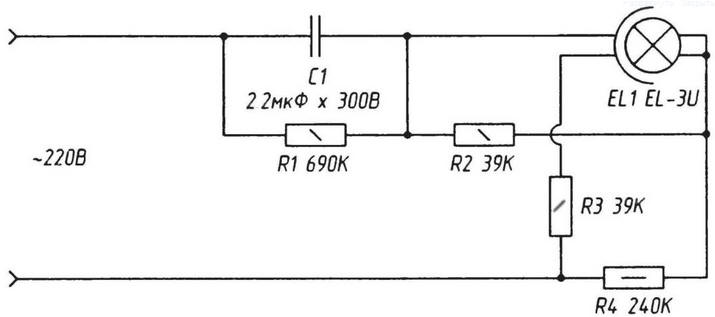
Fig. 1. Electrical diagram of a voltage Converter for fluorescent lamps power up to 8 W
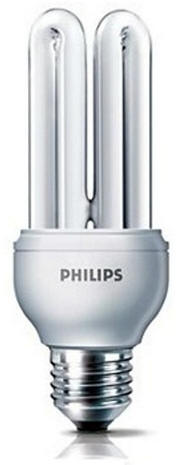
Photo 1. Energy saving lamp EL-3U
Four output fluorescent lamps (two on each side of the tube) is connected, as shown in the diagram. After such simple improvements lamp will serve long.
Improvement (recovery) energy saving lamps (as shown in the photo 1) use the diagram (figure 1) can be done only if power consumption energy-saving lamps do not exceed 8 watts (this is the entry at the base of each fluorescent lamp), which corresponds approximately to the force light from the incandescent lamp of 60 watts.
In the same way you can "revive" and a 4-pin miniature fluorescent lamps installed in luminaires and lamps (photo 2, Fig.2).
Once in the process of working on the burnt bulb by experiment turned out one interesting detail. When you touch your fingers to the glass fluorescent lamps connected to the network 220. In one wire (the switch circuit is open (no current flows), the lamp lights up. This is because on one of the contacts the lamp still comes "phase" of the network, and the human hand (through the glass of the bulb) is the source induced in the human body small AC voltage.
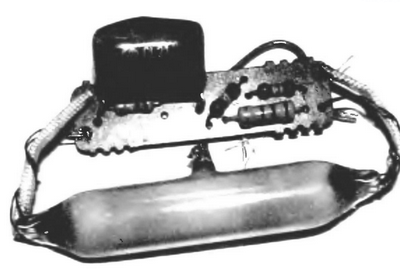
Photo 2. The lamp of the lamps and their power Board
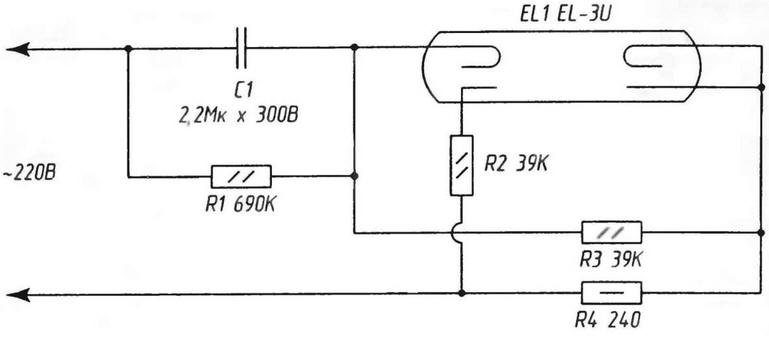
Fig. 2
If you just go ahead and act at a distance of 5 - 10 cm from the lamp bulb, included on the portable radio transmission (the transmission frequency of the radio signal has no value, the transmission power of 5 W), the lamp will light as bright as if it was included in the network of 220 V.
Thus, the idle energy-saving lamp (assuming it is connected to lighting 220 V) can "revive" and light a most unusual way. This allows to apply this technique even for tricks demonstrated to the uninitiated, based however on a normal physical phenomena.
Author: A. Kashkarov