



If the apartment in a village house, in the country there is a long hallway, utility the room with two exits, etc., for the purpose of energy savings and convenience use it is advisable to have the ability to turn on and off lighting in them from various places.
Diagram of the device that implements this function is shown in Fig.1.
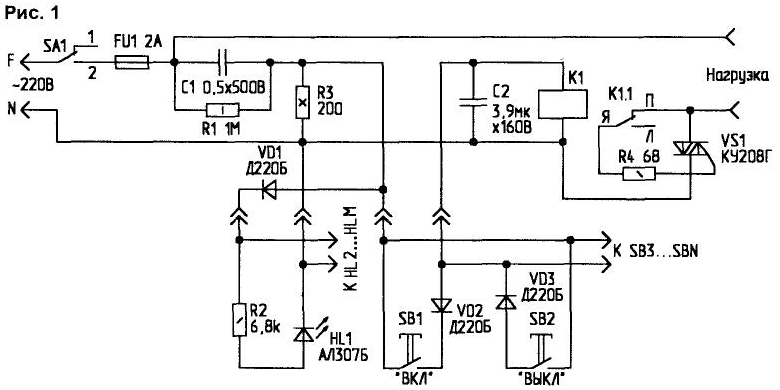
The device uses two-position polarized relay type WP4 (passport RS4.520.009, RS4.520.012), but will fit the relay and with other passports, have a winding with a resistance of 300 to 2000 Ohms. To enable lighting short press the SB1 (parallel to it can be enabled a group of buttons). Thus evolved the resistor R3 AC voltage (10 B) rectified by the diode VD2 and "throws" the anchor of the relay K1 to the right contact closing the control circuit of the triac VS1. The triac opens and energizes the load is a lamp.
When you click SB2 to the relay coil K1 is energized the other polarity, rectified by the diode VD3, and the armature of the relay switches to the left contact. Chain control the triac is broken, it closes and the light goes out.
To find buttons in the dark in the scheme entered the LEDs HL1…HLM (with your damping resistors, similar to R2), installed near the buttons and working in Lite mode at a current of 1 mA. Phase and neutral wires of the network is desirable to connect to the device as shown in the diagram. Then the buttons will be safe voltage (relative to the grounded neutral).
With the disappearance of the supply voltage and the appearance of it again, the device remains in the same condition which was set before switching off. Triac VS1 is supplied heat sink area of about 10 cm2, which allows switching load power up to 400 watts. The power consumption of the device is 0.5 watts.
To turn on and off the device you can do one button operation (a parallel-connected group), but, of course, the scheme becomes more complicated (Fig.2).
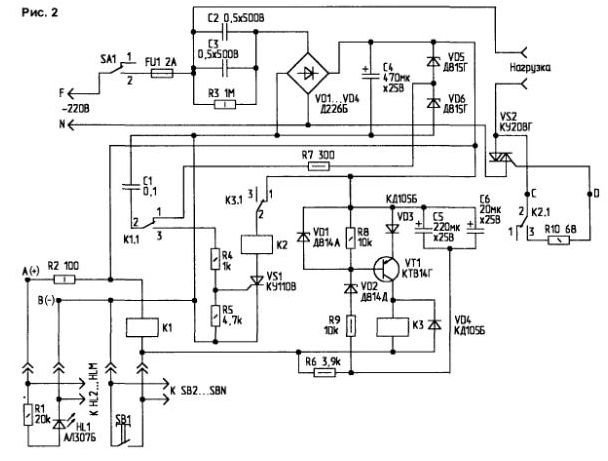
If you want to include lighting, short press the SB1 button (clicking the duration of 1 (C), and if off - press the button for 2…3 seconds. When pressed button 1 works only with the relay K1, and pressing it on 2…with 3 - relay K1 (including) and K3 (off). When triggered, switches K1 contacts To 1.1 (21 to 23), charged to the voltage In the condenser 10, is connected to the control electrode of the thyristor VS1 and opens it. This creates a chain for relay K2 (via normalisatie contacts K3.1 relay KZ), which their contacts K2.1 closes the circuit of the control electrode of the triac VS2. Triac, opening, includes a lamp.
If you hold pressed the button for 2-3 sec (more than 3), we also relay K1, but the state of the thyristor VS1 does not change (it is already open). Through a closed button charging the capacitors C5, Sat. After 2 the voltage on the capacitors is sufficient for the breakdown of Zener diode VD2. then opens the transistor VT1, and intermittent relay circuit. tearing their contacts K3.1 the anode circuit of the thyristor VS1. He closes relay K2 let go of the button to turn off the light depends on the total capacity C5 and C8.
If voltage in the network and the re-emergence of the scheme will be in this state, in which the lighting is off. Phase and neutral wires the network is preferably connected to the device. as indicated in the diagram (Fig.2), the buttons were safe voltage (relative to neutral).
Both devices have a galvanic connection to the network, so when they are commissioning it is necessary to observe appropriate security measures.
During commissioning the second scheme is better to feed a voltage of 25 V from laboratory source (connected to the points A and 8). For the control circuit of the start of the triac to points C and D is connected to the ohmmeter. In fact the scheme is powered by a voltage of 20 V for account Zener VD5. VD6, connected in series.
The device is equipped with magnetic reed relay type RECA (passport 0001) resistance windings 1800 Ohms, thyristors COW can be replaced by COA, and their contacts K2.1 disconnects the control circuit of the triac VS2. Triac closed off corridor lighting.
LEDs HL1…HLM (with their damping resistors) indicate the layout of the buttons in the dark. Permissible load device 400 watts, power consumption in standby mode is about 2 W Zener VD5. VD6 equipped with allottee area of 8 cm2 and a triac VS1 - about 10 cm2. The device is assembled in a plastic housing dimensions 80x230x40 mm.
Author: D. S. Babyn, p. Kelmentsi Chernivtsi region