



Opening the door of the apartment, you find yourself in the dark hallway. So in this case immediately also included lighting, you need to build a special machine. Two options this device is offered in a published article.
To automate the lighting in the hallway when the front door is opened, you can use the call button. This option was considered in article I. Alice Bell button controls the lighting" ("Radio", 1990, № 4, pp. 82).
A simpler solution is "automatic" button, normally closed contacts which is connected in parallel with the light switch in the hallway, and the button itself installed on the door. When you open the door contacts are closed and the lamp lighting lit.
The automation worked reliably, it is best to use magnetically controlled contacts. In other words - on the doorjamb need to place the reed switch, and on the door magnet set.
However, conventional reed switches can switch on the lights, so it's better reassemble the machine in the circuit shown in Fig. 1.
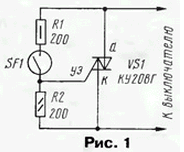
Here contacts SF1 reed switch control the triac VS1, and he switches on the light. Moreover, the reed switch should be with normally closed contacts when the door is closed is open. Is suitable, for example, any reed relay series RES. Relays being destroyed, only need to connect pins the pins double-wire in a safe isolation from other parts of the machine, Yes it is good to isolate the relay.
Details are placed in a small body of insulating material or inside switch. If not will the triac COG permitted to apply TS-10 or similar parameters. Resistors - MLT, S2-33.
Note that the lighting in the hall will be included to until opened the door. However, complicating the machine (Fig. 2) be able to provide delay off lighting.
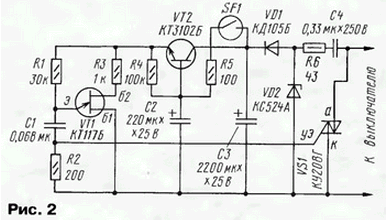
The machine includes a rectifier composed of the quenching capacitor C4, limiting resistor R6, Zener diode VD2, VD1 diode and a smoothing capacitor C3. Transistor VT1 is made a pulse generator with a frequency of follow about 2 kHz, and the VT2 - electronic key.
In standby mode, when the door is closed, the main contacts of the light switch and reed switch SF1 is open, the capacitor C3 is charged up to the voltage about 23 V. the Capacitor C2 is discharged, the transistor VT2 is closed, the generator is not works.
When the door is opened, the contacts of the reed switch are closed, the capacitor C2 quickly is charged up to voltage 18…20 V, the transistor VT2 is open, the generator starts to work. Now the triac is opened at the beginning of each half cycle the mains voltage. The lighting comes on and remains on after door closing about 30…40 while capacitors C2 and C3 are discharged to of several volts.
In the machine, it is permissible to use other than indicated in the diagram, the transistors CTA, CTV, CTG (VT1), CTA, CTV-CTE, KT312B(VT2), triac TS-10, any rectifier diode. Zener diode VD2 is possible to replace two or three series-connected Zener series D on the total voltage 22…25 V. Capacitor C1 - KLS, K10-17, C4 - K73 series, the other series C50. Resistors - MLT, S2-33. The reed switch is the same as in the previous design.
Most of the parts mounted on the circuit Board (Fig. 3) of one-sided foiled fiberglass, which is placed in the housing of insulating material.
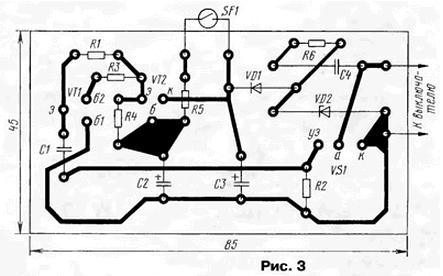
The establishment of the machine is reduced to the selection of the capacitor C2, depending on the desired off delay lighting. The capacitance of the capacitor C3 must be 5…10 times the capacitance of the capacitor C2.
Author: I. Nechaev