



Quartz oscillators (see figure) is assembled on the transistors T1 and T3. Capacitors C1 and C8 are selected to tune the frequency of the generators. Their capacity may be in the range of tens to thousands of picofarads. Such generators work well in the range 1-10 MHz, almost without requiring establishing.
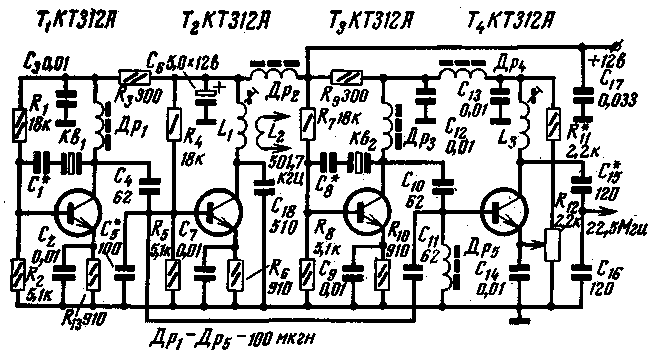
In many cases, chokes DR1 and Dr may be replaced by resistors 2-6 ohms. To obtain the frequency 501,7 kHz quartz crystals are used KV1 7,0 and 7,5 km 2 MHz. The frequency stability depends mainly on the stability of the supply voltage. When you change the supply voltage, ±1 V, the frequency was changed by ±40 Hz (control produced electronic frequency meter CH3-12). The mixer is made on the transistor T2. The capacitor C5 is selected for minimum nonlinear distortion by controlling the output voltage with the oscilloscope. Coils L1 and L2 wound on a core SB-12A and are respectively 100 and 20 turns of wire PEL of 0.1.
Additionally, this generator allows you to get any harmonics of the quartz resonators to transfer SSB signal in the working range, for example of 22.5 MHz (with frequency multiplier, assembled on the transistor T4). For a frequency of 22.5 MHz coil L3 has 6 turns of wire PEL of 0.8, the diameter of the frame is 8 mm. the Circuit is tuned by a core srdc-6.
When you configure regulate the resistance of the resistor R12, achieving the highest readings of the voltmeter connected to the output. Was built such a generator with the allocation of the frequency signal 277 kHz. He showed similar results.
Author: V. egorenkov (RA3DAV), Kaliningrad, Moscow region; Publication: N. Bolshakov, rf.atnn.ru