



The proposed supergenerators differs from the conventional crystal oscillators application instead of one or two identical parallel quartz resonators. This incorporation allows the adjustment of the oscillator frequency to a much greater extent than adequately scheme. So, according to my experiments for the resonators at the frequency 10,15 MHz this range is about 40 kHz and 13 MHz quartz - about 90 kHz (!).
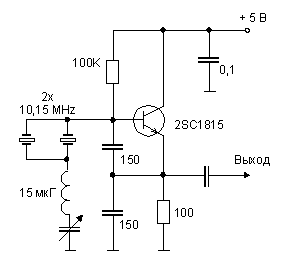
The oscillator circuit was proposed JA0AS (Mr. Shimizu) and JH1FCZ (Mr. Okubo) and named them "Super VXO". First article about this generator was published in Japan in August 1980 in the journal "Fancy Crazy Zippy" (N 64). Then the scheme was described in the book "Textbook for Homebrewing of Electronic Circuits", by which JH1FCZ..
Here are the results of my experiments:
1. Two quartz frequency 10.15 MHz, the inductor 15 µh, variable capacitor 20 pF. With these parameters, the generator worked in the range of 10.10 - 10.14 MHz. With this generator I did a direct conversion receiver in the range of 30 m. the Frequency is very stable. Used transistor 2SC1815 from the upper boundary frequency of 80 MHz.
2. Two quartz frequency of 13 MHz, the inductor VXO-50 (7… 11 µh), variable capacitor 30 pF. The obtained tuning range 12.91…13.00 MHz. The transistor is the same. Coil VXO-50 - brand, designed specifically for VXO to 6 feet and has a small temperature coefficient.
As this generator was applied by me in QRP transmitter on 6 meters At a frequency of quartz 11.2735 MHz and after tripling it overlaps the range of 50.00 - is at 50.27 MHz (270 kHz !).
The frequency tuning range of the specified generator may be wider, but stability becomes worse with increasing inductance. JH1FCZ recommends in his book to follow changes in the frequency within 0.5% of nominal frequency, i.e., 10 MHz - 50 kHz.
I tried inductors different designs, and in practice work better coils of large dimensions. Adjustment frequency with sudden dips in the frequency, this can be eliminated by inclusion of a parallel inductance resistor resistance of 10-30 ohms.
Frequency stability is largely dependent on the thermal coefficient of the material used core inductors. Therefore it is better to use the coil without core.
Author: MINOWA, Makoto, 7N3WVM; Translation and publication: N. Bolshakov, rf.atnn.ru