



An oscillator whose frequency is stabilized by a quartz resonator, is a binding site for the majority of modern receivers and transceivers, as well as for measuring devices. This review provides options for possible implementation of such generators for frequencies from a few to tens of megahertz.
Before moving on to practical schemes, note that for widespread quartz main operating frequency usually does not exceed 10… 15 MHz. This is due to difficulties in manufacturing (mass production) is very thin quartz plates with a high degree of parallelism of the working parties. The latter, in particular, strongly influences monoacetate resonator (no spurious resonances, particularly in the vicinity of the working frequency).
With respect to the generators of the presence of such resonances can lead to excitation of the resonator on the wrong frequency, which is listed on his body, or to the jump frequency of the generator when changing external conditions (temperature, load resistance, etc.). If the frequency is indicated on the housing of the quartz resonator, above 15 MHz, then with high probability this resonator harmonicly, and its main frequency to three or even five times below "par".
In the generator, the circuit of which is shown in Fig.1, a quartz resonator is excited at the fundamental frequency [1]. For stable operation of the load impedance (input impedance of the next stage) shall not be less than 1 Ohm. When this high-frequency voltage generator output will be not less than 0.5 V (effective value).
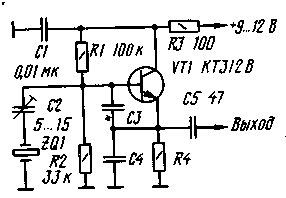
Fig.1
The values of capacitors C3, C4 and resistor R4 depend on the operating frequency of the quartz resonator. For the frequency band 1…3 MHz they should be 270 respectively pF, 180 pF and 3.3 kOhm; 3…6 MHz 180 pF, 120 pF and 3.3 kOhm; for 6…10 MHz 180 pF, 120 pF and 2.2 kOhm; for 10…18 MHz 150 pF, 68 pF, 1.2 kω; for 18…21 MHz 68 pF 33 pF and 680 Ohms.
As they say in such cases, and with proper detail and error-free installation of the generator configuration does not require (except, perhaps, some correction of the operating frequency by adjusting the capacitor C2). If the two above conditions, the generator still does not work, then the only reason for this could be low activity of the quartz resonator. In this case, it should either be replaced by another one, or try to "play" with the values of capacitors C3 and C4. In particular, can help change in one direction or another ratio of their capacitances.
In Fig. 2 is a diagram of a generator in which the quartz resonator is excited at the odd harmonics of its core operating frequency [2]. As in the previous embodiment, the input impedance of the next stage must not be less than 1 Ohm. The output voltage is approximately 0.5 V. the frequency range 15…25 MHz the capacitance of the capacitors C2, C3 and C4 are respectively 100, 100 and 68 pF; for 25…55 MHz - 100, 68 and 47 pF; 50…65 MHz - 68, 33 and 15 pF.
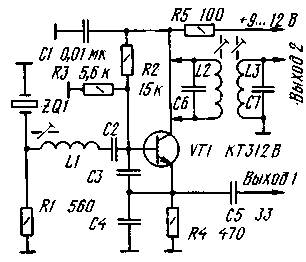
Fig. 2
The coil L1 is wound with a wire diameter of 0.3 mm on the frame with a diameter of 5 mm. It has podstroechnik carbonyl iron (diameter 4 mm). For the above three operational frequency bands, the number of turns must be respectively 15, 10 and 7.
Adjust the oscillator tuning coil 1.1 but stable generation at the third harmonic of the fundamental frequency of the quartz resonator. If this does not occur at any position of podstroechnik, we should choose the number of turns of the coil or to try to carry out this operation by selecting the capacitor C2 with a larger or smaller value. If this does not help, then the most likely cause is the low activity of the quartz resonator (see above). It should be noted that not all resonators, steadily generating at the fundamental frequency, also steadily work on harmonics.
Such a generator can provide a voltage of about 2 V at resistance load (e.g., mixing cascade on experience with insulated gate) at a higher frequency, if in the collector circuit of the transistor VT1 to enter a bandpass filter that is configured, for example, the second harmonic of the operating frequency of the generator (i.e. it will be a generator - frequency doubler on a single transistor). Inductors L2 and L3 of the filter is wound with a wire diameter of 0.6 mm on the frame with a diameter of 5 mm with two trimmers carbonyl iron (diameter 4 mm). The distance between the coils is 5 mm. For the bandwidth of 60…90 MHz, the number of turns must be 9, and for 90…130 MHz - 6. The values of capacitors C6, C7 filter 33 and 22 pF, respectively.
The generator, the circuit of which is shown in Fig.3 [3], slightly more complex - it contains an oscillating circuit. This will provide two advantages. First, it has a higher spectral purity of the output signal. Secondly, it provides a wider output level (about 1 V at a load of 100 Ohms).
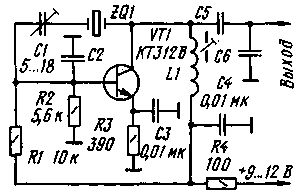
Fig.3
For the frequency band 1…3 MHz the capacitance of the capacitors C2, C5 and C6, respectively, are equal to 470, 270 and 2000 pF; for W…10 MHz - 330. 150 and 1500 pF; for 10…30 MHz - 180. 47 and 330 pF. Coil L1 must be in the middle position of podstroechnik such inductance. to ensure that the capacitor C5 resonance at the operating frequency. Build this generator for stable generation at the fundamental frequency of a quartz resonator or at its third harmonic.
Literature
- Detlef Lechner, Peter Fink. Kurzwellen sender. - Militarverlag der DDR, 1979.
- G. RJessop. VHF/UHF manual. -RSGB, 1983.
- J-Pavlovec, J. Samur. Krystalove jednotky a oscilatory. - Amaterske Radio (B), 1987. No. 2, p. 42-61.
- SW-journal No. 1, 1992
Publication: N. Bolshakov, rf.atnn.ru