



Relative frequency instability of oscillators, performed on resonators in the form of LC-circuits, usually not below 10-3…10-4.
The frequency stability of the generator depends significantly on the quality and stability of the oscillating system. The quality factor of the LC circuit is usually not higher than 200…300. Modern radio transmitters and receivers high requirements on frequency stability. Usually requires long-term relative frequency stability is not worse than 10-8 10-6…that could be enforced through quartz crystals. The quality factor of the quartz resonator is many times greater than the quality factor of the resonators on the LC-circuits and is 104…106.
There are many schemes of quartz oscillators. Therefore, it became necessary to consider the most frequently used in practice scheme.
The conventional equivalent circuit of the quartz resonator shown in Fig.1. Dynamic inductance Ls, a dynamic capacitance Cs and the resistance losses of Rs due to the presence of the direct and inverse piezoelectric effect and resonance properties of the piezoelectric element. Parallel capacitance CP due to interelectrode capacitance of a piezoelectric material, capacity building and mounting. The resonant frequency of the dynamic branches is called the frequency of the series resonance of the quartz resonator Fs.
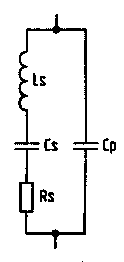
Fig.1
The quality factor of the quartz resonator Q is determined by a dynamic branch in accordance with the formula for the series resonant circuit
Q =(2pFsLs)/Rs
The frequency of the parallel resonance Fp is slightly higher Fs, due to parallel resonance CP, Cs and Ls. An important parameter of the quartz resonator is the parallel capacitance dynamic, denoted by g and called the capacitive ratio
r=Cc/Cs
According to various literature sources, capacitive coefficient for the at-cut quartz is $ 220…250.
Given that Cs/Cp<0,1, one can use an approximate expression for the frequency of parallel resonance
Fp=Fs(1+(Cs/2Cp)).
For capacitive coefficient g>25 resonant interval, defined as the difference between the frequencies of parallel and series resonance of the quartz resonator can be written in the form
dF=Fs/2r.
On the mechanical harmonic of the crystal resonant interval decreases and is determined by the expression
dFn=Fs/(2rn2)
where n is the harmonic number.
Capacitive coefficient determines the magnitude of the resonant period of the resonator, therefore, the frequency deviation of the controlled oscillator, the frequency stability when changing the parameters of the scheme, the conditions for the occurrence and maintenance of oscillations in the circuit of the quartz oscillator. To assess the ability of the quartz resonator excited in some circuits crystal oscillators use a parameter called
the quality factor. It is defined as the ratio of the quality factor of the resonator to its capacitive ratio
m=Q/r.
For quartz resonators the values of M range from 1 to 10000. When M<2 reactance of the resonator is positive (capacitive), with no region of the inductive reaction. Consequently, the initiation of such resonator in circuits crystal oscillators that require inductive reaction becomes impossible. When M>2, the resonator has a region of inductive reactions, and the larger the value M, this area is wider.
In practice most widely distributed two types of crystal oscillators:
(a) generators, in which the quartz resonator is part of a resonant circuit and an equivalent inductance;
b) generators, in which the quartz resonator is included in the feedback circuit, is used as a narrowband filter and the equivalent active resistance.
Quartz oscillators, in which the quartz resonator is used as a circuit element with an inductive reactions, is called oscillatory, and generators, in which the quartz resonator is included in the feedback circuit, called the generators of the series resonance.
Oscillator circuit the crystal oscillator with the quartz between the collector and base, made under the scheme with grounded emitter (capacitive type) shown in Fig.2.
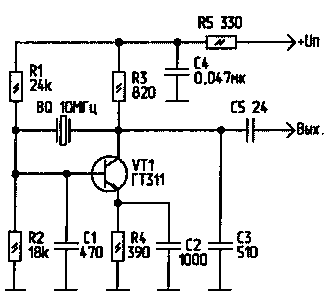
Fig.2
Currently capacitive type finds wide application in the frequency range up to 22 MHz when operating the resonator at the fundamental frequency, and up to 66 MHz when excited by a third mechanical harmonic (Fig.3). Oscillator with a quartz resonator between the collector and base in the circuit with a grounded high-frequency emitter, not prone to parasitic oscillations on the anharmonic overtones, has excellent frequency stability when changing the supply voltage and the ambient temperature.
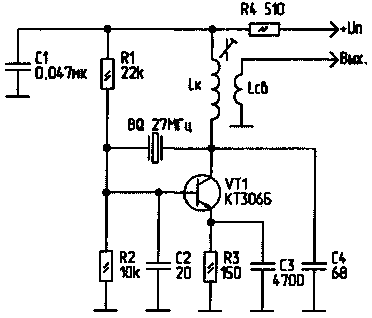
Fig.3
The effects of changes in the reactive parameters of the transistor depending on the voltage and time,is weakened with the increase of capacities C1, C3 (Fig.2), i.e. with the approach of the working frequency of the oscillator to Fg. However, excessive increase of capacities leads to a deterioration of the conditions of self-excitation. On the other hand, with the increase of capacities grows dissipated in the cavity capacity, which increases the instability of the generated frequency. Specifications power dissipation in the quartz limited 1…2 mW. However, in the frequency range 1…22 MHz at this power dissipation, the frequency of the series resonance depends on the dissipated power, and the coefficient of proportionality is (0,5…2) •10-9 Hz/µw, therefore, for highly stable oscillators power dissipation in the resonator should limit value of 0.1…0.2 mW.
In practice, it is recommended to select the capacitance C1, C3 so that the oscillation frequency is defended from Fs not more than a quarter of the resonant interval. Upon excitation of the quartz resonator on the odd mechanical harmonics of quartz, instead of the resistor R3 include an inductor LK (Fig.3). At a frequency generation circuit LK-C4 must have a capacitive reactance, i.e., its resonant frequency must be below the frequency of oscillation. The circuit parameters should be selected so that its natural frequency was 0.7…0.8 times the frequency of generation. As a result, the circuit has a capacitive conductivity at the required frequency harmonics, which eliminates the possibility of lasing at the lower harmonics and the fundamental frequency.
In the oscillatory generators operating at frequencies above 22 MHz, the resonator usually excite on the 3rd or 5th harmonic, but not higher, as much the effect of the parallel capacitance. More often than shown in Fig.2, applies a capacitive three-point circuit crystal oscillator with a quartz resonator between the collector and base of the switching circuit of the transistor with a grounded collector (Fig.4). This scheme is particularly convenient for generators with an electronic switcher of frequency (when the series with the quartz varicap), and has a smaller number of locking elements than the circuit with a grounded emitter. Many experts in the field of crystal oscillators consider a capacitive type-best of all circuits crystal oscillators operating at a principal or 3rd mechanical harmonic of the resonator. It should be noted that there is a scheme of capacitive treatacne not containing inductance, which is excited on the 3rd and 5th harmonics.
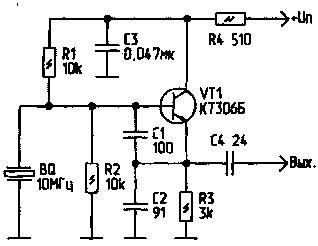
Fig.4
Oscillator with a quartz in the circuit. If the scheme in Fig.4 in series with the quartz to include an inductor L1, it will lead to emergence of new properties, i.e. in the generator (Fig.5) possible self-oscillations, stable quartz resonator.
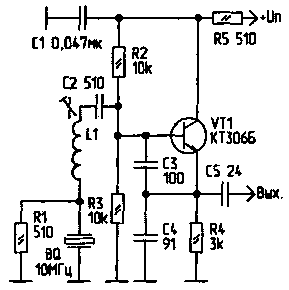
Fig.5
At high frequencies, where the reactance of the parallel capacitance of the resonator is less reactive resistance dynamic branches of the quartz resonator, it is possible self-excitation through the parallel capacitance CP. The presence of inductance L1 means the ability to perform the phase balance on the frequency of the series resonance, and also in some area of rastrac below the frequency of the series resonance. The inductance L1 provides the implementation of the phase balance in the conditions when M<2, and the equivalent reactance of quartz may not have an inductive character. This means that the generator with quartz in the circuit can operate at higher frequencies and the higher rooms mechanical harmonic of the crystal.
To exclude parasitic self-excitation through the parallel capacitance CP, which is most likely at high frequencies and high mechanical harmonics, parallel to the resonator includes a resistor R1, which is making losses in the circuit parasitic self-excitation.
To reduce the requirements to the activity of the quartz resonator on the mechanical harmonics is possible by using schemas generators serial resonance. As with increasing frequency and number of harmonics of the activity of the crystal decreases due to the increase of the equivalent resistance and enhancing the effects of static shunt (parallel) capacitance CP, it is necessary to neutralize or compensate. The neutralization can be carried out in a bridge circuit, where the quartz is placed in one arm of a balanced bridge.
Bridge series resonance oscillator. In the circuit shown in Fig.6, when the exact balance of the bridge (SR=S 2, ХL1-2=ХL2-3) feedback is through dynamic branch resonator. On the mechanical harmonic of the crystal dramatically increases the conductivity of the successive branches of the resonator, the bridge razbalansirovat, and with proper selection of circuit elements of the oscillator is oscillating. The circuit L1-C3 must be set to the frequency of the desired harmonic.
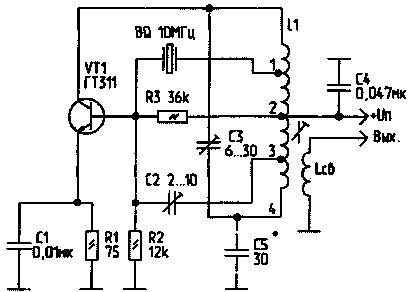
Fig.6
In this scheme manages to excite the quartz crystals on the 5th or 7th harmonics. Circuit with the neutralization of the static capacitance of the resonator is rather critical to the operation mode and difficult to adjust, although they can be used at frequencies up to 100 MHz. The upper limit frequency of the generator to the neutralization due to the difficulty of obtaining a large equivalent resistance of the circuit with increasing frequency as the primary circuit capacitance cannot be made small due to the parasitic capacitance.
The Butler scheme (Fig.7) is characterized by the highest resistance to destabilizing factors in the range up to 100 MHz. The upper limit of the generated frequencies are due to the deterioration of the properties of the emitter follower. In the scheme of Butler quartz resonator included in the feedback circuit between the emitters of the transistors. Transistor VT1 is connected to the common-collector, and the transistor VT2 - common-base. The disadvantage of this scheme is prone to parasitic self-excitation due to coupling of the output to the input through the parallel capacitance of the quartz CP. To eliminate this phenomenon parallel to the quartz connect an inductor, forming together with the parallel capacitance of the quartz resonant circuit, tunable to the frequency parasitic oscillations.
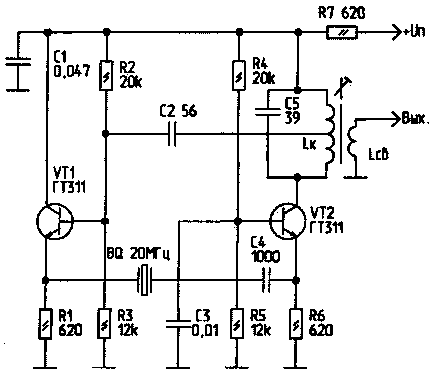
Fig.7
The oscillator according to the scheme of Butler on a single transistor with compensation CP. At frequencies up to 300 MHz it is advisable to use a single stage schema filters, e.g. filter circuit with a common base (Fig.8). Essentially, such an oscillator is a single-stage amplifier in which the circuit is connected to the emitter of a bipolar transistor using a quartz resonator, performing the role of the notch filter. The contour formed by parallel capacity quartz CP and the coil L2, tuned to the frequency of harmonics used. With the increase of the operating frequency increase is equivalent to the conductivity of the transistor, i.e. the fulfillment of the conditions of self-excitation is deteriorating. However, despite this, conditions of self-excitation of the oscillator at high frequencies are easier than oscillators with quartz between the collector and base and quartz in the contour that defines its advantage.
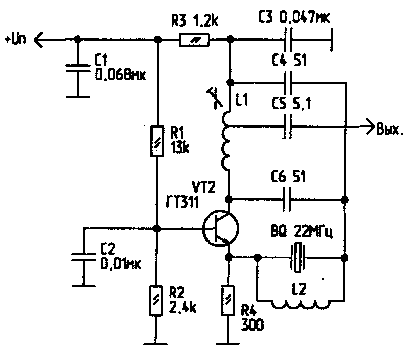
Fig.8
In conclusion, it should be noted that the models of crystal oscillators do not exhaust the variety of schemes of generators, stable quartz resonator, and a choice of schemes decisive influence the presence of quartz resonators with the equivalent parameters, the requirements for output power to the power dissipated in the resonator, the long-term frequency stability, etc.
A little about the resonators. When choosing a resonator for the oscillator special attention should be paid to the quality factor of the resonator - the higher it is, the more stable frequency. The greatest merit have vacuumed the resonators. But the tattered resonator, the more expensive it is. Often the resonators with a large spurious resonances.
In the USSR, in addition to the resonators, quartz resonators were produced from lithium niobate (labeled RN or RM), lithium tantalate (labeled RT) and other piezoelectric materials. As equivalent options such resonators differing from those of quartz resonators, they may not be instituted schemes, which work fine quartz, although the frequency marked on the case, may be the same. They may have worse frequency stability and tuning accuracy. The enterprise of the USSR, as a rule, produced quartz crystals with main frequency up to 20…22 MHz and above on the mechanical harmonics. This is due to outdated processing technology of quartz plates. Foreign enterprises produce crystals with base frequency of 35 MHz.
Leading foreign companies produce resonators in the form of so-called inverse mesostructure working on volumetric oscillations of the shear through the thickness, in which the frequency of the first harmonic up to 250 MHz! Using quartz crystals in schema generators, in which the oscillatory systems are used in systems with distributed parameters of inductance and capacitance, it is possible to obtain a highly stable oscillation at frequencies up to 750 MHz without frequency multiplication!
Author: O. Belousov, Vatutino, Cherkasy region; Publication: N. Bolshakov, rf.atnn.ru