



In everyday life, especially in rural areas, there are cases when suddenly disconnect the power supply. In such a situation to help out may crash power options. As the primary source for the most affordable automotive starter battery 12 V Energy she is able to give, enough to power for a few hours of TV, lighting and other household appliances.
When developing emergency Converter is usually the problem arises of obtaining on the output sinusoidal voltage. But not all consumers energy it needed. So, filament lamps and heater form voltage completely indifferent, is crucial to the effective value was equal to the nominal network. In the pulsed power supplies modern TVs and computers AC voltage pre-rectified, so it is necessary that its peak value was the same as in the network - 1.4 times more effective.
Made by traditional schemes transformer power supplies many of USC, radios and tape recorders are also able to work under non-sinusoidal the form of voltage. The proposed device generates a bipolar rectangular pulses with an amplitude of about 300 In duty cycle such that their effective stress is 220 V. the conversion Frequency is chosen equal to 80 Hz, which is somewhat facilitates the operation mode transformers power of most consumers. However, at this frequency will not normally work those devices that have AC motors - record players, reel to reel tape recorders, fans, and some others.
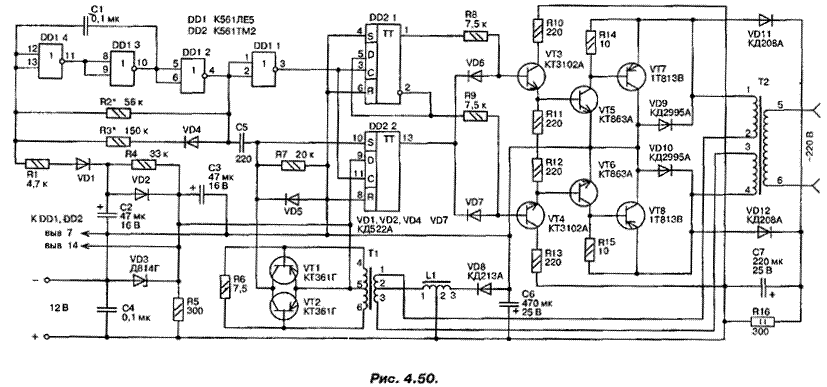
Due to the relatively low voltage of the primary source (12 V) efficiency Converter significantly affect the voltage drop is used in it electronic keys. For most typical silicon transistors the saturation voltage of more than 1 In, germanium it is significantly less. Test showed that best results have a key made on silicon the transistor with reduced saturation voltage - CTA and germanium - TV. At a current of 10 A, the voltage drop does not exceed 0.6 V. for the emergency Converter to power household equipment from a car battery the battery shown in Fig. 4.50.
Main technical characteristics:
- the voltage.....12 In;
- maximum output power.....180 W;
- maximum current consumption.....20 A;
- Efficiency.....90%;
- the frequency of the output voltage.....80 Hz.
On DD1 chip assembled the master oscillator. After the power is switched on, the duration of the generated pulses is very small. As the charging of the capacitor C2 through the resistor R4, it increases to working, which ensures smooth run the Converter. With each pulse master oscillator trigger DD2.1 changes the state. Signals with his direct and inverse outputs alternately open the transistors VT3 and VT4, control power transistors keys VT5…VT8.The trigger DD2.2 limits the duration of the open state the transistors. The front of the pulse at the output of the element DD1.1 sets the trigger in the state corresponding to the high level voltage at the output 13. The differentiating circuit C5, R7 generates a pulse that resets the trigger on the end of the pulse oscillator. The voltage level at the output 13 becomes low and, due to the diode VD7 VD6 and, one of the transistors VT3 or VT4, which was opened and closed.
In operation, the signals at pin 13 DD2 and DD1 3 are identical. The voltage across winding 4-6 of the current transformer T1, loaded with resistor R6, is proportional to the current flowing through the power switches. If it exceeds 1.2 V, one of the transistors VT1, or VT2 (depending on polarity) - opens and will reset the trigger DD2.2. As a result, both power switch will be closed. So helps protect from overcurrent.
The inductor L1 limits the rate of rise of current through the power switches. When they closed, the energy stored in the magnetic field of the inductor, is returned through the diode VD8 into a power source. Diodes VD11, VD12 and chain R16, C7 dampen the surges on the power of the keys. Low-power nodes Converter are mounted on a unilateral PCB from foil fiberglass. The location of the printed conductors and components on the Board shown in Fig. 4.51.
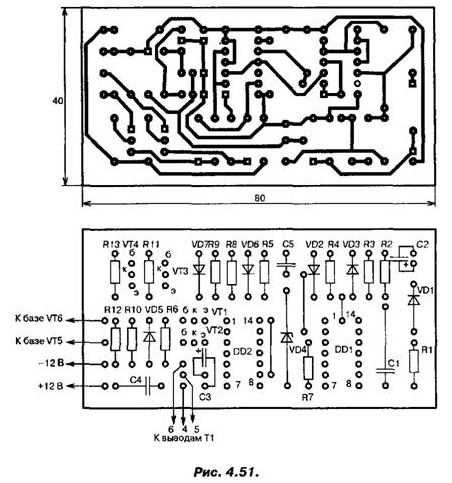
The power section is made mounted Assembly, and the transistor VT7 and VT8 is provided with a square sinks 160 cm2. On the same heatsink install diodes VD9 and VD10. Most parts not required stringent requirements. As C1 should not be used a ceramic capacitor whose capacitance is strongly dependent on temperature. Transistors VT3 and VT4 must have a current transfer ratio of at least 60. When the absence of transistors TV them replace the same with another letter index. In a pinch you can use GTA or P, however, the output the power Converter as a result of this replacement is reduced. You will need change and threshold current protection, increasing the value of the resistor R6 to 16 Ohms.
Transistors KTA be replaced by others not recommended, at least it is permissible to use CTB. The use of transistors with higher the saturation voltage will adversely affect the efficiency of the Converter. Diodes KDA allowed to replace CD, CD, CDA.
The transformer T1 is wound on a W-shaped magnetic core of electrical steel section of 0.56 cm2. Winding 1-3 represents two turns of copper tape width of frame size and a thickness of 0.1 mm with a branch of the middle, winding 4-6 - 260 turns of PEV-1-0.3 mm, also with a branch of the middle.
The transformer T2 is made on the basis of the CU-180 from the TV CNT-47/59. Network the winding is used in the inverter output. All secondary windings are removed, their the place is wound two primary 35 turns of PEV-1 01,6 mm each. Good any other suitable power transformer having a winding network and two on voltage 8 In each. The inductor L1 is wound on a ferrite magnetic core with Sh non-magnetic gap of 1.1 mm. Its winding 1-2 contains nine turns of PEV-1 01,6 mm and 2-3 - 17 turns of PEV-1 01 mm.
The establishment of the Converter is reduced to setting the frequency of the pulses defining of the generator. It should be equal to 160 Hz, with a duty cycle 2. Generator set up, not feeding the supply voltage on the power of the keys. For this enough to break the conductor that connects pin 2 of the inductor L1 with a positive pole of the battery.
The frequency and duty cycle of control pulses at pin 3 of IC DD1, achieving the required values, the selection of resistors R2 and R3. After that, restoring the power of the keys, you must ensure that the effective value of the output voltage is 220 V (it should be measured with a voltmeter electromagnetic system, as usual avometr will give you incorrect readings).
Changing the resistance of the resistor R3 can slightly adjust the output voltage.
Author: A. P. Seman