



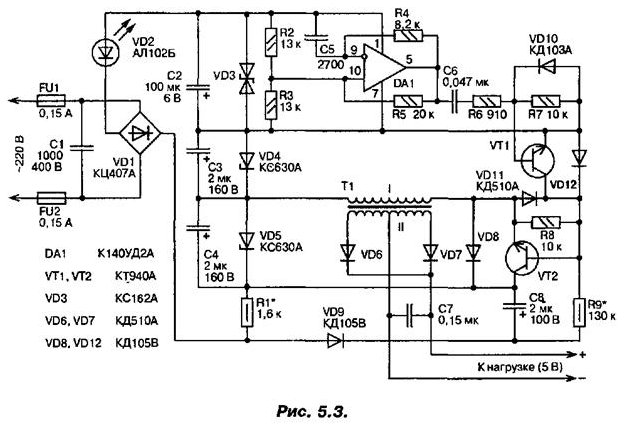
This unit can be used to power an electronic watch calculator, electronic thermometer, the other low-power electronic apparatus (Fig. 5.3).
Main technical characteristics:
- the AC voltage of the power source.....220 ±15%;
- the maximum power load.....3 W;
- frequency conversion.....35 kHz;
- efficiency.....75%;
- power density.....115 W/dm3
The main unit of the block is the so-called half-bridge Converter voltage, transistors VT1, VT2 and transformer T1. Voltage the mains supply is rectified by a diode bridge VD1. Zener diodes VD3…VD5 and resistor R1 included parametric stabilizer, with the capacitors C2, C4… form a rectified voltage divider. VD2 led serves as an indicator the power supply is turned on. The voltage on the symmetrical Zener diode VD3 is used to power the oscillator. The resistor R1 is included as ballast in parametric stabilizer, provides a voltage boost voltage the capacitor C8.
In case of a short circuit at the output of this resistor limits the current, consumed by the power supply unit from the mains. In addition, he and capacitor C8 form a filter that suppresses high-frequency noise generated by the Converter. The master oscillator is assembled by operational amplifier DA1 scheme multivibrator. Its peculiarity is the use of unipolar power voltage from the Zener diode VD3, which reduces the total number of elements block.
Galvanic isolation of the generator and the high voltage transistor VT1 by DC provides a capacitor C6. Unusual and control method the transistor VT2. It opens the current flowing through the resistor R9 when closed the transistor VT1. At the time of opening of the transistor VT1 to emitter the transition of the transistor VT2 is applied reverse voltage, causing the efficient resorption of minority carriers in the base, which leads to his closing without the appearance of a through current. Diode VD11 limit reverse the voltage at the emitter junction of transistor VT2, without impeding the flow of current through the primary winding of the transformer T1 and an outdoor transistor VT1. Such a construction this node Converter allows you to exclude pass-through current through the transistors and does not require the use of a transformer in the control circuit. The closing of the transistor VT1 leads to the opening of the transistor VT2 without the occurrence of through current. Transistors VT1, VT2 work in Lite mode, which provides enhanced the reliability of the power supply.
The transformer T1 is wound on the ring size KHz ferrite 2000NM The primary winding has 500 turns of wire sew-2-0,15; secondary, designed for output voltage 5 V, 50 turns of wire sew-2-0,31, a branch of the middle. Zener XA can be replaced by XA. Transistors can be CTB or CTB, but then the Zener CSA will have to replace the CSA. In this case, the efficiency of the unit will deteriorate. The establishment of the PSU is reduced to the selection of resistors R1 and R9 for a specific value of power load.
Resistor R9 is chosen from the condition of saturation of the transistor VT2, which is determined an oscilloscope. The resistance of the resistor R1 should be selected so that, when rated load and the mains voltage 220 through the Zener VD4, VD5 flowed a current of at least 5 mA. To reduce the output voltage ripple the capacitance of capacitors C3 and C4 should be increased in 2…3 times. In addition, the level ripple can be further reduced by connecting in parallel with the capacitor C7 oxide capacitor 50…100 µf rated voltage up to 10 V.
Author: A. P. Seman