



The proposed unit is designed to power small electronic devices (handheld radios, tape recorders, watches and etc.). The output voltage can be selected in the range from 5 to 12 V. One of advantages of the block - small dimensions: all its parts are accommodated in the housing network the fork.
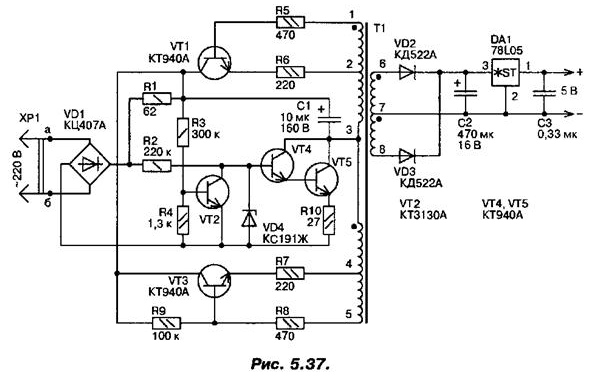
Schematic diagram of the unit shown in Fig, 5.37.
Main technical characteristics:
- voltage frequency 50…500 Hz, .....100…250;
- output voltage (depends from used integrated stabilizer), .....5…12;
- nominal load current (at an output voltage of 5 V), mA.....20;
- maximum (at the same voltage), mA.....100;
- pulse level (at rated current), max, %.....1.
It works as follows: rectified by a diode bridge VD1 is the voltage across the divider R1, R3, R4 is supplied to the base of transistor VT2, and through resistor R2 to the base composite transistor VT4, VT5 during each half cycle until the voltage at the point connection of collectors VT1, VT3 relative to the emitter VT2 does not exceed 100 In it closed, VT4, VT5 opened and the capacitor C1 is charged through the resistors R1, R10 and plot the emitter-collector of transistor VT5.When the voltage at the specified point above 100 V, VT2 opens and bypasses the emitter junction compound of the transistor. The capacitor C1 is discharged, feeds the oscillator transistors VT1, VT3. The oscillation frequency of the oscillator is about 60 kHz. From the secondary winding the transformer T1 is removed, the voltage of about 7 V. It is rectified by diodes VD2, VD3, smoothed by the capacitor C2 and stabilizes the integral stabilizer DA1. Capacitor C3 reduces high frequency pulsations.
The maximum voltage collector-emitter transistors VT1, VT3 in steady state does not exceed 200 V, VT4 and VT5 - 210 V. the Maximum current transistor VT5 when specified on the circuit component values and static the current transfer ratio base h2b transistors VT4, VT5, is $ 25, not exceeds 300 mA. At the moment of switching voltage collector-emitter transistors VT4 and VT5 may exceed 300 V, and the collector current VT5 - 0.5 A, which will lead to their failure. To limit the collector current VT5 at this moment serve resistor R10 and Zener diode VD4.
To limit voltage collector-emitter composite transistor, between the collector and emitter VT5 it is desirable to include a varistor voltage of about 250 V. When using the unit to power a low power load (input current no more than 5…10 mA) resistance of the resistors R6 and R7 is advisable to increase to 470 Ohms, and the capacitance of the capacitor C1 to reduce to 2.2…4,7 UF (in this case, the block there will be less heat and reliability will increase).
Except CTA (VT2), the device can use any transistor in this series, and also series KT3102 or foreign production with similar characteristics (for example, BCW60D). Transistors CTA interchangeable on CTA, BF469/PLP (VT1, VT3) or CTA, BF459 (VT4, VT5). Capacitors C1, C2 and import may application C50-35, C3 - K10-17. Diodes VD2, VD3 - any small silicon with a valid direct current of at least 100 mA reverse voltage of at least 20 and In the working frequency of 150 kHz. The resistors R1-R3 is C1-4 with a work or other voltage of at least 350, and the rest - C2-33, S2-23 MLT, ALT or the like.
The transformer T1 is wound on two stacked ferrite (2000NM) rings size KHz. Winding 1-2 and 4-5 contain 8 turns of PEV-1-0,1, winding 2-3 and 3-4 - 200 turns of the same wire, winding 6-7 and 7-8 - 14, 22, or 28 turns of PEV-1-0,17 (respectively, for output voltages of 5, 9 or 12 In). For winding and outer insulation is recommended PTFE film or PET film. In the original power pack mounted in a standard plug with a diameter of 40 and a height of 27 mm.
Printed charge (Fig. 5.38) made of double-sided foil fiberglass a thickness of 0.5 mm.
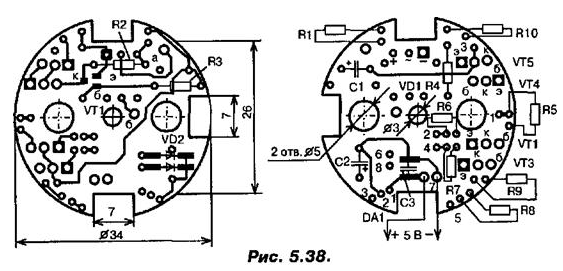
The distance between the centers of the holes in the Board under the pins network plugs 19mm. All resistors, except for R2 and R3, set perpendicular to Board. The Zener diode VD4 soldered to the printed conductors of the installation transistor VT2. To the pads marked "a" and "b", solder the wires from the pins of the plug, and to the pads with numbers 1.8 - the terminals of the windings of the transformer T1. Place it over the capacitor C3 in the free space between the transistors VT1, VT3 and the capacitor C2. Assembled from undamaged parts and without error in the mounting block does not require forging.
Author: A. P. Seman