



The feature of this power supply is that the rotation of the handle controls not only to change the output voltage, but also its polarity. Almost the voltage is adjustable from + 12 to -12 V. this was Achieved through a little the unusual inclusion of stabilizers bipolar power source, so that both stabilizer regulated by a single variable resistor. Schematic diagram of the source is shown in Fig. 2.25.
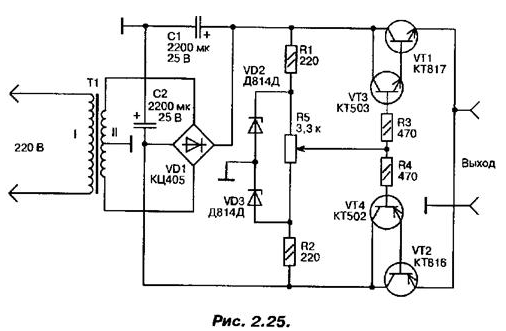
Rectifier - bipolar performed according to the standard scheme of the transformer T1 with a secondary winding with a branch of the middle, the diode bridge VD1 and the capacitors C1 and C2. As a result, its output is a bipolar voltage. It the voltage is fed to two stabilizer transistors VT1 and VT3 (adjustment positive voltage) and transistors VT2 and VT4 (adjustment negative voltage).
Unlike standard two-pole circuit that outputs stabilizers included together, and that to adjust the voltage using a single common variable resistor R5. Thus, if the engine of this resistor is installed exactly in the middle, and the voltage across it is relatively common wire is zero, both stabilizer closed, and the voltage at the circuit output is also zero. If the engine began to move towards positive voltages (up) starts to open the regulator positive voltage on the transistors VT1 and VT3, and the stabilizer negative voltages and VT2 VT4 remains closed.
The design uses the finished transformer capacity of 10 watts, outstanding on the secondary winding of two alternating voltage to 12 V. the capacitance of the capacitors C1 and C2 should not be less than 1000 µf, you need to consider that they determine the level ripple at the output.
Zener diodes can be any low voltage of 12 V. the Transistor CT you can replace KT815, KT807, CT. Transistor CT - CT. Transistors CT and CT can be replaced, respectively, by KT361 and KT315. Rectifier the bridge you can use another, for example, KTS402 or collect it from the type diodes D226 or CD. Transistors VT1 and VT2 you need to put on a small heatsink.
Author: A. P. Seman