



Many hams remember boom caused seven years ago new - phones with caller ID, getting big name "caller ID on the Z80". Passed time, new superclean, far surpassing the capabilities his predecessor. However, many still remain and work fine good old caller ID with which part is no meaning, no desire, especially if the machine is built with your own hands. But some work he needs. This will be discussed in the article.
This structure has been a few "pain points". One of them is so called the "freeze" of the processor system. What consequences it brings, owners caller ID on the Z80 is well known. However, if the "freeze" occurs once 2…3 months is quite normal. "Hang" every five minutes already a fault condition. When the processor executes prescribed the sequence of commands, the error in the reading of only one bit leads to disruption of this sequence. The specific causes of failures can to be different, such as impulse noise.
Yourself to get out of a frozen state of the processor can't, on it is necessary to apply an external reset signal or, as they say, restart a processor. In One there are two reset - start when you turn on power and forced (regeneration), performed on one of the channels timer KR580VI53. However, the operation of the device forced reset was unreliable, since the reset signals are generated only when properly normal operating the processor system, i.e. when they do not need.
In Fig. 1 shows a diagram of a simple block of autoregeneration, whose connection to Aonu on the Z80 allows you to not only quickly "reset" hangs, but provides installation of the processor to its original state when you enable network power.
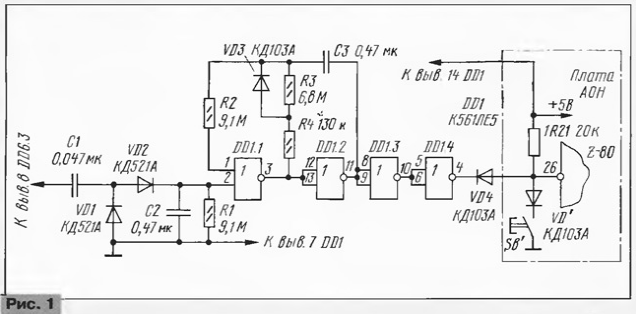
The unit can be inhibited multivibrator elements DD1.1 and DD1.2. To the output of the multivibrator is connected to two series-connected inverter DD1.3, DD1.4 that functions as a buffer amplifier. When you "hang-UPS" almost always lost the overwrite pulses, which in normal working the apparatus is received from the output of the element DD6.3 (scheme phone with caller ID in the article "Business phone", "Radio", 1993, No. 9, p. 33). The overwrite pulses have a duration of 0.5 MS and a repetition period of 8 μs. The absence of these pulses and is a signal about the "freeze".
With caller ID card the pulses arrive at the detector voltage doubler (elements VD1, VD2, C2, R1). From the detector high level goes to pin 2 of the element DD1.1 and inhibits the multivibrator. The output DD1.4 the high level, the diode VD4 is closed and the device does not affect the operation of the processor.
In case of pulses, the capacitor C2 is discharged and the voltage reaches the switching threshold of the element DD1.1, the multivibrator begins to work. The output element DD1.4 there appears a low level pulse duration 0,1…0,15 C, which resets the processor. If for 1,5-2 with normal operation the CPU part is not restored, the reset cycle is repeated.
The need for relatively long pause due to the fact that in some the versions of the software when the device is in the network sounds a little tune, and only then there is information on the indicator.
If the pause is shorter musical backgrounds, the start of caller ID during power you cannot maintain. In determining the number, all the "strength" of CPU spent on the operation and display stops at the first digit of the indicator displayed rectangle. Discharge time of the capacitor C2 should be less than the identification service, because otherwise it will be perceived as "hang". When specified on the diagram the nominal discharge time is 3…5 seconds.
The device is mounted on a circuit Board of one-sided glass fiberglass thickness of 0.75-1 mm. drawing of the PCB shown in Fig. 2. All resistors and diode VD1 mounted vertically. The jumper is made by cable Sew or PEL. In the case of the phone unit is attached in any convenient place, for this there is a free space on the Board. It is desirable that the connecting the wires have a minimum length. On the Board Aona need to remove the circuit elements bootstrap processor (VD12, VD13, C4, R20) and circuit connections forced regeneration (VD14).
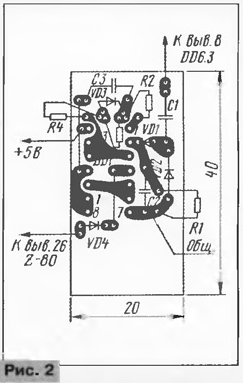
DD1 chip can be replaced by CLE. Capacitors - any small-sized, for example, type km. As the domestic resistors MLT - 0,125 release resistance of up to 3 MW, the device incorporates imported resistors. It is permissible to use a few resistors MLT - 0,125 included successively. To get the right time and through the use of capacitors C2 and C3 with a larger capacity at the proportional reduction of resistance of the resistors R1 and R3.
Configure the device does not require, but in view of the considerable scatter capacity ceramic capacitors should check the pulse duration, pause, and the discharge time of the capacitor C2. If they are significantly lower than the nominal values, you need to pick the capacitors C2 and C3.
Experience shows that the introduction of an additional button SB manual reset CPU simplifies the use of the apparatus - with its help you can not hesitate to leave most of the modes in the core. In devices assembled in the housing WEF, use the mute button.
Perhaps your machine, worked fine at first, over time, increasingly began to falter, "hang". The main cause of such troubles are bad contacts - people say that electronics is the study of the contacts. Defects contacts are divided into three groups - bad metallization vias fees, poor quality (so-called "cold") soldering and poor contact in the socket on which the chip installed. The first defect is almost fully taped during the installation and commissioning of the device, the last two manifest themselves over time. To find and eliminate 2 - 3 cold soldering - a feasible task, but if more than 10, it makes little sense to spend time on it.
Domestic sockets of the old issues, even with gold-plated contacts, ensure a reliable connection. And if your phone has such sockets, replace them. On the socket are almost always install the ROM chip and very often the processor. As experience shows, the most sensitive to the quality of contacts chip ROM and socket you need to replace in the first place. It is best to use sockets with collet the contacts.
When removing the socket main task is not to damage the circuit Board, otherwise the subsequent repair will be difficult and time-consuming. Do not try to remove the socket soldering iron with group sting or using a solder suction - these methods do not guarantee the absence of damage. More reliable is another way. With a sharp knife carefully break off the edges of the panels so that the pins are left without mechanical fasteners. Then, warming up the soldering iron mounting holes, tweezers are alternately removed from the circuit Board contacts. This should be done without excessive effort, otherwise you can pull the wires from the sockets, and if the leg is not "better to wait a bit until completely melted solder in the mounting the aperture. After removal of the contacts and removing body panels, it is necessary to prepare holes for the installation of the new panels. For this soldering iron heated pads and sharpened match entered into the hole with side parts, removed from the hole solder residue. After that establish and raspalaut a new socket. This method provides a quick dismantling the panels without damaging the PCB.
The resistance of the resistor R2 does not necessarily have to be so large - enough 10 ohms. The lower circuit output resistor R4 is better to switch to the output element DD1.3, while the operation of the multivibrator will be more stable.
Author: Dmitry Turchinsky, Moscow