



The peak of popularity "room" radio telephones designed for small remove the handset from the base unit connected to a public telephone network, General. passed since become ubiquitous mobile cellular phones. But in many, they continue to "plow" in the apartments, and their reliable exploitation remain.
One such topical issues is premature (as it seems to owners cordless phone) "wear and tear" (loss of capacity) of the battery (AB). Often it happens that store-bought new radiotelephone apparatus (MOUTH) in the warranty period does not provide stated in the passport normal (20 to 30 minutes continuous talk provided a charged battery) my experience loss of battery capacity became visible at 3-4 months life-of-MOUTH. What are the causes of loss of battery capacity? There are several of them.
First, it conditions the MOUTH. One owner conducts frequent conversations I. accordingly, often discharges and recharges the battery (hangs up when the "base") to the Other speaks rarely. and, as a rule, his phone is constantly is at the "base", i.e. in the charge mode. Despite the fact. in most The MOUTH of the automated charging system (battery charging occurs up to a certain moment when "saturation" of the battery is terminated), it does not help the situation, since AB little "trains" periodic cycles, the discharge-charge. Manufacturers focus on the MOUTH first, active users, which training is recharged itself. Thus, active the owner of the MOUTH. unwittingly, prolongs the life of the phone from staff of the battery. Secondly, it is important which type of battery is used.
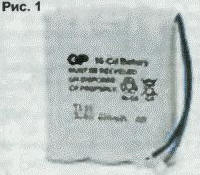
Nickel cadmium (NiCd) (Fig.1) batteries are cheaper, they are still produced, but have the infamous "memory effect". This effect manifests itself in the capacity loss of the battery, if not fully discharged battery is included in the mode charge (handset placed on the base) In permanent operation in this mode the time of "active" use of the tube gradually decreases, creating the inconvenience. People are starting to blame the manufacturers of the MOUTH, I regret thrown in wind" money, although the situation is actually easy to fix.
First of all, it should be noted that more adapted to frequent regime change NiMH batteries (Fig.2). They don't have any "memory effect", is able to recruit capacity at partial discharge is almost at a maximum and, on the contrary, "not in love", when they drain to the end. What type of battery is used in a particular case, it is easy to specify, by opening the battery cover of your MOUTH and read the symbol on the battery case.
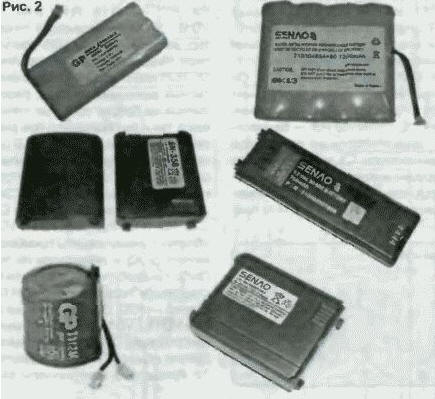
Both are considered type AB in appearance similar and typically have a nominal voltage of 3.6 V. in addition, they vary the capacitance, the value of which determines the duration of the conversation. For ordinary users MOUTH I would not advise to buy batteries with a capacity of below 600 mA h.
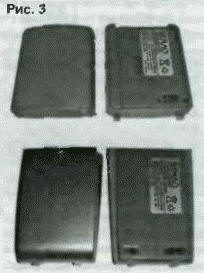
There are batteries Li-ion (Fig.3), which differ from the technology of production, long life work, appearance, and application (used in cell phones).
In addition to the replacement NiCd battery NiMH, there is a simple and effective way restore accumulators MOUTH For that is disconnected from the battery tube (capacity 300…2000 mAh) is forcibly discharged by connecting to its conclusions a resistor of 10 Ohms and a power dissipation of 1 watt.
Parallel to the resistor it is desirable to connect any DC voltmeter with a measuring range of 5… 10 for discharge control AB. Without control we can assume that the battery capacity 300 mA h will be fully discharged in about an hour. The resistor during discharge maybe a little warm. For batteries of different capacity resistor is selected other resistance. In practice, it is noticed that the more resistance shunt resistor (of course, up to certain limits), the longer it will to serve AB.
Discharged thus AB is installed in the tube, which is placed on the base, and recharge e for 8 to 10 hour (at this time it is advisable not to use the phone for conversation, so telephone line connector on the MOUTH it is better to disable) Then AB again drain resistor and charge-based. The cycle of forced discharge and state of charge repeat 5 to 7 times. As a result, the battery is restored to a state close to the new one. In principle, we can restrict and 2-3 cycles, the result is to increase the capacity will be noticeable after that.
In this way I was able to recover more than five dozen NiCd and NiMH batteries for the MOUTH the only Exception was completely "lost" copies, for a long time were in complete inaction. They usually manifest themselves the lack of a significant effect after 1-2 cycles of discharge/charge The recommended way to restore other miniature AB with other nominal voltage.
Author: A. Kashkarov, St. Petersburg