



This device will be useful for those who have in the apartment few rooms, and telephone (SLT) one and the call can not hear from the next room or kitchen. The simplest solution may be connecting in parallel to t another call in another room from an old broken phone. The call is connected in series with a capacitor of 1 UF the operating voltage of 160 V. But in this case, when dialing a phone number on phone (when in the line formed by the interrupter pulses), an additional call will rang. The same thing will occur if it is connected to the two THE parallel.
This is inconvenient as it creates a lot of noise, but if the apartment has two the same, it is possible to mistakenly pick up the phone, taking podzwanianie for the call signal. To get rid of this problem will help Supplement scheme phone, is shown in Fig. 2.12. Shows you two options for eliminating "Pozvoni". The device explanations do not require and allow you to use the same Electromechanical a call that is set in TA.
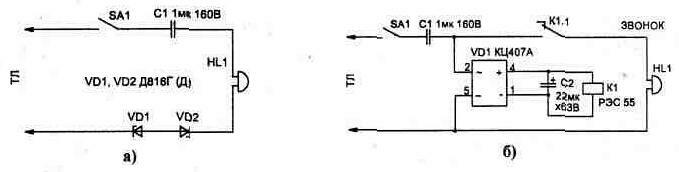
Fig. 2.12
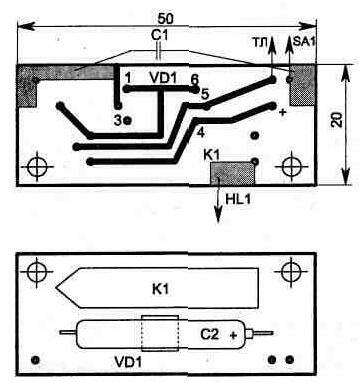
Fig. 2.13. A printed circuit Board, and the arrangement of elements (C1 is located under the printed conductors and not shown)
The circuit consumes power from the telephone line only during the call signal. When using the option with reed relays it can to be type RASA RS4.569.601 (RS4.569.606) or RESB RS4.569.626 (RS4.569.631).
The circuit layout for this circuit is shown in Fig. 2.13. The capacitor C2 type K50-29 at 63V.
The scheme in Fig. 2.14 eliminates Electromechanical the phone call. The call signal in the form of an audible signal is generated the piezo oscillator BF1 (of any type). The scheme consists of two generators, collected on the chip D1 type LE (or LE), signal amplifier transistor VT1 type CTA (CTB), the piezo oscillator pitch (or similar).
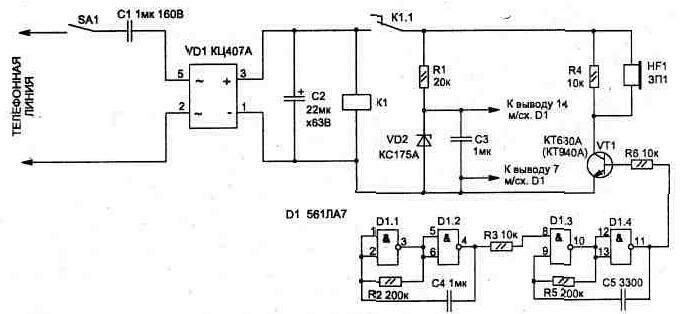
Fig.2.14
Diode matrix VD1 can be replaced by four diodes type KDA. Resistors and capacitors will suit any type.
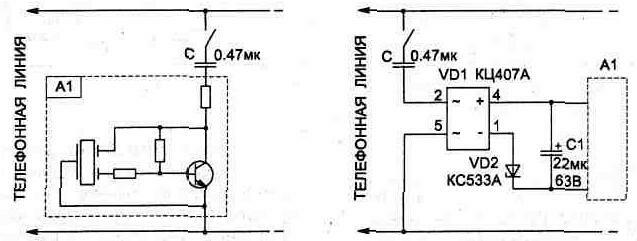
Fig. 2.15
Currently there are many phones with keypad dialing and pietzonka. The typical layout of such a device's ringer (call) is shown in Fig. 2.15. Use a little refinement, shown in the figure, would eliminate podzwanianie when dialing in parallel.
With proper Assembly and operational details of all the schemes the settings don't need.
Publication: www.cxem.net