



Despite the fact that the magazine "Radio" was published, a lot of descriptions communication devices offers one containing interesting design solutions.
Intercom {PU) provides a link from the front door to the panel, located in the house or apartment, a Dialogue occurs between subscribers switching mode (reception - transfer} button on the remote control.
Unlike the similar purpose PU, published in [1), the proposed device has some advantages, In-perih, it provides the speaker at a distance of 100 m or more two-wire line. Secondly, the output power reaches 0.4 watts. And in addition, the device does not have microphones - perform their role dynamic heads.
The core of the device (Fig.1) is a universal AF amplifier operational amplifier (op-amp) COD, developed in the laboratory of Radio magazine [2]. For electrical switching devices used small relay RES-60 (K1) with two groups of switching contacts (K1.1 and K1.2).
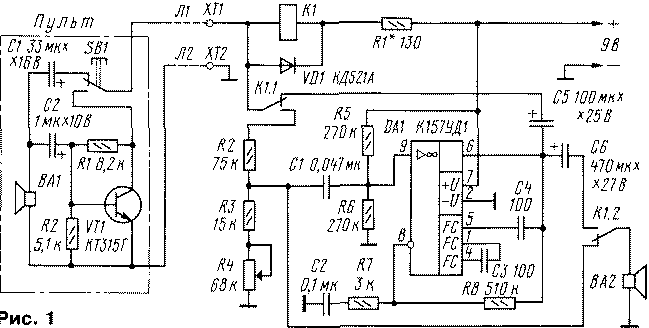
PU is always in the "Reception" when the relay is de-energized and contacts groups occupy the position shown in the diagram. Once outside the door bell sound, he converted a dynamic head BA2 into an electrical signal that passes through the closed contacts of the group K1.2 and the capacitor C1 at the input of the circuit DA1 (pin 9). Then the signal is amplified and the output of op-amp (pin 6) on the circuit the capacitor C5 - contacts group K1.1 - clamp 1 - wire communication line L1 is supplied to the pools, where through the closed contacts of the button SB1 and the capacitor C1 reaches the head BA1 reproducing sound {of course, in the signal transmission is involved, the common wire circuit - clamp HT - wire L2).
In the "Transfer" PU transferred by pressing the SB-1. This creates the following chain DC: plus power supply the resistor R1 is about Hank relic-clamp 1-wire L1 - closed contacts of a button - plot the collector-emitter of the transistor - wire L2 - clamp HT minus power supply. On this circuit provides power to the transistor cascade of remote relay. the switching contacts of the groups K1.1 and K1,2, the switching circuits: amplifier output is connected to the head vases, and input it on the wire communication line connects with the remote.
Now we can talk. The signal 34 from the head VD1 through the capacitor C1 is supplied to the base of transistor VT1, amplifies them and stands out on the load of the cascade - the relay coil. Next, the signal passes through the closed contacts KTJ, the divider of the resistors R2-R4 and the coupling capacitor to the input of the main amplifier. From the amplifier output signal is fed via the capacitor C6 and the closed contacts of the group K1.2 on the head BA2, from which the visitor hears the answer, the sound Volume adjust in advance the variable resistor R4. Pressing and releasing the button on the remote, guide the conversation with the visitor.
The device is fed from the rectifier or ready adapter with an output voltage 9 8 and the load current is less than 100mA. In sleep mode, the device consumes less than 4 mA, and in the "Transfer" the current rises up to 100mA.
The length of wires in a line, as mentioned above, can reach 100 m or more, not being reflected in the sound quality. It reached a preliminary signal amplification transistor 34 cascade directly into the remote, which reduces the impact of interference and even allows you to use unshielded wire. In order to negotiate, say, from different rooms, each of them will have to install the clamps or sockets and connect them to the portable remote control Or even to produce two control panels, place them in the right places and be connected in parallel.
The device may be possible to apply any transistor series CTS with current transfer ratio base not less than 30, the Relay K1 - RES, passport RS4,BD-02 or RS4,569,435-07 winding resistance 230 310 Ohms…and trip current 22,5 mA. Ideal, of course, another small relays with the same parameters, but then have to change the drawing of the PCB.
Dynamic head BA1 - small (0,25 GDS-2: 0,HD-50) and voice coil impedance of 50 Ohms, VAZ - 1 GD-coil impedance of 8 Ohms, Diode VD1 - any of the series WD, WD. Oxide capacitors - K50-6, K53-1; S2 - MBM, km-6; other ceramic types, km, KD, All resistors - MINTS-0,125 button -KM1.
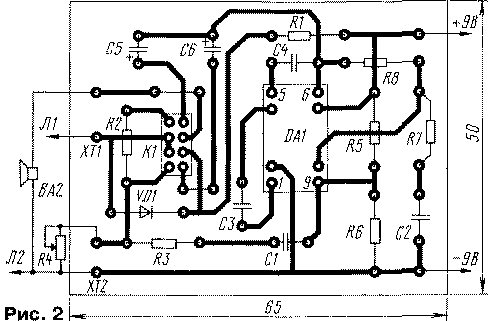
Details of the main amplifier are mounted on a printed circuit Board (Fig. 2) size 50x60 mm from unilateral foiled fiberglass. Charge is installed in a separate housing, for example, from a subscriber of a speaker. You can also install a power supply.
Console details are placed in a box the size of HH mm On its face establish the dynamic head. opposite the diffuser which is pre-drilled hole. On the side wall fastened the button. The console is connected to the terminals of the amplifier stranded wire (mgshv, MTV, etc.).
Feature nodes PU differently, That's one option, the Dynamic head of VD strengthen inside the front door above the sight glass. Opposite the diffuser in the door must be drilled holes diameter 4…6 mm. Close door 8 corridor place the main amplifier, which is connected to the flexible head (preferably shielded) wire with the so-called loop compensation - it eliminates wire breakage when you open the door.
The establishment of PU is reduced to the approval of the transistor of the cascade controller with relay used. It lies in the selection of the resistor R1 of the main amplifier such resistance, so that when the button is pressed tripped relay (at a current of 22…23 mA) and the voltage at the collector of the transistor (at the terminals 1, HT) was in the range of 1.7…V. 2
Literature
Author: Ivanov, Omsk Publication: www.cxem.net