



The described ignition unit is designed to operate in a contactless system ignition of VAZ-2108 and VAZ-2109, complete the interrupter-distributor 40.3706 and modernized VAZ-2105 and VAZ-2107 with the interrupter-distributor 38.10.3706 and ZAZ-1102 (Tavriya) 53.3706. In these machines the torque sensor is sparking switch current, using the Hall effect. The ignition unit is suitable for cars "Volga" and "Moskvich", equipped with the "breaker" Hall effect coil and serial ignition 27.3705 (TU 37.0031184 - 83) or close to it in the parameters. He replaces serial blocks ignition 36.3734, 3620.3734 and foreign performing similar functions.
According to the principle of the block belongs to the class of the transistor with the valuation time the accumulation of energy in the ignition coil. It provides two specific way interconnected waiting multivibrator, which has eliminated Quad Norton amplifier used in well-known foreign and domestic devices. In addition, unit* using widely different common parts of domestic production, simplicity of design, not requires special manufacturing techniques, therefore, are available in the repetition.
The device performs the following functions: generates current pulses in ignition the primary winding of an ignition coil; limits the current flowing through the primary winding and the voltage across it and its output transistors; closes these transistors when the ignition is on and the engine not running.
The limitation of current pulses prevents overheating of the ignition coil and the output of power transistor unit, and the limit voltage reduces wear spark plugs and the probability of failure of the cover and runner dispenser the ignition of the transistors of the output stages of the block. Stopping the current through the coil the ignition unstarted engine preventing unnecessary heating elements of the unit, ignition coil, discharge the battery and increases fire safety of the car.
Main technical characteristics
- Switching voltage 6 …17…
- Current consumption, And, at frequency of neoplasms of 33.3 Hz......0,9…1,2
- The highest average current consumption, And . . 2,4 2,6…
- Switching current through the primary winding of the ignition coil, And......8 10…
- The duration of passing a current through the primary winding of the ignition coil, MS......2,5 15…
- Time current cutoff when unstarted engine, with......0,7 1,3…
- The highest frequency of sparking, Hz, not less......250
- The voltage on the primary winding of an ignition coil, In......380…420
- The voltage of the high voltage pulse, V, not less, when the vehicle voltage 14 In......27 000
- The slew rate of the front high-voltage pulse, V/μs, not less......700
- Spark energy, MJ......50 70…
- The duration of the spark discharge, MS......1,5…2
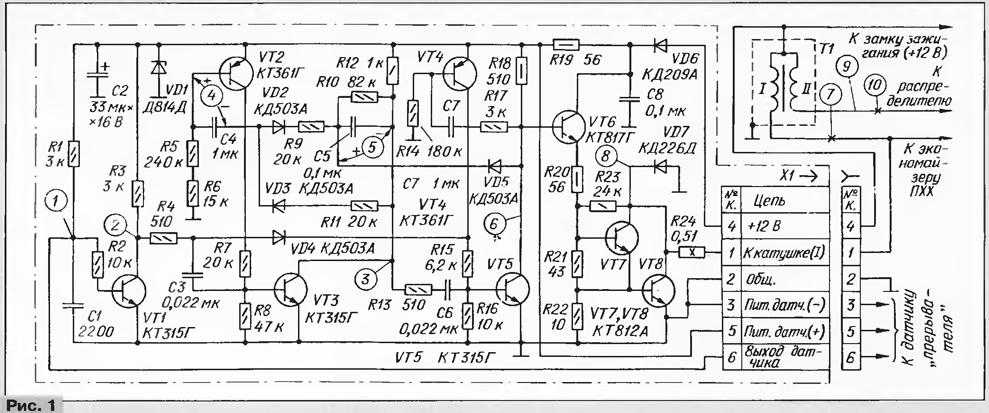
A circuit diagram of the considered block plug with chain connecting it to the electrical system of the vehicle is represented in Fig. 1. The block contains the start node of the transistor VT1, two single-shot first transistors VT2, VT3, and the second VT4, VT5, the current amplifier transistor VT6, the switch current to the transistor VT7, VT8, enabled by the Darlington circuit.
(click to enlarge)
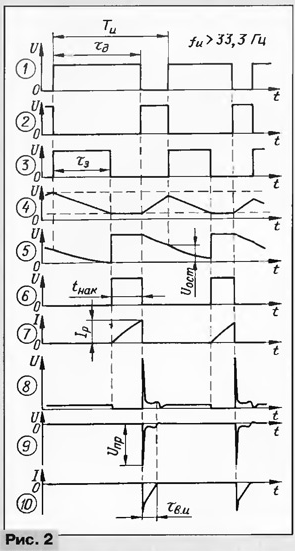
The timing diagrams shown in Fig. 2, explain the operation of the switch and the processes occurring in it by increasing the frequency f and the sparking. Of the market. 4 and 5 are taken directly from the capacitors C4 and C5). 7 - with resistor R24, 9 - output measuring voltage divider 10 MW/1 Ohm and 10 - resistor resistance of 10 Ohms, in series with spark gap.
The power supply voltage to a contactless sensor pulses neoplasms ("breaker") is supplied through the filter-limiter R19VD1C2C8. Diode VD6 protects the unit from accidental polarity reversal of the supply voltage.
When the ignition transistors VT2, VT3 and VT4, VT5 opened, a VT6 and VT7, VT8 closed. The current through the ignition coil is not leaking. The transistor triggering unit VT1 can be in any state depending on the signal level, coming from the sensor.
With the start of rotation of the engine crankshaft to the input of the transistor VT1 from the sensor receive trigger pulses with a duration TD (Fig. 1). When the transistor VT1 closed (Fig. 2), the capacitor C3 is charged through the circuit R3R4 and emitter junction transistor VT3. The timing capacitor C4 is charged to a voltage limited by the Zener diode VD1, through transistors VT2, VT3, diode VD2 and resistors R9, R10 (Fig. 4). Charging takes time, about 0.4; this time mainly depends on the capacity of the capacitor C4 and the resistors R9, R10. The timing capacitor C7 is also charged through the transistors VT4, VT5 and resistor R17 (Fig. 6).
As soon as the sensor output signal to appear to the high level, the transistor VT1 opens, the capacitor C3 is discharged through the circuit R4VT1R8 that will lead to the closing transistor VT3, VT2 transistor is also closed. Begins recharging the capacitor C4 through the chain of R5, R6, R12, R11, VD3. Thus, the first the single vibrator generates a pulse delay of T3 required for the launch of the second single vibrator.
When the voltage on the capacitor C4 reaches the level at which it opens the transistor VT2, the first single-shot returns to its original state. On his the output occurs recession pulse (Fig. 3) passing through the circuit and R1ЗС6 launching the second single vibrator; transistors VT4 and VT5 closed.
This increases the voltage at the collector of transistor VT5 (Fig. 6) and recharge timing capacitor C7 through resistors R14, R18, R17. In a result, the transistor VT6-VT8 open, through the primary winding of the coil ignition T1 current begins to flow (Fig. 7) from the power source and accumulates electromagnetic energy over time tнак. Simultaneously with an increase in the voltage at the collector of the transistor VT5 charging the capacitor C5 through a resistor R18, diode VD5, the transistor VT3 (Fig. 5), and terminates to operate the charging circuit of the timing capacitor C4, despite the fact that transistors VT2 and VT3 are open (see Fig. 3 and 4). His charge is delayed by time tнак, while the second single vibrator will not return to its original state.
As soon as the sensor output "breaker" will be the decline of the pulse, the transistor VT1 of triggering unit is closed, the second single-shot returns to its original state regardless of the charge on the capacitor C7 because of the connection through the diode VD4 (Fig. 6). Therefore, the current switch VT7, VT8 is closed. At this point in the secondary the winding of the ignition coil is induced by the high voltage pulse (Fig. 7-9), which is at a voltage Unp punches spark gap spark plugs. Occurs spark discharge duration of twee, depending on the current Ip in retriva the primary winding of the ignition coil and its parameters (Fig. 10).
After returning the second single vibrator in their original condition, its effect on a charging circuit of the capacitor C4 is terminated and he is again charged and the capacitor C5 discharges through resistor R10, thus slowing down the charging capacitor C4, as to the common point of resistors R9 and R10 is applied positive voltage from the left on the diagram the plates of the capacitor C5.
At a low frequency of tumor - at motor start capacitor C5 manages to almost completely discharged, and on high it is discharged in two stage. The first corresponds to the time of a closed state of the transistor VT1 and the second closed state of the transistor VT2, VT3 (Fig. 5). More than the frequency, the more residual stress Iost on the capacitor C5 to the end the first stage and the smaller the charge will get the capacitor C4.
As follows from the principle of the device, the resistor R9 and the chain R10C5 increase the charging time of the capacitor C4 in the first single-shot charge a temporary delay in the onset of accumulation of electromagnetic energy in the coil the ignition. In this case, the diode VD3 allows the flow of discharge current capacitor C4 through resistor R11, bypassing the resistor R9 and the chain R10C5.
The time constant of the charging of the capacitor C4 is big, so if you increase the frequency of sparking he does not have time to fully recharge, which provides approximately inversely proportional relationship between the pulse duration, formed the first single vibrator, and the frequency of sparking. High the frequency of these pulses become shorter, as the capacitor C4 nagasarete due to the acts of the action chain R10C5.
If you turned on the ignition and started the engine, and the output signal of the sensor "breaker" has a high level, the current through the primary winding of the coil the ignition will stop after about a second, because in this case the second a single-shot returns to its original state as a result of recharge capacitor C7.
Selection of resistor R6 sets the time of accumulation of energy in the coil ignition, and hence the flowing current. The choice of time constant discharge of the capacitor C5 set the desired law of variation of the current in the interval the engine speed from idle to maximum value.
From interference from the vehicle network unit to protect the circuit VD6C8, R19C2VD1 and elements C1, R4, R13. Resistor R23 limits the surge inductance at the output transistor VT7 and VT8 (Fig. 8). Resistor R24 limits the current cells these transistors and the primary winding of the ignition coil, and diode VD7 blocks the reverse voltage pulses to the transistors in transition process.
The ignition module used capacitors K73-9 at a voltage of 100 V - C1, C3, C6; K53-1A (16 IN) - C2; K73-17 (63 In) - C4, C7; K73-17 (250) - C5, C8. Resistor R24 - C5-16V rated power of 10 watts. Diodes KDA (VD2-VD5) replace KDA, KDA or similar. Connector X1 - plug block GST-ZG-52-7-In-AE (same as in commercially available units ignition).
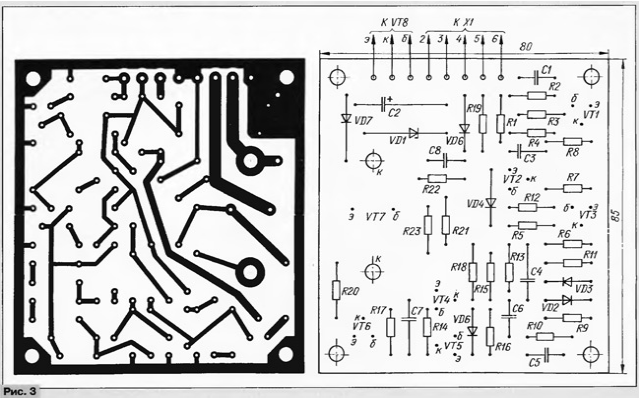
Almost all parts of the device are mounted on a printed circuit Board from unilateral foiled fiberglass 1.5 mm thick. drawing of the PCB and the location of the parts on it are depicted in Fig. 3. Board is placed in the metal case from the factory block 42.3734. Transistor VT8 attached to the inner wall of the housing through the mica strip. Resistor R24 also attached to the inner wall.
To establish the unit will need a power source with an output voltage, variable from 5 to 18 V at currents up to 3 A (ripple should not exceed 0.5 V to a frequency of 100 Hz), the generator of rectangular pulses with the amplitude of the output voltage 3…5 V, pulse repetition frequency 10…250 Hz and a duty cycle 3+0,25, oscilloscope, providing a measurement of the parameters of rectangular pulses forms and voltages up to 500 V, with an adjustable spark gap spark gap to 15 mm standard ignition coil 27.3705.
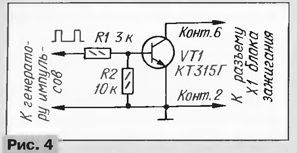
After checking the correctness of the installation according to the block circuit diagram connect the power source and the ignition coil with spark gap (in series with it includes a resistor of 4.7…5,6 kOhm power not less than 2 watts). The signal output from the generator is fed to the input unit via an inverting buffer an amplifier with an open collector output, collected by the circuit of Fig. 4.
Install the power supply unit 14 and the spark gap size of 10 mm. Served triggering pulses of 10 MS with a repetition frequency of 33.3 Hz, which corresponds to working a four-cylinder four-stroke engine the engine speed 1000 min-1, i.e. close to idling. In this case, the current drawn by the unit must be in the range of 0.9-1.2 A, otherwise you should choose a resistor R6 (or even change the resistance chain R5R6, usually equal to 240…270 ohms).
Control on the oscilloscope amplitude of the voltage pulse at the collector transistor VT7 (VT8). It should be in the range 380…420 V. If the amplitude differs from specified, you should choose a resistor R23.
Further reduce the voltage to 7.5 In and see the spark in the gap the spark gap. If it is unstable or absent, check the accuracy the selection of resistors R5, R6. In the extreme case, you should replace the transistor VT6, VT7, VT8 other, with a large value of the static current transfer ratio.
Then check the functionality of the unit at a frequency of sparking 50, 100, 250 Hz at a voltage of 14 V. disruption of sparks should not be.
Even easier to establish the unit if you install it directly on the car. For this gap in the wires connecting the primary winding of the ignition coil with the on-Board network (or pin 1 of connector X1), to include ammeter, measuring average current, for example avometr. At idle the engine choose the resistor R6 so that the ammeter showed the current 0,9… 1,2 A. R6 Is you can temporarily solder a variable resistor 68 ohms. In this case, as when establishing laboratory, it is highly advisable to control the amplitude of voltage pulse at the collector of transistor VT8.
Author: B. Bespalov, Kemerovo