



The reader is offered two options of power sources (13, 20…30A) for transistor LW, УSW-transceivers. Both tested with the load and in practical work in the air, reliable, does not fail in the short circuit on the output, do not have "throws" of the output voltage.
OPTION I - NORMAL TRANSFORMER
The scheme is extremely simple and is merely a scheme actually stabilizer (Fig.1). It consists of 4 connected in parallel, widely sold at radio chip stabilizers SD series, LT-1084 (1 = 5 (A) or 1083 (I = 7.5 A). In the first case, the maximum output current will be 20…22 And, in the second 28…30 A. moreover, in the experiments on the incorporation of these circuits in parallel, it turned out that their options quite identical, to supply the control voltage from one of a resistive divider on all control inputs are also included in parallel.
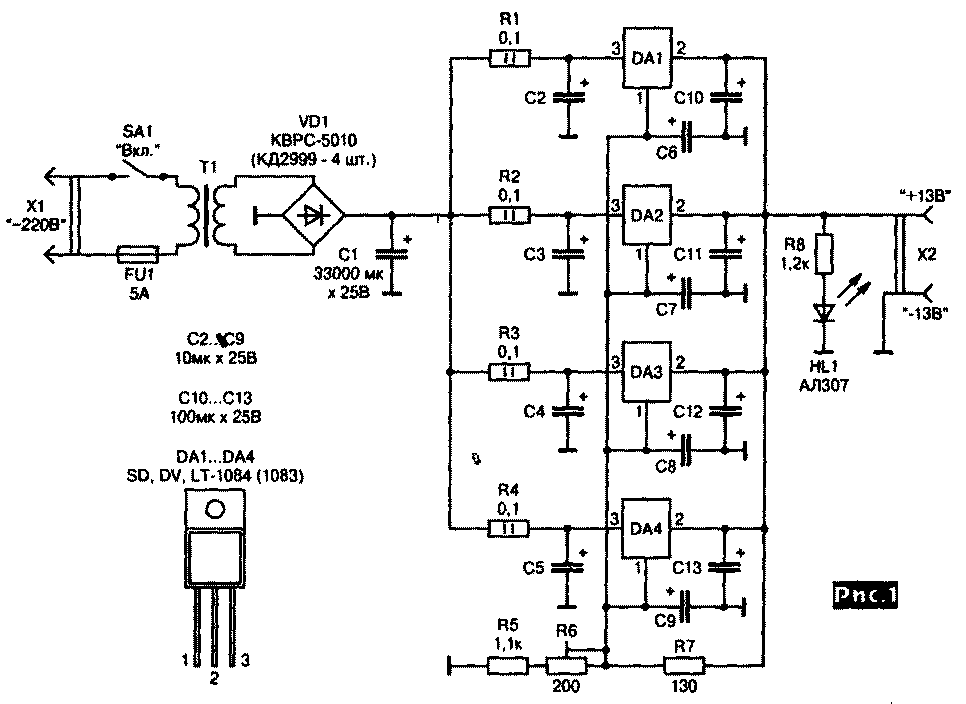
Fig.1
(click to enlarge)
Details
Transformer P. the Author tested three types:
a) standard CCI-2-8. Output winding on each half of the core are connected in series, and then the resulting two windings in parallel (to increase current). Thus, it has turned 14… 15 V AC.
b) TH-61. Winding also includes a series-parallel to provide Uвых=15 V.
b) improvised. Used transformer from Latr 240 watts of power. Existing primary winding is covered with varnished cloth and on top of the secondary winding is wound on Uвых=15…16 In (wire sew 01,8…2.4 mm). Recent rounds is desirable to make the bends.
C1 in the diagram indicates the minimum capacity. Better to use more (up to 82 000 µf). You can dial from a separate smaller capacitors. Import and more reliable option.
The bridge VD1 - I PR.max. = 40…50 A, Iobr.max>50 V. the Author tested with the same positive result: a) SWРС-5010 (50 A, 1000 V) - modular bridge in a metal casing, is attached to the radiator directly; b) CD (4 PCs) - installed on the radiator via the mica strip.
Blocking capacitors - ordinary import (covered with foil) vertical or horizontal mounting. Recommended for use with LT1084 (1083) tantalum't tried, because of self-excitation and interference was not atentlawye.
Design
Housing dimensions depend on the application of the transformer and C1 (the most overall details). Recommended layout (Fig.2): T1 and C1 - in the middle of the side walls is a small home-made or suitable ready radiators, which through mica strengthen DA1…DA4 (2 units each side). The bridge VD1 - on the back wall. There's also a fuse, a ground terminal, the power supply plug "-220".
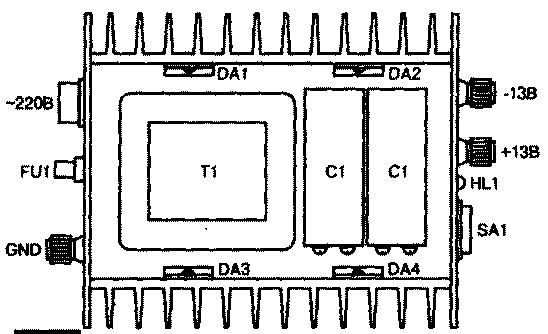
Fig.2
On the front panel - switch, led, terminals "+13 and -13 In". Optionally, you can install a compact device, measuring the voltage or current output (or both via a switch). The lower and upper lids must have holes for ventilation. On the lower lid strengthen small legs, you can apply the caps from the tubes. The main requirements for the installation:
(a) Blocking capacitors fluster mounted Assembly directly on the terminals of the chip and the contact lugs "common wire" that are installed next to each chip.
b) All connections of chips in parallel produce segments of wires (cross-section not less than 0.75 mm2) of the same length and the same point. For this purpose, pre-cut wire segments of the same length.
Setting
In the first stage serves voltage from the rectifier on one of the chips and put through R6 output voltage of about 13 V. Then one connect the rest of the chip and make sure that the output voltage does not change much. Connecting to the output load current of 5…10 A, measure the voltage drop across the resistors R1-R4. They should be about the same under different output currents. It shows approximately the same current distribution on the chips. If not, use one of the following methods: a) replace the chip with a large difference current to another instance; b) establish individual source of control voltage (like R5, R6, R7) to the chip (by disabling the control pin from the others, of course) and adjusting it, achieve the desired result.
It is possible to apply the scheme of article Yuri Karanda "Parallel CRE-NA- ("PX" N92/2000, p. 35), where one of the stabilizers performs the function model, and the others were watching him with shelter, levelling their output currents. It should be borne in mind that the greater output AC voltage is removed from the transformer, the more General heating design. Therefore, if there is a possibility (the presence of taps in the secondary winding T1), it is necessary to set such a minimum value, which provides normal operation of the source (no drawdown of the output voltage) with a maximum required output current with a minimum voltage in your network. This can be done by connecting the source to the network via Latr, and to output a voltmeter and load. The criterion of selection of the output AC voltage from the secondary winding of T1 is the beginning of falling of the output voltage when "minimum network".
OPTION II - "TRANSFORMERLESS" PULSED SOURCE
Very convenient if you take in the expedition, to the country, etc., because the lightweight transformer is 5…6 kg and is only 700 grams.(!) Bought at radio cheapest switching power supply from PC power of 230 watts (about 13$), the author has done the following:
1) Unsolder all wires from the outputs of other sources (-5 V, -12 V, +5 V), except GND and +12 V.
2) These remaining wires are laid in bunches. A yellow beam (+12V) did a few turns on a ferrite ring (2000NM, 25 mm diameter) and then black (GND) connected respectively to the terminals the "+12V" and "-12" installed on the place of sockets for connection of the monitor. Parallel to these terminals connect the capacitor 33 µf x 25 V.
3) the Hole in the casing, through which came out of the power wire, used for installation of key switches (-220) with backlight (previously filed gave the desired hole shape).
4) Replaced the rectifier diodes source +12 (Assembly of two diodes on the heatsink) on CD (2 PCs.) with any letter, setting them on the same heatsink using thermal paste and pulling the same screw and plate to the radiator according to the scheme in Fig.3. It is better to use here an Assembly of diodes with Schottky barrier 25 x 100 And In less voltage drop and, accordingly, the heat.
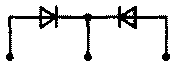
Fig.3
5) To increase the output voltage
from 12 to 13 volts tear the printed wire that goes from the midpoint of the rectifier Assembly +5 V, and include in this chain of any silicon diode 1..2 And in the direct inclusion, as shown in Fig.4 (TNX RW3DVY). The author applies KD. Thereafter, the transceiver has to give to your antenna
"native" 100 watts (At 12 V -80…90 watts).
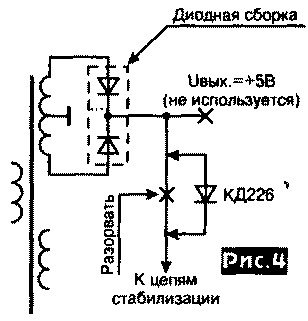
Fig.4
In this circuit, the voltage feedback for the cascade stabilization of the output voltage; decreasing voltage with PRIAMOS-aligned diode is about 0.6 V resulted in the increase of output voltages, including the source of +12 V to +13 V; instead diode can be used and a resistor, picking up his resistance to obtain +13…+13.5 V.
6) In the author's copy of the acquired unit was missing the filter network In -220 (China, Hi), which had to be made independently - two wires going from the switch to the connector-plug "-220", wound a few turns (to fill) on a ferrite ring 2000NM, 025 mm Parallel to the contacts of the connector "-220" soldered elalamy capacitor 0.1 μf x 630 V. the filter reduced the level murmuring noise-harmonic, repeated every 35…40 kHz band of 1.8…7 MHz (the other was not and without filter), 5 points (30 dB) scale S-meter transceiver (from S5 to S0!).
The measurements were established the most favorable conditions for listening to these interference antenna disconnected, UHF enabled. Although UHF in these ranges when working on the air the author never, and without noise filter air here when connected to the antenna can be easily mask a 5-point noise level - but that's a matter of principle, it is necessary to press!
After improvements turned out to be lightweight (weighs about 700 g), small (80x100x150 mm), reliable source of power protection short-circuit. output (10 times "short" output pigtail - he just disconnected). The output voltage does not vary by more than 30…40 mV at a voltage of from 180 to 280 V. Spurious modulation signal is absent. Idling consumes from a network of about 7 watts. Efficiency when the load current from 5 to 20 And within 80…85%.
Computer power supply units, including modernized the author calculated by circuit +12 V at a current of about 9 And, therefore, to provide load currents up to 20A "begs" fast winding for +12 V by a thicker wire. But in practice, many manufacturers perform all of the secondary winding of such a PSU with the same wire, providing current up to 23 A (the same as for circuit +5 V).
Author: Nicholas butchers (UA3DJG), Ramenskoye, Moscow region; Publication: N. Bolshakov, rf.atnn.ru