



This device is powered from the AC mains, for nourishment instruments and mechanisms of the electrical equipment installed in it electronic equipment during the repair or maintenance works. For example, in the preparation of the car to the inspection, for the long, for recharging the battery, check the ignition system, control and measuring devices, etc., it can also nourish portable transceiving equipment with output power up to 100 W, and around the clock. The current in the load connected to the source, can reach 20 And when the voltage ripple of about 1 V.
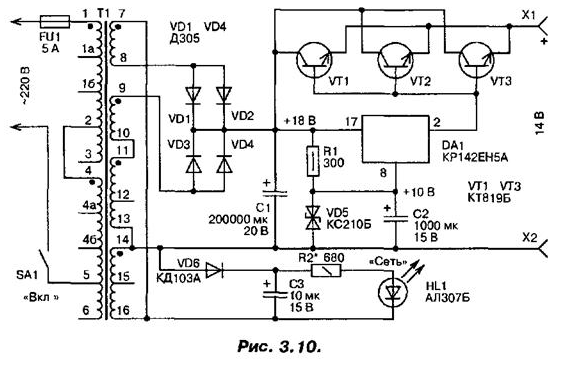
But keep in mind one important fact: to start the engine of the vehicle the starter of this power source is unusable. Diagram of the device shown in Fig. 3.10. Winding with the conclusions of 7-8, winding connected in series with the conclusions 9-10, 11-13, 14-16 mains transformer T1 and diodes VD1…VD4 form full-wave rectifier. To decrease the internal resistance rectifier diodes VD1, VD2 and VD3, VD4 his shoulders are parallel. Besides they germanium, and therefore the voltage drop across them is minimal, helps to reduce emissions of heat.
For smoothing of the rectified voltage applied to the oxide capacitor C1 large capacity is 200,000 UF. The resistor R1 and the Zener diode VD5 form parametric direct voltage of 10 V. This voltage, ripple which is further smoothed by the capacitor C2, served on conclusion 8 integrated stabilizer CREA
(DA1) fixed output voltage 5 V output (pin 2) of the stabilizer a voltage of about 15 V is supplied to the base of emitter follower composed three parallel power transistors VT1 VT3.... In General, however. the selection of the Zener diode VD5 with less voltage stabilization can be set at the output of the source voltage from 8 to 12 V. the diode VD6 and condenser NW assembled half-wave rectifier AC voltage winding to conclusions 14-16 mains transformer that feeds HL1 led - indicator connect the device to the network. Resistor R2 limits the current through the led.
In principle, the led indicator can be connected to the output of the main rectifier, but then due to prolonged discharge of filter capacitor C1 he will still take some time to glow after the contact opening network switch.
Mains transformer T1 is uniform, brand TN. Replace it by transformer with two secondary windings, each of which provides AC voltage 14…16 V At a load current up to 20 A. the Capacitor C1 is oxide C50-18 for a rated voltage of 20 V.
It should be borne in mind that the oxide capacitors have significant variation the nominal capacity and, in addition, over time, reduce the capacity. Therefore, in the power source is desirable to use a capacitor may larger capacity the release of the latest years. The capacitor C2 - C50-6, NW - K53-1A, or any other oxide for a rated voltage of not less than 15 V. the Diode D305 (VD1…VD4) replace D or CDA - powerful with the Schottky barrier. The Zener diode VD5 - XV or DV. It may happen that during extended operation of the source under load one of the main diodes of the rectifier will be heated more than the other three. This will indicate that the resistance in the open state more than other diodes of the rectifier. This diode should be replaced.
The desired brightness of the indicator HL1 set by selection of the resistor R2. Described here, the power source of higher power has no node protection overloads. Therefore, using them, avoid accidental short circuits its output socket - clamps or in a circuit connected to the device. In the case of long-term operation of the source at the maximum load current must to control the temperature of the mains transformer - it should not exceed 60°C.
Author: A. P. Seman